Advertisements
Advertisements
प्रश्न
The poem speaks of ______.
विकल्प
Man’s plan to shape destiny
Man seeking pleasure and riches
Man indulging in wars and acts of destruction
Man’s fear of Nature
Advertisements
उत्तर
The poem speaks of Man indulging in wars and acts of destruction.
APPEARS IN
संबंधित प्रश्न
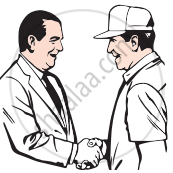
Guess what friendly words these two gentlemen exchange when shaking hands.
What do you associate with the title of the poem?
What happens to the poet when he visits someone for the third time?
What does the poet long for?
Interpret each of the following expression used in the poem, in one or two line.
hands search my empty pockets
Read the line given below and answer the question that follow.
‘But now they only laugh with their teeth, While their ice-block-cold eyes…’
- Who are ‘they’?
- Explain: ice-block-cold eyes
- Identify the figure of speech used here.
Explain the following lines with reference to the context.
Once upon a time, son They used to laugh with their eyes:
Explain the following line with reference to the context.
I have learned to wear my faces Like dresses …
Explain the following lines with reference to the context.
I want to be what I used to be.
This poem is nothing but a criticism of modern life. Justify this statement.
Why does the poet feel glad that he does not play any game?
Do you think the narrator is heroic? Why?
Read the poem and answer the following in a short paragraph of 8–10 sentences each.
When officialdom demands Is there a doctor in the stands?
- Why are doctors called from stands by the sponsors?
- Why does the poet make such an observation?
Read the given line and answer the question that follow in a sentence or two
When snaps the knee and cracks the wrist….
Identify and explain the use of the literary device in this line.
Explain the following with reference to the context in about 50–60 word each.
They do not ever in their dealings Consider one another’s feelings…
Underline the alliterated word in the following line.
For this most modest physiques…
Underline the alliterated word in the following line.
They do not ever in their dealings…
Read the lines given below and answer the question that follow.
And ‘tis my faith that every flower
Enjoys the air it breathes…
- What is the poet’s faith?
- What trait of Nature do we see here?
Work in groups of 4−6. Discuss how you would preserve the environment and protect Nature. One or two representatives may share their ideas with the class.
Mention any two qualities of Macavity.
Give an account of Macavity’s destructive mischief.
Read the given lines and answer the question that follow.
He’s the bafflement of Scotland
Yard, the Flying Squad’s despair:
For when they reach the scene of crime
— Macavity’s not there!..
- What is ‘Scotland Yard’?
- Why does the flying squad feel disappointed?
What does the ladder symbolize?
Creative Activity
- Write eight words you associate with success.
- Use the words to write eight lines that mean success to you or how success makes you feel.
- Arrange your lines into a poem.
- Share your poem with the class and post a copy on the notice board.
Discuss the following topics in groups of five and choose a representative to sum up the views and share them with the class.
To succeed in life, one must have a single-minded devotion to duty.
Work with a partner and take this short quiz to find out how well-informed you are about history.
- Name a few wars and battles you have read about.
- What is the difference between a war and a battle?
- Why do rulers wage wars and battles?
- Is the outcome of a war always fair?
- Do you think rulers understand the true meaning of life – in defeat or in victory?
- Can you name a few kings and leaders who have fallen from glory to disgrace?
Fill in the blank with appropriate word from the box and complete the statement suitably:
The business woman wished to ______all her riches to an orphanage, after her death.
Based on your reading of King Richard’s speech, answer the following questions in about 100 - 150 words each. You may add your own ideas if required to present and justify your point of view.
Who does the future generations remember easily - the victor or the vanquished? Give reasons. Also, cite relevant references from King Richard’s speech.
