Advertisements
Advertisements
प्रश्न
Read the poem once again carefully and identify the figure of speech that has been used in each of the following line from the poem:
“Bores through his castle wall, and farewell king!”
Advertisements
उत्तर
Personification
APPEARS IN
संबंधित प्रश्न
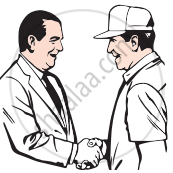
Guess what friendly words these two gentlemen exchange when shaking hands.
What is the relationship between the narrator and the listener?
Explain the following line with reference to the context.
There will be no thrice.
Explain the following line with reference to the context.
I have learned to wear my faces Like dresses …
Explain the things the poet has learnt when he grew into an adult.
Do you think the narrator is heroic? Why?
The poet is satisfied just watching the heroic deeds of others. What could be the reason?
How does the poet establish the victory of common sense over ego?
According to the poet, what contributes most to the injuries sustained by the athletes?
Complete the summary of the poem by filling in the blanks with the words given below.
The poet, in a relaxed state of mind, is sitting in a (1) ______. He reflects on how his mood brings (2) ______thoughts, which are inevitably followed by (3)______ones. He feels connected to all of nature, and senses an inherent joy in all (4)______. He has faith in the fact that all the primroses and periwinkles around him (5)______ the air they breathe. He feels that every bird in the grove moves with (6)______. As the twigs catch the breezy air, they do so with the same pleasure (7)______ all life on earth. This joy of nature seems to be heaven-sent. Nature’s holy plan is to offer joy and peace to all forms of life on earth. The poet’s pleasant train of thought slowly leads to the sad reflection of how mankind alone has wrought sorrow and (8)______ upon itself. He firmly believes that man is meant to spend his days blissfully taking part in the vitality and joy surrounding him in (9)______. He therefore concludes rhetorically, emphasizing that he has good reason to (10)______ the distress, man unnecessarily brings upon himself.
| creations | abundance | savour |
| pleasant | suffering | grove |
| lament | pervading | sorrowful |
| ecstasy |
Read the lines given below and answer the question that follow.
If this belief from heaven be sent,
If such be Nature’s holy plan.
- What does ‘heaven’ refer to?
- Why does the poet call it ‘holy’?
Explain the following line with reference to the context in about four to five sentence each.
In that sweet mood when pleasant thoughts
Bring sad thoughts to the mind.
Read the following line and identify the figure of speech used in each extract.
And ‘tis my faith that every flower
Enjoys the air it breathes.
Read the following line and identify the figure of speech used in each extract.
What Man has made of Man?
How does the poet feel while enjoying the beauty of Nature?
Answer in a paragraph of about 100−150 words.
Do you think the poet wants to say that man is unhappy because he has lost his link with nature and forgotten how to enjoy nature, or because man is cruel to other men?
Work in groups of 4−6. Discuss how you would preserve the environment and protect Nature. One or two representatives may share their ideas with the class.
Which law does Macavity break?
Why does the poet say Macavity is ‘outwardly’ respectable?
Who does the Secret Service suspect when a loss is reported?
Which two characters does the poet refer to as examples of wicked cats?
Read the given lines and answer the question that follow.
‘It must have been Macavity!’ but he’s a mile away.
- What is Macavity blamed for?
- Where is he?
Fill in the blanks using the words given in the box to complete the summary of the poem:
King Richard the Second, had surrendered to his (a)______cousin, Bollingbroke. He experienced deep distress at the horror of his circumstances. In that desperate situation, he speaks of (b)______, (c)______, (d)______and other things connected with death. He spoke of how people leave nothing behind and can call nothing their own, except for the small patch of (e)______, where they will be buried. King Richard yielded to dejection and talked of all the different ways in which defeated kings suffer how some had been deposed, (f)______in war, (g)______by their wives and so forth. He attributed this loss of lives to (h)______, who he personified as the jester who watches over the shoulder of every ruler, who mocks kings by allowing them to think their human flesh, was like (i)______brass. However, Death penetrates through the castle walls, silently and unnoticed like a sharp (j)______, thus bidding (k)______to him and all his pride forever. Finally, Richard appealed to his soldiers not to mock his mere flesh and blood by showing (l) ______and respect to him. He added that he too needed bread to live, felt want, tasted (m)______and needed (n)______. He concluded thus, urging his men not to call him a (o)______as he was only human, just like the rest of them.
| barren-earth | friends | graves | slain |
| rebellious | poisoned | worms | grief |
| impregnable | epitaphs | death | farewell |
| reverence | king | pin |
What hides within the crown and laughs at the king’s grandeur?
What does ‘flesh’ mean here?
Read the poem once again carefully and identify the figure of speech that has been used in each of the following line from the poem:
“Let’s talk of graves, of worms, and epitaphs;
Make dust our paper, and with rainy eyes Write sorrow on the bosom of the earth’’.
Read the poem once again carefully and identify the figure of speech that has been used in each of the following line from the poem:
“How can you say to me, I am a king?”
Pick out the alliteration from the following lines:
“Our lands, our lives, and all, are Bolingbroke’s,…”
Based on your reading of King Richard’s speech, answer the following questions in about 100 - 150 words each. You may add your own ideas if required to present and justify your point of view.
How are eternal truths and wisdom brought to the reader here?
