Advertisements
Advertisements
प्रश्न
Complete the summary of the poem by filling in the blanks with the words given below.
The poet, in a relaxed state of mind, is sitting in a (1) ______. He reflects on how his mood brings (2) ______thoughts, which are inevitably followed by (3)______ones. He feels connected to all of nature, and senses an inherent joy in all (4)______. He has faith in the fact that all the primroses and periwinkles around him (5)______ the air they breathe. He feels that every bird in the grove moves with (6)______. As the twigs catch the breezy air, they do so with the same pleasure (7)______ all life on earth. This joy of nature seems to be heaven-sent. Nature’s holy plan is to offer joy and peace to all forms of life on earth. The poet’s pleasant train of thought slowly leads to the sad reflection of how mankind alone has wrought sorrow and (8)______ upon itself. He firmly believes that man is meant to spend his days blissfully taking part in the vitality and joy surrounding him in (9)______. He therefore concludes rhetorically, emphasizing that he has good reason to (10)______ the distress, man unnecessarily brings upon himself.
| creations | abundance | savour |
| pleasant | suffering | grove |
| lament | pervading | sorrowful |
| ecstasy |
Advertisements
उत्तर
do it yourself.
APPEARS IN
संबंधित प्रश्न
Guess what friendly words these two gentlemen exchange when shaking hands.
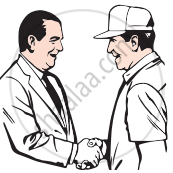
What does the poet mean when he says ‘good bye’?
Interpret each of the following expression used in the poem, in one or two line.
to unlearn all these muting things
Explain the things the poet has learnt when he grew into an adult.
The poet does not wish to exchange places with the athletes. How does he justify his view?
Explain the following with reference to the context in about 50–60 word each.
Athletes, I’ll drink to you, Or eat with you, Or anything except compete with you…
What sort of encouragement should an athlete in India be given? Give a few suggestions.
Read the poem once again. Identify the rhyme scheme and pick out the rhyming pairs of words.
Why is the Flying Squad frustrated?
Read the poem once again and complete the summary using the words given in the box.
‘Macavity – The Mystery Cat’ is a humorous poem, where the poet T.S. Eliot describes the mysterious (a) _______of a shrewd vile cat. He commits a crime at every possible opportunity. He is an elusive master (b)______who leaves no evidence after he commits a crime. Even the Scotland Yard, the London (c) ______ agency is unable to arrest him. The Flying Squad is (d) ______ because every time they rush to the crime spot to seize Macavity, he is not there. He breaks the human law as well as the law of (e) ______. He baffles even a (f) ______ with his powers of levitation. Macavity appears tall and thin with (g)______ eyes. He is always preoccupied with some serious (h) ______. His coat is dusty and his (i)______are unkempt. Macavity is a (j) ______in the guise of a cat. He appears to be outwardly (k) ______ but his actions disprove it. Macavity loots the (l)______, ransacks the jewel-case, and breaks the (m)______glass but wonder of wonders he is not to be found anywhere there. He is always a mile away from the scene of crime, happily relaxing or doing difficult (n) ______ sums. He is clever at making up an (o) ______every time he plots a crime. All the notorious cats are nothing but the (p) ______Macavity, the Napoleon of Crime.
| larder | whiskers |
| respectable | criminal |
| devil | thought |
| sunken | division |
| agents | detective |
| alibi | desperate |
| fakir | qualities |
| gravity | greenhouse |
What are the mysterious ways in which Macavity acts?
Read the given lines and answer the question that follow.
‘It must have been Macavity!’ but he’s a mile away.
- What is Macavity blamed for?
- Where is he?
Explain the following line with reference to the context.
He always has an alibi, and one or two to spare
Identify the literary devices used in the following lines:
- He sways his head from side to side, with movements like a snake.
- They say he cheats at cards.
Pick out all the pairs of rhyming words used in the poem.
Identify the following personalities and their fields of achievement.
| Name | Field | |
 |
||
 |
||
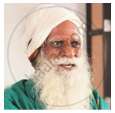 |
||
 |
||
 |
||
 |
||
 |
||
 |
- Mention a remarkable achievement of any of these personalities.
- What quality do you admire the most in each of these achievers?
- What are the qualities that you may share with them?
- Name a few more popular personalities who have made our nation proud.
- ______.
- ______.
- ______.
- ______.
Which quality does the speaker wish to nourish? What is his mission?
What does ‘hillock’ refer to in the line ‘Every hillock has a summit to boast!’?
Why does the speaker say ‘Everest is not the only peak’?
Read the given line and answer the question that follow.
He, who does not stoop, is a king we adore. We bow before competence and merit;
- Who is adored as a king?
- What is the figure of speech used in the first line?
Discuss the following topic in groups of five and choose a representative to sum up the view and share them with the class.
‘Success is not final, failure is not fatal.’ It is the courage and perseverance that counts.
Discuss the following topic in groups of five and choose a representative to sum up the view and share them with the class.
Successful people neither brood over the past nor worry about the future.
Fill in the blank with appropriate word from the box and complete the statement suitably:
The spectators died laughing at the ______of the clown.
Fill in the blank with appropriate word from the box and complete the statement suitably:
The fortress was ______and could not be conquered by the enemies.
Fill in the blank with appropriate word from the box and complete the statement suitably:
Alexander the Great, wished to conquer many lands and ______the entire world.
Bring out King Richard’s feelings when he was defeated.
Working with your partner, discuss the following adages and share your views with the class. You may need to give your ideas and justify your point of view. Remember to take turns while making your presentation/short speech.
War begets war
Read the poem once again carefully and identify the figure of speech that has been used in each of the following line from the poem:
“Bores through his castle wall, and farewell king!”
Based on your reading of King Richard’s speech, answer the following questions in about 100 - 150 words each. You may add your own ideas if required to present and justify your point of view.
Death has been cited in many ways in this monologue. Identify the poetic devices used in those references.
