Advertisements
Advertisements
प्रश्न
Both Ramanand and Azam Khan seem to have very fixed views. How does Ramanand score over Azam Khan towards the end of the story?
Advertisements
उत्तर
Ramanand was a money-minded man who would agree to his customer. Was not this how he had built all his money? However, Azam was a man who lived by his worn-out pride, tracing his lineage that his father was a Sultan. He was proud in vain. He was determined that only a man who is the successor of a warrior or is associated with a royal house can have a Tiger moustache. And a money lender is supposed to have a goat moustache. Ramanand did agree to Azam every time and turned the tip of his moustache down to keep his customer happy while raising the other end to tempt him to return with another possession to bargain. Stubborn they both were in their trading and pride. It helped Ramanand to gain possessions while Azam became a pauper bargaining all that he possessed to feed his false pride.
APPEARS IN
संबंधित प्रश्न
B1. Select
Fill in the blanks choosing the correct alternatives from those given in the bracket:
(i) The author was inspired and motivated to read ............................................ by the time she was eleven.
[Shakespeare, Chaucer, G.B. Shaw]
(ii) Every lesson .......................... ......... took was spiced with half a dozen or more anecdotes.
[Mrs. Rowlands, Sister Monica, Mr. A.N. Patil]
(iii) The teachers helped the narrator to become ..................................... . .
[confident, happy, independent]
(iv) Mrs. Cynthia Nesamani and Sister Monica gave .......................................... to the narrator.
[freedom to do what he wanted, advice to do something, instructions to produce better results]
In a way, one of the greatest gifts any teacher can give a student, I think, is to inculcate a curiosity to learn.
I've been incredibly lucky to have at least one such teacher at every stage in my life. The first was Mrs. Rowlands who taught me in primary school. She taught me to read without ever pushing me. She made me want to read more by giving 'me some of the most interesting children's books available. And although I still love to go back to those books from time to time, it was only because of her that I was able to read Shakespeare by the time I was ten, and Chaucer a year later.
In later years, it was Mr. A.N. Patil, my Marathi and Hindi Teacher who made a huge impression on me. Every lesson he took, was spiced with half a dozen or more anecdotes from a wide variety of subjects: among them history, politics, religion and sociology. I was, and still am in awe of his knowledge, which despite rather desperate attempts, I doubt I'll ever be able to match.
There have also been other teachers who helped me to try to become independent: to think and act for myself using my own judgement, which to my mind has been just as, if not more important, than actually learning anything.
After all, it's much too easy to become a completely useless repository of facts and little else.
Two teachers whom I remember in particular are Mrs. Cynthia Nesamani and Sister Monica, both taught me in school. The former, by and large, gave me a free rein to do what I wanted to do. I, being one of those people who dislike instructions, she helped me to produce much better results than I'd have otherwise done.
B2.Complete
Read the extract and complete the following:
The teacher can
(i) .............
(ii) ..............
(iii )..............
(iv).................
B3. Similar word
Look at the following sentences arid pick the word having similar meaning to the given word and rewrite:
(i) Spiced His conversation is always with a lot of humour. (made interesting, garnished, flavoured)
(ii) Repository
The library should not merely be a ................ of books. (store-house, reservoir, tank)
(iii) Inculcate
It is the responsibility of the parents and teachers to .......values in the child's formative years. (imbibe, give, show)
(iv) Incredibly
I have been .. lucky to have at least one such teacher at every stage in my life. (importantly, unbelievably, beautifully)
B4. Language study
(i) There have also been other teachers. They have helped me to try to become
independent. (Combine using 'who')
(ii) It was only because of her that I was able-to read Shakespeare.
(Rewrite beginning with: If it was not for her, ).
B.5 Out motivators
Look at the following table and complete it by presenting your own views
| Personalities | Influence on your life |
| (i) Teachers | |
| (ii) Parents | |
| (iii) Relatives | |
| (iv) Friends |
What were Helen’s memories of Radcliffe?
How does a black kite spread wildfire ?
Griffin failed not only as a son and a scientist, but also as a human being. Comment. (The Invisible Man)
The narrative has many phrases to describe the scenic beauty of the mountainside like:
A flawless half-moon flated in a perfect blue sky.
Scan the text to locate other such picturesque phrases.
“One day back there in the good old days when I was nine and the world was full of every imaginable kind of magnificence, and life was still a delightful and mysterious dream. ” The story begins in a mood of nostalgia. Can you narrate some incident from your childhood that might make an interesting story?
Examine the communication channels in the story between Paul's mother and his uncle.
How is the idyllic juxtaposed with the pedestrian in the poem?
Try rewriting the lecture as a formal essay and examine Forster’s statement: 'since the novel is itself often colloquial, it may possibly withhold some of its secrets from the graver and grander streams of criticism’.
Arrange the following set of words in the alphabetical order in your notebook.
ship, small, successful, scoldings, stone, saving, someone, stood, streets, still, screamed, sat, seemed, saint, share.
Find evidence from the lesson and write in your own words.
In Israel, the media have a positive outlook and self-respect.
Answer the given question in your own words.
Where was the Happy Prince’s statue located?
Complete the web with the help of adjectives used to describe eyes and nose in all respects. Two are done for you.
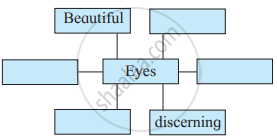

Given below are some words from legal terminology used in court affairs. Discuss and complete the table accordingly.
| Sr. No | Legal Terminology | Description |
| 1. | Affidavit | A written statement confirmed by oath or affirmation for use as evidence in court. |
| 2. | Argument | |
| 3. | Consent | |
| 4. | Counsel | |
| 5. | Judgement | |
| 6. | Trial | |
| 7. | Verdict | |
| 8. | Contempt of Court | |
| 9. | Notice | |
| 10. | Stay order |
Read the poem and complete the web about the activities the planners do.

Expansion of Idea:
Expand the following idea in about 100-150 words by using the points.
'Beauty is truth, truth beauty'.
- Meaning of the proverb
- Significance of the proverb
- Add your own points.
Form groups and discuss the following question:
The events described in the poem take place at a certain place, at a certain period of the year, under specific weather conditions. Describe the place, the time, and the weather conditions.
Shakespeare’s poetry has come to be valued for its own sake on the stage. Comment with reference to the play ‘A Midsummer Night’s Dream.’
Explain the meaning of the following phrase:
An eagle’s eye
Add ten more words to the list on your own. Each of the component words must be meaningful.
What do the following event/action tell us about the characters? Discuss.
Arthur agreed to bring Sir Kay a sword at once.
Form groups. Discuss the first two paragraphs. Try to present their content in the form of a series of conversations among the volunteers and the villagers.
Talk about your strengths.
Complete the following sentence with reference to the passage.
They may be composed and sung or recited for many years before __________________.
Sayali’s mother did not want her to go on the trip.
Gather more information about the following from your Science textbook, the internet, and other sources.
Gravitational force
Answer in your own words.
How is the boy from the 1500s dressed?
Which lines are repeated in the poem? What do they mean?
Mention the various places that the brook flows past.
‘Unke, Munke, Timpetoo,
I wish, my wish is coming true.’
Try to compose two other funny magical chants that have rhyming lines.
Listen carefully and guess how the sentence would end.
When the students saw the question paper, they were ______.
Find out how the following game is played.
Kho-Kho
List the rhyming words in the (On the water) poem.
What different names is ‘Rangoli’ known by in different regions?
Guess the meaning of the following word.
magnificent
How did the bird try to reach its parents without having to fly?
Gilson asked the narrator to buy a tie.
Who baked the homemade cookies?
How did Hamid’s friends enjoy the games in the fair?
What did Suresh ask Usha? Why?
Which of these statements do you find in the speech?
- Inclusion is essential for us to do well in life.
- We should neglect others.
- Communicate politely with the less privileged.
- Teachers teach us to communicate well.
- Effective Communication is inessential to excel in life.
What do you think are the two most important lessons that the speaker mentions?
Which mode of transport did Fogg choose?
Read the “Story of Self Sacrifice and Bravery” once again and complete the flow chart.
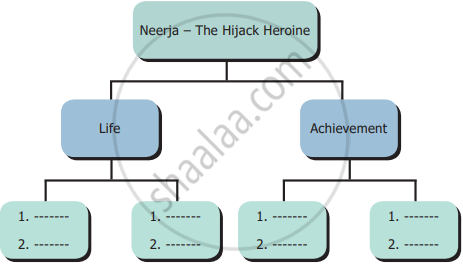
The author did not want to plant saplings in the forest because______.
Find out the idiom that relates to ‘whatever the circumstances’, from the first paragraph.
Narrate the story based on the story map
Identify the speaker/character.
He felt something moving along his body almost up to his chin.
Who is the wisest of all? Why?
Why did Yazhini want to join the military?
Complete the following sentence using the prepositions from the option.
The summer vacation ends _____ Monday.
Robot asked Vicky to sell him to an ______ master.
What day is it?
Why did the old man need someone?
Read the advertisement and answer the question given below.

What is free, for LED TV?
Speak and win.
Join in one of the two groups. Choose two characters. Support or oppose any one of the characters. Say some sentences for the one you support and say some sentences against the other one, to win.
| I support | I oppose |
Fill in the blank
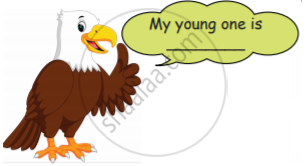
Rani thought of herself as a _______ engineer.
Do you think it is right for the tanker to take water? Why?
We shouldn't ______ ever.
