Advertisements
Advertisements
प्रश्न
Both Ramanand and Azam Khan seem to have very fixed views. How does Ramanand score over Azam Khan towards the end of the story?
Advertisements
उत्तर
Ramanand was a money-minded man who would agree to his customer. Was not this how he had built all his money? However, Azam was a man who lived by his worn-out pride, tracing his lineage that his father was a Sultan. He was proud in vain. He was determined that only a man who is the successor of a warrior or is associated with a royal house can have a Tiger moustache. And a money lender is supposed to have a goat moustache. Ramanand did agree to Azam every time and turned the tip of his moustache down to keep his customer happy while raising the other end to tempt him to return with another possession to bargain. Stubborn they both were in their trading and pride. It helped Ramanand to gain possessions while Azam became a pauper bargaining all that he possessed to feed his false pride.
APPEARS IN
संबंधित प्रश्न
Describe the progress made by Helen Keller during the two years she spent at Wright-Humason School for the Deaf in New York City.
Orangutans use big leaves during a downpour because
How do chimps drink water from the waterholes?
Notice these expression in the text. Infer their meaning from the context.
salt flats
Briefly comment on:
“As a Buddhist, he told me, he knew that it didn’t really matter if I passed away, but he thought it would be bad for business.”
Locate expressions in the text reflect the Indian idiom, for example, the pride of the generations of his ancestors.
What distinguishes the tribal imagination from the secular imagination?
Study the Note to Aspects of the Novel given at the end. Discuss the features that mark the piece as a talk as distinguished from a critical essay.
'Trees are sacred my grandmother used to say'– what does the poet imply by this line?
Write words from the poem that describe the following.
- sky ____________
- heart ____________
- hand ____________
- beginning ____________
- surprises ____________
Make a list of the preparations made for an assault on Tiger Hill.
After confirming the multidirectional assault as the best strategy the commanding officer ________________.
Answer in your own words.
In what ways is Ashangbi different from other women of her community?
Think and write down how the following creature can be useful:
Dragon fly:
Find proof from the poem for the following.
The struggle of the cherry tree for survival.
‘But the peasant bowed and prayed to God ...........’ What could he have prayed for?
For preparing questions based on the poem, an overall understanding of the poem is a must. Discuss with your partner and prepare a set of five questions.
For example:
- What is the name of the bridge?
- ________________________________
- ________________________________
- ________________________________
- ________________________________
- ________________________________
Pick out the statements which aptly depict the theme of the poem.
- In the poem, the speaker memorises the past.
- In ‘The Planners’ the poet describes the unstoppable force of modernisation.
- The poet talks about the replacement of natural environment by the concrete jungle.
- The poet proposes to stop modernisation.
- The poet laments helplessly.
Dos and Don'ts for Email Etiquettes. Discuss and add one or two Dos and Don'ts on your own.
| Sr. No. | Dos | Don'ts |
| 1. | Have a clear subject line. | Don’t forget your signature. |
| 2. | Use a professional salutation. | Don’t use humour and sarcasm. |
| 3. | Recheck your e-mail. | Don’t assume the recipient knows what you are talking about. |
| 4. | Keep private material confidential. | Don’t punctuate poorly. |
| 5. | Keep your email short and flawless. Stay concise. | Don't hit 'Reply All'. |
| 6. | Check your attachments before sending them. | Don’t think that no one but the intended recipient will see your email. (No predictions) |
| 7. | Include your name or a signature with additional details and contact information. | Don't forward emails without permission. |
Discuss in groups and think about it.
Mention three occasions on which you have made someone else angry. What made that person angry? Can you avoid such things in the future?
Correct the given sentence with justification.
The play is restricted to only a part of the woods.
The characters are a part of the stage setting. How does this reflect when the characters of the play range from the Duke and the Indian boy to the faeries?
Comment on the versatility and the aptness of the stage settings, as per the requirement of the play “A Midsummer-Night’s Dream!”
In each of the following line, spot the sound that is used repeatedly -
- There’s a silver house in the lovely sky.
- As round as a silver crown
- It takes two weeks to build it up. And two to pull it down.
Choose any one of the seven States. Find more information about it and prepare a leaflet or brochure to invite people to visit it.
What were the three things that Sushruta discovered?
Hold a mock trial for the following offence. There should be a complainant, a defendant, and lawyers to argue the case on behalf of them. The whole class can vote to pass the judgment. On what occasions will you plead for justice? What punishment will you suggest? When will you plead for mercy?
A poor man stole some ornaments from a rich girl.
Visit a library:
Find and read stories and poems written by Edith Nesbit.
Write a short note on the following:
The ‘four signs’ that Prince Siddharth beheld.
Prepare similar word chains using the following ideas.
| rain | drizzle | ______ | ______ | ______ |
| wind | breeze | ______ | ______ | ______ |
| sunshine | warm | ______ | ______ | ______ |
| waterbody | pool | ______ | ______ | ______ |
| size | big | ______ | ______ | ______ |
| size | small | ______ | ______ | ______ |
Choose the appropriate phrase to insert in the gap, to make the sentence meaningful. Use the appropriate form of the verb.
Before we ______ let us stand in attention for the National Anthem.
Rohan had finished ______ rounds of the tree before Mrs. Groover discovered him.
Describe the following in one or two lines.
The first little house of the bird.
Find out how rice is cultivated. Describe the process with the help of pictures or diagrams.
Name a few other things that people often count. (At least 5.)
Write any one of these stories, not as told by Gulliver, but by some other person.
Write a short note on ‘money’.
Do you long to be something else? Write about your longing.
What is the ‘Internet’?
Read the following line from the poem and answer the question that follow.
So let the way wind up the hill or down, O'er rough or smooth, the journey will be joy: Still seeking what I sought when but a boy, New friendship, high adventure, and a crown,
- How is the way of life?
- How should be the journey of life?
- What did the poet seek as a boy?
The author was going to New York.
The taxi driver took away the narrator’s suitcase.
The weather is always too hot or cold; Summer and winter alike they scold. Nothing goes right with the folks you meet Down on that gloomy Complaining Street.
Pick out the rhyming words and identify the rhyme scheme of the above lines.
There were many toys in the stall. Three of Hamid’s friends had bought some toys.
Write the names of Hamid’s friends in column A and the toys they bought in column B
| A | B |
Read the letter again and write a few lines on each of the following.
- things that the coach taught….
- transformation in the child……..
- things that amazed the writer……..
Teachers help me to learn ______ things.
- new
- bad
- difficult
He preferred handling mail by himself.
Give a picturesque view through which the train travels.
Match the actions with the picture.
| mixes for community food service | 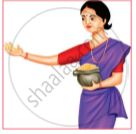 |
| sows the grain |  |
| feeds the birds |  |
Complete the following sentence using the prepositions from the option.
The summer vacation ends _____ Monday.
Name the character or speaker.
"Play me a pleasant song."
Why do we discover a mystery?
The bird-catcher let the pigeon jump into the fire.
Some words sound the same but their spelling and meaning are different. Such words are called homophones. There are many homophones.
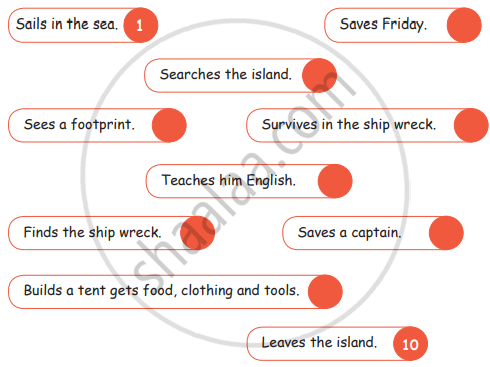
Arrange the actions of Robinson by numbering from 1 to 10.
Recite any 4 lines of the poem with intonation.
Whose word are these? Name the character.
“We do not have money to buy anything.”
Choose the right word.
Tansen was a famous ______.
What did the books in the library look like ?
Why did the child in the poem like looking at the pictures?
On the basis of your understanding of the given passage, make notes in any appropriate format.
The Sherpas were nomadic people who first migrated from Tibet approximately 600 years ago, through the Nangpa La pass and settled in the Solukhumbu District, Nepal. These nomadic people then gradually moved westward along salt trade routes. During 14th century, Sherpa ancestors migrated from Kham. The group of people from the Kham region, east of Tibet, was called “Shyar Khamba”. The inhabitants of Shyar Khamba, were called Sherpa. Sherpa migrants travelled through Ü and Tsang, before crossing the Himalayas. According to Sherpa oral history, four groups migrated out of Solukhumbu at different times, giving rise to the four fundamental Sherpa clans: Minyagpa, Thimmi, Sertawa and Chawa. These four groups have since split into the more than 20 different clans that exist today
Sherpas had little contact with the world beyond the mountains and they spoke their own language. AngDawa, a 76-year-old former mountaineer recalled “My first expedition was to Makalu [the world’s fifth highest mountain] with Sir Edmund Hillary’’. We were not allowed to go to the top. We wore leather boots that got really heavy when wet, and we only got a little salary, but we danced the Sherpa dance, and we were able to buy firewood and make campfires, and we spent a lot of the time dancing and singing and drinking. Today Sherpas get good pay and good equipment, but they don’t have good entertainment. My one regret is that I never got to the top of Everest. I got to the South Summit, but I never got a chance to go for the top.
The transformation began when the Sherpa Tenzing Norgay and the New Zealander Edmund Hillary scaled Everest in 1953. Edmund Hillary took efforts to build schools and health clinics to raise the living standards of the Sherpas. Thus life in Khumbu improved due to the efforts taken by Edmund Hillary and hence he was known as ‘Sherpa King’.
Sherpas working on the Everest generally tend to perish one by one, casualties of crevasse falls, avalanches, and altitude sickness. Some have simply disappeared on the mountain, never to be seen again. Apart from the bad seasons in 1922, 1970 and 2014 they do not die en masse. Sherpas carry the heaviest loads and pay the highest prices on the world’s tallest mountain. In some ways, Sherpas have benefited from the commercialization of the Everest more than any group, earning income from thousands of climbers and trekkers drawn to the mountain. While interest in climbing Everest grew gradually over the decades after the first ascent, it wasn’t until the 1990s that the economic motives of commercial guiding on Everest began. This leads to eclipse the amateur impetus of traditional mountaineering. Climbers looked after each other for the love of adventure and “the brotherhood of the rope” now are tending to mountain businesses. Sherpas have taken up jobs as guides to look after clients for a salary. Commercial guiding agencies promised any reasonably fit person a shot at Everest.
