- C: Consumption expenditure
- Y: Income
- f: functional relationship
Topics
Demand
- Introduction to Microeconomics and Macroeconomics
- Microeconomics
- Macroeconomics
- Macroeconomics Vs Microeconomics
- Introduction to Demand
- Meaning of Demand
- Features of Demand
- Types of Demand
- Determinants of Demand
- Demand Function
- Quantity Demanded and Demand
- Law of Demand
- Demand Schedule
- Demand Curve
- Individual Demand Curve to Market Demand Curve
- Slope of the Demand Curve
- Linear Demand Curve
- Reasons for the Downward Slope of the Demand Curve
- Importance of the Law of Demand
- Exceptions to the Law of Demand
- Movement Along the Demand Curve
- Change in Demand – Shift in Demand Curve
- Difference Between Extension and Increase in Demand
- Difference Between Contraction and Decrease in Demand
- Cross Price Effects
- Relationship Between Income and Demand
- Impact of Tastes and Preferences on Demand for a Commodity
- Industry Demand Vs Firm Demand
- Concept of Utility
- Cardinal Utility Analysis / Marginal Utility Analysis
- Types of Marginal Utility
- Total Utility and Marginal Utility
- Forms of Utility
- Features of Utility
- Relationship Between Total Utility and Marginal Utility
- Law of Diminishing Marginal Utility
- Exceptions of the Law of Diminishing Marginal Utility
- Importance of the Law of Diminishing Marginal Utility
- Consumer's Equilibrium through Cardinal Utility Approach
- Law of Equi-Marginal Utility
- Exceptions of the Law of Equi-marginal Utility
- Importance of the Law of Equi-marginal Utility
- Ordinal Utility Analysis/Indifference Curve Analysis
- Indifference Schedule
- Indifference Curve
- Indifference Map
- Marginal Rate of Substitution (MRS)
- Assumptions of Indifference Curve Analysis
- Properties of Indifference Curves
- Price Line or Budget Line
- Consumer's Equilibrium through Indifference Curve Approach
- Comparison of Utility Theory and Indifference Curve Theory
- Consumer's Equilibrium through Indifference Curve Approach
- Relationship Between Marginal Rate of Substitution and Marginal Utility
Microeconomic Theory
Theory of Income and Employment
- Introduction to Theory of Income and Employment
- Basic Model of Income Determination
- Aggregate Demand and Its Components
- Desired (Ex Ante) and Effective Demand (Ex Post)
- Propensity to Consume or Consumption Function
- Propensity to Save - Saving Function
- Relationship Between Consumption and Saving Functions
- Derivation of Saving Function
- Investment Expenditure
- Private and Public Investment
- Induced and Autonomous Investment
- Determination of Equilibrium Income and Output
- Concept of Aggregate Demand and Aggregate Supply
- Saving-investment Approach
- Investment Multiplier
- Investment Multiplier Defined
- The Multiplier Mechanism
- Graphic Presentation of Multiplier
- Derivation of Multiplier Formula
- Solved Numerical Problems on Propensity to Consume and Save, Equilibrium Income and Multiplier
- Meaning of Full Employment and Voluntary Unemployment
- The Concept of Full Employment
- Voluntary and Involuntary Unemployment
- Excess Demand
- Measures to Correct the Excess Demand
- Deficient Demand
- Measures to Correct Deficient Demand
- Deficient and Excess Demand and Business Cycle
- Aggregate Demand in a Three - Sector Economy
- Features of the Consumption Function
- Shifting of the Consumption Function
- Importance of the Consumption Function
- Gross Investment and Net Investment
- Paradox of Thrift
- Variables
- Partial and General Equilibrium
- Static Analysis
- Comparative Static Analysis
- Dynamic Analysis
- Difference between Static and Dynamic Analysis
- Psychological Law of Propensity to Consume
- Measures to Raise Propensity to Consume
- Importance of Investment
- Static Multiplier
- Dynamic Concept of Multiplier
- Limitations of Multiplier
- Leakages of Multipler
- Importance of Multiplier
- Types of Multiplier
- Balanced-Budget Multiplier
- Unemployment Associated with Full Employment
- Inflationary Gap
- Foreign Trade Policy
Elasticity of Demand
- Introduction to Elasticity of Demand
- Meaning and Types of Elasticity of Demand
- Price Elasticity of Demand
- Classification of Price Elasticity - Degrees of Price Elasticity of Demand
- Methods of Measuring Price Elasticity of Demand
- Percentage or Proportionate Method
- Total Expenditure Method
- Point Method (Geometric Method)
- Arc Elasticity of Demand
- Revenue Method
- Numerical Problems of Price Elasticity of Demand
- Factors Affecting Price Elasticity of Demand
- Importance of Elasticity of Demand
- Income Elasticity of Demand
- Types of Income Elasticity of Demand
- Importance of Income Elasticity
- Cross Elasticity of Demand
- Туpes of Cross Elasticity of Demand
- Limitations of Cross Elasticity of Demand
- Importance of Cross Elasticity of Demand
Money and Banking
Supply
- Concept of Supply
- Individual and Market Supply
- Distinction Between Supply and Stock
- Determinants of Supply
- Supply Function
- Law of Supply
- Supply Schedule
- Supply Curve
- Derivation of Market Supply Curve From Individual Supply Curves
- Explanation of the Law of Supply
- Time Period and Supply
- Exceptions to the Law of Supply
- Movement Along the Supply Curve Or Expansion and Contraction of Supply
- Shift of the Supply Curve or Change in Supply
- Expansion of Supply and Increase in Supply
- Contraction of Supply and Decrease in Supply
- Elasticity of Supply
- Meaning and Types of Elasticity of Demand
- Price Elasticity of Supply
- Categories (Degrees) of Elasticity of Supply
- Measurement of Elasticity of Supply > Percentage Method
- Measurement of Elasticity of Supply > Geometric or Point Method
- Determinants of Elasticity of Supply
- Importance of Elasticity of Supply
Market Mechanism
- Introduction to Market Mechanism
- Basic Concepts of Equilibrium and Equilibrium Price
- Equilibrium Price and Quantity in a Competitive Market
- Changes in Equilibrium
- Effects of Changes (Shifts) in Demand on Equilibrium Price and Equilibrium Quantity
- Effects of Changes (Shifts) in Supply on Equilibrium Price and Equilibrium Quantity
- Effects of Simultaneous Changes (Shifts) in Demand and Supply
- Some Special Cases of Equilibrium
- Importance of the Element in the Determination of Price
- Applications of Tools of Demand and Supply Price Control
- Mаximum Price Legislation or Price Ceiling and Rationing
- Minimum Price Legislation or Floor Price
- Important Areas of Applications of Tools of Demand and Supply Curves
- Meaning of Perfect Competition
- Assumptions and Conditions of Perfect Competition
- Pure and Perfect Competition
- Time Element in the Theory of Price Determination
- Determination of Equilibrium Prices
- Normal Price and Law of Returns
- Comparison between Market Price and Normal Price
- Practical Applications of Tools of Demand and Supply Analysis
Balance of Payments and Exchange Rate
Public Finance
Concepts of Production
- Concept of Production
- Product
- Factors of Production
- Production Function
- Short-run and Long-run
- Features of Production Function
- Types of Production Functions
- Some Basic Concepts - Total, Average and Marginal Physical Products
- Relationship between Average Product (AP) and Marginal Product (MP)
- Relationship between Total Product (TP) and Marginal Product (MP)
- Returns to a Factor - Laws of Returns to a Variable Factor
- Law of Variable Proportions
- Statement of the Law of Variable Proportions
- Assumptions of the Law of Variable Proportions
- Illustration of the Law of Variable Proportions
- Three Stages of Production
- Explanation of the Law of Variable Proportions
- Stages of Operation and the Decision to Produce
- Conditions Or Causes of Applicability
- Applicability of the Law of Variable Proportions
- Changes in Production
- Returns to a Factor or Law of Returns
- Law of Variable Proportions and Returns to Scale Compared
- Variation of Output in the Long Run - Returns to Scale
- Scale of Production
- Concept of Indivisibility
- Economies of Scale
- Diseconomies of Scale
National Income
Cost and Revenue
- Introduction to Cost of Production
- Money Cost Or Accounting Cost / Explicit Cost
- Economic Cost
- Opportunity Cost
- Real Cost
- Private and Social Cost
- Fixed Cost and Variable Cost
- Different Cost Concepts
- Total Cost Curves
- Average Cost Curves
- Marginal Cost (MC)
- Relationship between Average and Marginal Cost
- Long-Run Cost Curves
- Long-run Average Cost (LAC) Curve
- Long-run Marginal Cost (LMC) Curve
- LAC Curve U-shaped - Economies and Diseconomies of Scale
- Numerical Problems Long-run Cost Curves
- Revenue Concepts
- Behaviour of Revenue Under Different Market Structures
- Relationship Between Total, Average and Marginal Revenues Under Perfect Competition
- Relationship Between Total, Average and Marginal Revenue Under Imperfect Competition
- Significance of Revenue Curve
- Numerical Problems of Revenue
Main Market Forms and Equilibrium of a Firm
- Concept of Market
- Market Structure
- Factors Determining Market Forms
- Perfect Competition
- Features of Perfect Competition
- Pure and Perfect Competition
- Monopoly
- Features of Monopoly
- Monopolistic Competition
- Features of Monopolistic Competition
- Oligopoly
- Features of Oligopoly
- Monopsony
- Features of Monopsony
- Duopoly
- Characteristics of Duopoly
- Bilateral Monopoly
- Other Forms of Market
- Factors Determining Market / Extent of Market
- Demand Curves of Firms under Different Market Forms
- Comparison between different forms of market
- Difference Between Imperfect Competition and Monopolistic Competition
- Firm : An Economic Entity
- Profit Maximisation Objective
- The Definition of Profits
- Rules for Profit-Maximisation
- Producer's (Firm's) Equilibrium: Total Revenue and Total Cost Approach
- Producer's (Firm's) Equilibrium: Marginal Revenue and Marginal Cost Approach
- Short-run Equilibrium
- Long-run Equilibrium
- Firm is a Price Taker, Not a Price Maker
- Equilibrium of Industry
- Difference Between Firm and Industry's Equilibrium
- Meaning of a Producer
- Producer's Equilibrium under Perfect Competition
- Determination of Price and Equilibrium Under Monopoly
- Monopoly Equilibrium and Laws of Costs
- Price Discrimination or Discriminating Monopoly
- Price and Output Discrimination Under Discriminating Monopoly
- Measures of Monopoly Power
- Nature of Demand and Cost Curves
- Equilibrium Price and Output under Monopolistic Competition
- Group Equilibrium in Monopolistic Competition
- Product Differentiation
- Selling Costs
- Equilibrium with Selling Costs
- Price and Output Under Oligopoly Indeterminate
- Price and Output Determination under Oligopoly
- Price Rigidity-Sweezy's Kinky Demand Curve Model or Equilibrium under Independent Action
- Reasons for Price Stability
- Cournot's Model
- Collusive Oligopoly
- Mergers
Estimated time: 16 minutes
- Consumption function
- Definitions: Consumption function
- Formula: Average Propensity to Consume
- Formula: Marginal Propensity to Consume
- Graphical meaning: APC
- Graphical meaning: MPC
- Properties of Keynesian consumption function
- Linear consumption function
- Characteristics of Propensity to Consume
- Tabular Representation of Propensity to Consume
CISCE: Class 12
Consumption function
- The consumption function or propensity to consume shows the relationship between income (Y) and planned consumption expenditure (C) of households.
- In symbols, this relationship is written as:
C = f(Y)
This means that consumption depends on income.
CISCE: Class 12
Definitions: Consumption function
- "The consumption function shows what changes can be expressed in the consumption from given changes in income." — Hansen
- "Consumption function is nothing more than a statement of the relation between consumption, expenditure and income." — R.G. Lipsey
- "It is a functional relationship indicating how consumption varies when income varies." — Dillard
- "Consumption function may be defined as a schedule showing amounts that will be spent for consumer goods and services at different income levels." — Peterson
CISCE: Class 12
Graphical meaning: APC
- On a graph, income (Y) is on the horizontal axis and consumption (C) on the vertical axis.
- At any point on the consumption curve CC, APC equals the ratio of the vertical distance to the horizontal distance from the origin:
\[APC=\frac{\text{vertical distance (C)}}{\text{horizontal distance (Y)}}\] - Geometrically, it is the slope of the ray drawn from the origin to the point on the consumption curve.
CISCE: Class 12
Graphical meaning: MPC
- The slope of the consumption curve CC represents MPC.
- Between two points KK and LL on the consumption curve:
\[MPC=\frac{\Delta C}{\Delta Y}=\frac{\text{vertical change KL}}{\text{horizontal change Y1Y2}}\] - For a linear (straight-line) consumption function, MPC is constant at all income levels.
CISCE: Class 12
Properties of Keynesian consumption function
1. Consumption varies directly with income
- When income increases, desired consumption increases; when income falls, desired consumption falls.
- Countries with higher per capita incomes generally have higher levels of consumption.
- Symbolically:
\[C=f(Y),\quad\mathrm{with}\frac{dC}{dY}>0\]
2. Increase in consumption is less than increase in income
- When income rises, consumption also rises, but by a smaller amount than the rise in income.
- The additional income is split between additional consumption and additional saving.
- In terms of MPC c:
(consumption increases with income)
(increase in consumption is less than increase in income)
Hence:
0 < c < 1
CISCE: Class 12
Linear consumption function
In this chapter, a linear consumption function is assumed:
C = a + cY
Where:
- C: aggregate consumption
- Y: income
- a: autonomous consumption (positive constant) – minimum consumption even when income is zero.
- c: marginal propensity to consume (MPC) – constant slope of the consumption line.
Interpretation:
- Autonomous consumption (a): part of consumption independent of current income (basic needs financed by borrowing/dissaving).
- Induced consumption (cY): part of consumption that depends on income; it increases when income increases.
- For this linear function, MPC = cc is constant. In more general, non-linear cases, MPC may fall as income rises (people consume a smaller fraction of each additional rupee of income).
CISCE: Class 12
Characteristics of Propensity to Consume
- Psychological Nature: Based on personal tastes/habits (e.g., festival shopping urge). Stays steady short-term.
- Links to Income/Jobs: Higher PTC → more spending → business growth → jobs (e.g., Diwali sales boom).
- Unequal Across Groups: Poor spend nearly all (100% PTC) on basics; rich save more (e.g., slum family vs. high-rise owner).
- Short Run: Consumption rises slower than income; PTC falls as Y grows. (See Table below.)
- Long Run: PTC stable; no "must-spend" base—full income drives spending.
CISCE: Class 12
Tabular Representation of Propensity to Consume
Insight: At low income, borrow to eat. Beyond ₹550, extra income saves—consumption plateaus.
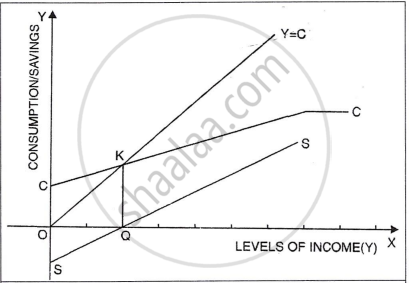
Diagram Description
X-axis: Income; Y-axis: Consumption/Savings. 45° line = C=Y. CC curve (upward, below 45°) shows rising but slower C. SS curve starts negative (borrowing), crosses zero at breakeven. Point K: Y=C (no savings).
Real-Life Example: Mumbai street vendor spends 90% on stock/food (high PTC); banker saves 60% for flat loan (low PTC).
