- Average Propensity to Consume (APC) = $$\frac{Total\ Consumption\ (C)}{Total\ Income\ (Y)}$$
- Symbolically: \[\mathrm{APC}=\frac{C}{Y}\]
Where:
- C = total consumption expenditure
- Y = total income
According to Keynes, consumption depends mainly on the level of income.
He studied this relationship using two technical concepts:
"The average propensity to consume is the ratio of consumption to income \[\left(\frac{\mathrm{C}}{\mathrm{Y}}\right)\] at a specific level of income. It is the proportion of a given income that is spent for consumption purposes." — Peterson
Table: Aggregate income, consumption and APC
From Table :
Thus, as income increases, APC tends to decline because consumption rises less than proportionately to income.
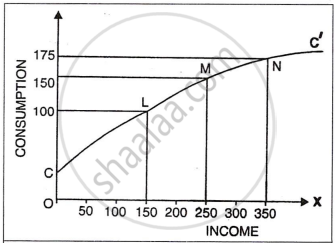
In Fig. , income is shown on the horizontal (OX) axis and consumption on the vertical (OY) axis.
The curve CC′ is the consumption curve, which is drawn by joining points like L, M and N showing different income–consumption combinations.
If we divide the vertical coordinate (consumption) of each point by its horizontal coordinate (income), we get APC at that income level.
As we move to the right along the CC′ curve (from L to M to N), the curve becomes flatter, showing that APC is falling with rise in income (from 0.66 to 0.60 to 0.50).
