Topics
Microeconomic Theory
Microeconomics and Macroeconomics: Introduction
Theory of Income and Employment
Demand and Law of Demand
- Role of Demand and Supply in Economics
- Paul A. Samuelson: Father of Modern Economics
- Concept of Demand
- Types of Demand
- Determinants of Demand
- Demand Function
- Law of Demand
- Demand Schedule
- Individual Demand Schedule
- Market Demand Schedule
- Demand Curve
- Individual Demand Curve
- Market Demand Curve
- Reasons for the Downward Slope of the Demand Curve
- Importance of the Law of Demand
- Exceptions to the Law of Demand
- Movement along the Demand Curve and Shift of the Demand Curve
- Change in Quantity Demanded: Movement along the Demand Curve
- Change in Demand – Shift in Demand Curve
- Difference Between Extension and Increase in Demand
- Difference Between Contraction and Decrease in Demand
Theory of Consumer Behaviour: Marginal Utility and Indifference Curve Analysis
- Basic Concepts of Microeconomics > Utility
- Cardinal Approach (Utility Analysis)
- Total Utility and Marginal Utility
- Relationship Between Total Utility and Marginal Utility
- Approaches to Consumer Behaviour
- Law of Diminishing Marginal Utility
- Alfred Marshall: Key Contributor to Economics
- Consumer's Equilibrium through Cardinal Utility Approach
- Law of Equi-Marginal Utility
- Importance and Limitations of law of Equi-Marginal Utility
- Ordinal Utility Analysis/Indifference Curve Analysis
- Marginal Rate of Substitution (MRS)
- Relationship Between Marginal Rate of Substitution and Marginal Utility
- Properties of Indifference Curves
- Price Line or Budget Line
- Consumer's Equilibrium through Indifference Curve Approach
Money and Banking
Balance of Payment and Exchange Rate
Elasticity of Demand
- Concept of Elasticity of Demand
- Types of Elasticity of Demand > Price Elasticity
- Methods of Measuring Price Elasticity of Demand
- Percentage or Proportionate Method
- Total Expenditure Method
- Point Method (Geometric Method)
- Arc Elasticity of Demand
- Revenue Method
- Numerical Problems of Price Elasticity of Demand
- Factors Affecting Price Elasticity of Demand
- Importance of Elasticity of Demand
- Types of Elasticity of Demand > Income Elasticity
- Types of Elasticity of Demand > Cross Elasticity
Supply: Law of Supply and Price Elasticity of Supply
- Concept of Supply
- Determinants of Supply
- Law of Supply
- Movements Along and Shifts in Supply Curve
- Elasticity of Supply
- Price Elasticity of Supply
- Categories (Degrees) of Elasticity of Supply
- Measurement of Elasticity of Supply > Percentage Method
- Measurement of Elasticity of Supply > Geometric or Point Method
- Determinants of Elasticity of Supply
Public Finance
Market Mechanism: Equilibrium Price and Quantity in a Competitive Market
- Basic Concepts of Equilibrium and Equilibrium Price
- Equilibrium Price and Quantity in a Competitive Market
- Effects of Changes (Shifts) in Demand on Equilibrium Price and Equilibrium Quantity
- Effects of Changes (Shifts) in Supply on Equilibrium Price and Equilibrium Quantity
- Effects of Simultaneous Changes (Shifts) in Demand and Supply
- Some Special Cases of Equilibrium
- Applications of Tools of Demand and Supply Price Control
- Mаximum Price Legislation or Price Ceiling and Rationing
- Minimum Price Legislation or Floor Price
National Income
Laws of Returns: Returns to a Factor and Returns to Scale
- Basics of Production Theory
- Products
- Factors of Production
- Production Function
- Types of Production Functions
- Basic Product Concepts
- Relationship between Average Product (AP) and Marginal Product (MP)
- Relationship between Total Product (TP) and Marginal Product (MP)
- Law of Variable Proportions
- Three Stages of Production
- Stages of Operation and the Decision to Produce
- Variation of Output in the Short-Run Returns to a Factor
- Changes in Production
- Explanation of the Law of Variable Proportions
- Variation of Output in the Long Run - Returns to Scale
- Law of Variable Proportions and Returns to Scale Compared
- Scale of Production and Concept of Indivisibility
- Economies of Scale
- Diseconomies of Scale
- Significance of Economies of Scale
Cost and Revenue Analysis
- Cost of Production
- Theories of Costs: Traditional Theory of Costs/Short Run Cost Curves
- Cost Concepts > Total Costs
- Cost Concepts > Average Cost
- Cost Concepts > Marginal Cost
- Costs in Long Run Period
- Difference Between Short - Run & Long Run Costs
- Behaviour of Cost in the Short - Run
- Relationship between Average and Marginal Cost
- Long-Run Cost Curves
- Revenue Concepts
- Types of Revenue
- Relation Between Total, Average and Marginal Revenue
- Relationship between Total, Average and Marginal Revenues under Perfect Competition
- Relationship between Total, Average and Marginal Revenue under Imperfect Competition
- Relationship Between (Mutual Determination) AR, MR, and Elasticity of Demand
- Comparative Study of Revenue Curves under Different Markets
- Significance of Revenue Curve
Forms of Market
- Concept of Market
- Market Structure
- Classification of Market Structure
- Perfect Competition
- Monopoly
- Monopolistic Competition
- Oligopoly
- Duopoly
- Bilateral Monopoly
- Concept of Monopsony
- Other Forms of Market
- Factors Determining Market / Extent of Market
- Demand Curves of Firms under Different Market Forms
- Comparison between different forms of market
Producer's Equilibrium
Equilibrium of Firm and Industry Under Perfect Competition
- Concept of Equilibrium in Economics
- Firm's Equilibrium
- Producer's (Firm's) Equilibrium: Total Revenue and Total Cost Approach
- Producer's (Firm's) Equilibrium: Marginal Revenue and Marginal Cost Approach
- Determination of Short Run Equilibrium of a Firm
- Firm is a Price Taker, Not a Price Maker
- Determination of Long Run Equilibrium of a Firm
- Equilibrium of Industry
- Difference Between Firm and Industry's Equilibrium
Producer's Equilibrium Under Perfect Competition
Determination of Equilibrium Price and Output Under Perfect Competition
- Perfect Competition
- Price Determination Under Perfect Competition
- Changes in Equilibrium
- Effects of Changes (Shifts) in Demand on Equilibrium Price and Equilibrium Quantity
- Time Element in the Theory of Price Determination
- Determination of Equilibrium Prices
- Normal Price and Law of Returns
- Comparison between Market Price and Normal Price
- Practical Applications of Tools of Demand and Supply Analysis
- Determination of Short Run Equilibrium of a Firm
- Determination of Long Run Equilibrium of a Firm
Price Output Determination Under Monopoly
Price Output Determination Under Monopolistic Competition and Oligopoly
- Imperfect Competition
- Monopolistic Competition
- Equilibrium Price and Output under Monopolistic Competition
- Group Equilibrium in Monopolistic Competition
- Product Differentiation
- Selling Costs
- Oligopoly
- Price and Output Determination under Oligopoly
- Price Rigidity-Sweezy's Kinky Demand Curve Model or Equilibrium under Independent Action
- Cournot's Model
- Collusive Oligopoly
- Mergers
Theory of Income and Employment
- Basic Model of Income Determination
- Aggregate Demand and Its Components
- Propensity to Consume or Consumption Function
- Propensity to Save
- Investment Expenditure
- Determination of Equilibrium Income and Output
- Saving-investment Approach
- Investment Multiplier and Its Mechanism
- Solved Problems on Consumption and Income
- The Concept of Full Employment
- Important Terms of Employment and Unemployment
- Excess Demand
- Deficient Demand
Basic Concepts of Macro Economics
Aggregate Demand and Supply-Determinants of Equilibrium
Consumption Function (Propensity to Consume)
- Propensity to Consume or Consumption Function
- Kinds or Technical Attributes of Propensity to Consume > Average Propensity to Consume
- Kinds or Technical Attributes of Propensity to Consume > Marginal Propensity to Consume
- Propensity to Save
- Determinants of Propensity to Consume
- Psychological Law of Propensity to Consume
- Measures to Raise Propensity to Consume
Concept of Investments-Types and Determinants
Multiplier - I : Static and Dynamic
Full Employment and Voluntary Unemployment
Problems of Deficient Demand and Excess Demand
Measures to Correct Deficient and Excess Demand
Money: Meaning and Functions
Banks: Commercial Bank and Central Bank
- Concept of Bank
- Types of Bank
- Commercial Banks
- Banking > Functions of Commercial Bank
- Credit Creation by Commercial Banks
- Role of Commercial Banks in an Economy
- Central Bank
- Comparison Between Central Bank and Commercial Banks
- Central Bank as a Controller of Credit
- Methods of Credit Control
- Quantitative Methods
- Qualitative (Or Selective) Methods
Balance of Payment and Exchange Rate
- Concept of Balance of Payments
- Features of Balance of Payment
- Balance of Trade and Balance of Payments- Comparison
- Structure of Balance of Payment
- Methods to Measure Balance of Payments
- Components of Balance of Payments
- Current Account Transactions
- Capital Account Transactions
- Balance of Payments Always Balances
- Categories of Balance of Payments
- Balance of Payments Disequilibrium
- Measures to Correct Disequilibrium in the Balance of Payments
- Foreign Exchange Rate
- Exchange Rate
- Types of Foreign Exchange Rate
- Fixed Rate of Exchange
- Flexible Rate of Exchange
- Managed Floating Exchange Rate System
- Determination of Equilibrium Rate of Exchange
- Factors or Determinants of Foreign Exchange Rate
- Concepts of Depreciation, Appreciation, Devaluation and Revaluation
- Determination of Exchange Rate in a Free Market
Fiscal Policy
- Structure of Public Finance > Fiscal Policy
- Public Finance
- Instruments of Fiscal Policy
- Objectives of Fiscal Policy
- Miscellaneous Objectives of Fiscal Policy
- Fiscal Measures for Stabilisation
- Methods of Fiscal Policy in Developing Countries
- Limitations of Fiscal Policy
- Structure of Public Finance > Public Revenue
- Instruments of Fiscal Policy - Taxation
- Types of Taxes
- Tax Reforms in India
- Proportional, Progressive and Regressive Taxes
- Structure of Public Finance > Public Expenditure
- Importance of Public Expenditure
- Structure of Public Finance > Public Debt
- Reasons for Borrowing by the Government
- Public Debt - Redemption
- Deficit Financing
- Fiscal Policy in Action
Government Budget
- Budget
- Types of Budget
- Government Budget
- Need and Importance of Government Budget
- Types of Government Budget in India
- Components (Structure) of the Government Budget
- Modern Classification of Budget
- Classification of Budget Receipts
- Balanced Budget Vs Unbalanced Budget
- Zero-Base Budgeting (ZBB)
- Zero-Base Budgeting in India
- Concepts Related to Budget Deficits
- Constituents of budget /Structure of the budget
- Structure of Public Finance > Public Expenditure
- Revenue Expenditure and Capital Expenditure
- Developmental and Non-developmental Expenditure
- Tax Revenue
- Public Revenue > Non-tax Revenue
- Capital Receipts
- Objectives of Budget
- Significance of Budget
- Types of budget deficit
- Budgetary Procedure
National Income and Circular Flow of Income
- Concept of National Income
- Domestic Income
- National Income Aggregates
- Significance or Importance of National Income
- Circular Flow of Income
- Circular Flow in a Closed Economy
- Circular flow and the Equality between Production, Income and Expenditure
- Circular Flow in a Open Economy
- Economic Sectors of an Economy
- Two-Sector Model without Savings and Investment
- Two-Sector Model with Savings and Investment
- Three-Sector Model of Circular Flow of Income
- Four-Sector Model of Circular Flow of Income
- Significance or Importance of Circular Flow of Income
National Income Aggregates
- Key Relationships Among National Income Aggregates
- National Income Aggregates
- Gross Domestic Product at Market Price
- Gross National Product at Market Price
- Constituents of GNP
- Net Domestic Product at Market Price
- Difference between Net Domestic and Net National Product at Market Price
- Net National Product (NNP)
- Difference between Net National and Gross National Product at Market Price
- Net National Income or Product at Factor Cost
- Net Domestic Product or Income at Factor Cost
- Difference between Net Domestic Product at Factor Cost and Net Domestic Product at Market Price
- Gross Domestic Product or Income at Factor Cost
- Gross National Product at Factor Cost
- Factor Income from Net Domestic Product accuring to Private Sector
- Private Income
- Difference between National and Private Income
- Personal Income of National Income
- Difference between Private and Personal Income
- Disposable Income Aggregates
- Per Capita Income
- Real Income
- Interrelationship among National Income Aggregates
- Real GDP and Nominal GDP
- Gross Domestic Product (National Income) and Economic Welfare
Methods of Measuring National Income
- Concept of National Income
- Methods of Measurement of National Income
- Net Product or Value Added Method
- Precautions in the Estimation of National Income by Value-added Method
- Difficulties in the Estimation of National Income by Value-added Method
- Income Method
- Expenditure Method
- Precautions in the Estimation of National Income by Expenditure Method
- Alternative Methods of National Income Estimation
- Reconciling The Three Methods Of Estimating National Income
- Components of Net National Product at Factor Cost in its Three Phases
- Transactions Included in National Income
- The Identity of Output, Income and Expenditure
- Significance of three Methods
- Transactions not Included in National Income
- Numericals on Income, Product and Expenditure Method
National Income and Economic Welfare
- Welfare Economics
- Definitions of Welfare Economics
- Factors Determining the Size of National Income
- National Income and National Welfare
- Relation between Economic Welfare and National Income
- National Income as a Measure of Economic Welfare
- Causes of Slow Growth of National Income
- Suggestions for Increasing National Income
- Perfect competition
- Monopoly
- Imperfect competition (including monopolistic competition)
- Oligopoly
- Real-Life Application
- Key Points: Comparative Study of Revenue Curves under Different Markets
CISCE: Class 12
Perfect competition
Definition and price behaviour
- Many buyers and many sellers; each firm is very small compared to the whole industry.
- A single firm cannot influence the market price; it is a price taker and sells any quantity at the given market price.
Revenue schedule (Table 5, Price = ₹5)
| Units (Q) | TR (₹) | AR (₹) | MR (₹) |
|---|---|---|---|
| 1 | 5 | 5 | 5 |
| 2 | 10 | 5 | 5 |
| 3 | 15 | 5 | 5 |
| 4 | 20 | 5 | 5 |
| 5 | 25 | 5 |
- TR increases by the same amount (₹5) when each additional unit is sold.
- AR remains constant at ₹5, and MR is also constant at ₹5 for every extra unit.
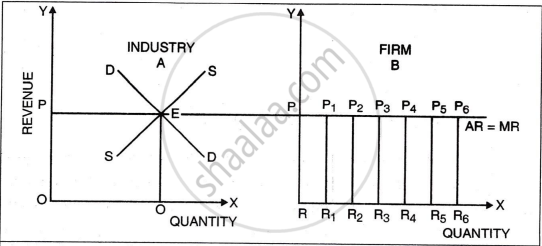
Shape of curves
- TR curve: a straight line from the origin, rising at a constant rate.
- AR curve: horizontal straight line at price = ₹5.
- MR curve: coincides with the AR curve, also horizontal at ₹5.
Because price is the same for all units, AR = MR under perfect competition.
CISCE: Class 12
Monopoly
Definition and price behaviour
- Single seller of a product with no close substitutes.
- The monopolist is a price maker: to sell more, the firm must lower the price, so the AR (demand) curve slopes downward.
Revenue schedule with constant TR (Table 6)
| Units Sold (Q) | Price (₹) | TR (₹) | AR (₹) | MR (₹) |
|---|---|---|---|---|
| 5 | 4.00 | 20 | 4.00 | – |
| 10 | 2.00 | 20 | 2.00 | 0 |
| 20 | 1.00 | 20 | 1.00 | 0 |
| 40 | 0.50 | 20 | 0.50 | 0 |
| 50 | 0.40 | 20 | 0.40 | 0 |
- Whatever the combination of price and quantity, TR stays at ₹20.
- Since TR does not rise when output increases, MR is zero over this range.
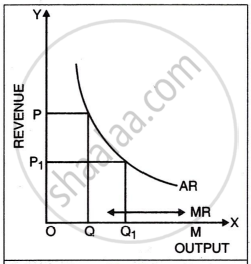
Rectangular hyperbola AR and MR
- The AR curve is shaped like a rectangular hyperbola such that Price × Quantity is constant (TR = constant).
- At every point on the AR curve, the rectangle under it (P × Q) has the same area. Hence, TR is the same, and MR = 0.
- The MR curve in this special case lies along the X‑axis (coincides with OX).
CISCE: Class 12
Imperfect competition (including monopolistic competition)
Nature of market
- Many firms selling differentiated but close-substitute products (toothpaste brands, soaps, restaurants, etc.).
- Each firm faces a downward-sloping AR (demand) curve but with more elasticity than pure monopoly.
Illustration with a part of revenue schedule
- 2 units sold at ₹5 each → TR = ₹10.
- To sell 3 units, the price is reduced to ₹4 → TR = ₹12, not ₹15.
- The third unit adds only ₹2 to TR, so the MR of the third unit is ₹2, while its price (AR) is ₹4.
- This is because the price cut applies to all units, not only to the marginal one.
| Price | Units Sold | TR | AR | MR |
|---|---|---|---|---|
| 6 | 1 | 6 | 6 | 6 |
| 5 | 2 | 10 | 5 | 4 |
| 4 | 3 | 12 | 4 | 2 |
| 3 | 4 | 12 | 3 | 0 |
| 2 | 5 | 10 | 2 | –2 |
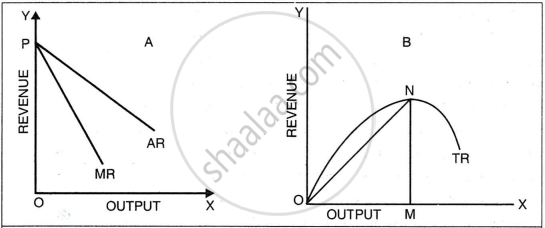
TR, AR, and MR behaviour
- AR curve slopes downward from left to right.
- MR curve lies below AR and falls faster; it may become zero and then negative.
- TR curve first rises at a diminishing rate as output increases, reaches a maximum point N, and then starts falling.
- At the output where TR is maximum (point N on TR), MR = 0.
CISCE: Class 12
Oligopoly
Definition and interdependence
- A few large firms dominate the market (telecom, airlines, soft drinks).
- Each firm’s price and output decisions influence rivals, and firms watch each other’s moves closely.
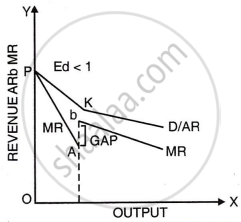
Case (a): Rivals do not follow price increase
- If one firm raises its price and others keep their prices unchanged, many buyers shift to the cheaper rivals.
- Demand facing the firm becomes highly elastic above the current price.
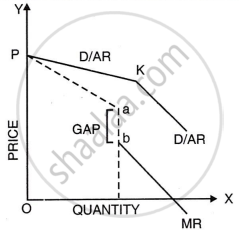
- AR curve: relatively less elastic up to point K; beyond K, it becomes highly elastic.
- MR curve: correspondingly rises discontinuously from a lower to a higher level at the output around point K.
Case (b): Kinked demand curve when rivals follow price cuts
- If a firm believes that rivals will match price cuts but will not follow price increases, its demand curve has a kink at the present price–output combination K.
- Above K: demand is relatively elastic (few customers accept higher price when rivals stay low).
- Below K, demand is relatively inelastic (all firms cut price together, so each firm gains little extra demand).
- The MR curve has a vertical discontinuity (a gap) between points a and b at the kink; below the gap, MR continues at a lower level.
- Small changes in cost may still keep the profit-maximising output within the MR‑gap, so price tends to remain rigid.
CISCE: Class 12
Real-Life Application
- A farmer selling wheat in a large grain market accepts the going price. Selling one more sack adds exactly that price to TR.
- A firm with a strong monopoly over a life-saving drug may set different price–quantity combinations that all yield roughly the same total revenue when it wants to maintain a fixed revenue target.
- A restaurant reducing prices to attract more customers must charge the lower price to existing customers as well, so extra revenue from additional customers is less than the new price.
- In telecom, when one operator cuts call rates, other operators quickly match the cut. If one operator raises prices alone, many users shift to cheaper networks.
CISCE: Class 12
Key Points: Comparative Study of Revenue Curves under Different Markets
- Under perfect competition, AR = MR = Price; both are horizontal, and TR rises at a constant rate.
- Under monopoly with constant TR, AR is a rectangular hyperbola and MR = 0 along the X‑axis.
- Under imperfect competition, AR slopes downward, MR lies below AR, and TR rises at a diminishing rate, becomes maximum when MR = 0, then falls.
- Under oligopoly with kinked demand, AR has a kink and MR is discontinuous; prices become sticky around the kink.
