Topics
Micro Economics
Introduction to Micro and Macro Economics
- Introduction to Microeconomics and Macroeconomics
- Father of Econometrics: Ragnar Frisch
- Microeconomics
- Macroeconomics
- Macroeconomics Vs Microeconomics
Introduction to Micro Economics
- Analysis of Market Structure
- Microeconomics
- Micro Economics - Slicing Method
- Use of Marginalism Principle in Micro Economics
- Micro Economics - Price Theory
- Micro Economic - Price Determination
- Micro Economics - Working of a Free Market Economy
- Micro Economics - International Trade and Public Finance
- Welfare Economics
- Micro Economics - Useful to Government
- Assumption of Micro Economic Analysis
Consumers Behavior
Analysis of Demand and Elasticity of Demand
Analysis of Supply
Types of Market and Price Determination Under Perfect Competition
Factors of Production
- Factors of Production - Feature of Capital
- Factors of Production
Utility Analysis
- Basic Concepts of Microeconomics > Utility
- Commodities and Their Specific Utility for Individuals
- Total Utility and Marginal Utility
- Law of Diminishing Marginal Utility
- Paradox of Value
- Relationship Between Marginal Utility and Price
- Indifference Curve Analysis by Hicks and Allen
Macro Economics
Introduction to Macro Economics
- Macroeconomics
- Allocation of Resource and Economic Variable
National Income
Determinants of Aggregates
- Total Demand for Good and Services
- Concept of Aggregate Demand and Aggregate Supply
- Consumption
- Investment Demand
- Government Demand
- Foreign Demand
- Difference Betweeen Export and Import
- Effect of Population of Consumption Expediture
- Types of Investment Expenditure
- Micro Eco-Equilibrium
Money
- Concept of Money
- Functions of Money
- Standard of Deferred Payment
- Standard of Transfer Payment
- Money - Store of Value
- Barter system
- Monetary Payments
- Concept of Good Money
Commercial Bank
Central Bank
- Central Bank
- Central Bank Function - Banker's Bank
- Central Bank as a Controller of Credit
- Monetary Function of Central Bank
- Non Monetary Function of Central Bank
- Methods of Credit Control
- Repo Rate and Reverse Repo Rate
- Central Bank Function - Goverment Bank
Public Economics
- Introduction of Public Economics
- Features of Public Economics
- Government Budget
- Objectives of Government Budget
- Features of Government Budget
- Public Economics - Budget (1 Year)(1 April to 31 March)
- Types of Budget
- Taxable Income
- Budgetary Accounting in India
- Budgetary Accounting - Consolidated , Contingency and Public Fund
- Components (Structure) of the Government Budget
- Factor Influencing Government Budget
Demand Analysis
Elasticity of Demand
- Introduction to Elasticity of Demand
- Income Elasticity of Demand
- Cross Elasticity of Demand
- Price Elasticity of Demand
- Perfectly Elastic Demand
- Perfectly Inelastic Demand
- Unitary Elastic Demand
- Relatively Elastic Demand
- Relatively Inelastic Demand
- Methods of Measuring Price Elasticity of Demand
- Linear Demand Curve
- Non-Linear Demand Curve
- Factors Influencing the Elasticity of Demand
- Importance of Elasticity of Demand
- Determinants of Price Elasticity of Demand
Supply Analysis
Forms of Market
- Concept of Market
- Classification of Market > Based on Place
- Classification of Market > Based on Place
- Classification of Market > Based on Time
- Classification of Market > Based on Competition
- Perfect Competition
- Price Determination Under Perfect Competition
- Imperfect Competition
- Monopoly
- Concept of Monopsony
- Oligopoly
- Monopolistic Competition
Index Numbers
- Index Numbers
- Features of Index Numbers
- Types of Index Numbers
- Index Numbers Used by Government of India
- Significance of Index Numbers
- Rebasing of GDP, IIP, and WPI
- Construction of Index Numbers
- Methods of Constructing Index Numbers > Simple Index Number
- Price Index Number
- Quantity Index Number
- Value Index Number
- Methods of Constructing Index Numbers > Weighted Index Number
- Laaspeyre’s Price Index Number
- Paasche’s Price Index Number
- Concepts of Sensex and Nifty
- Crops in India's Agricultural and Industrial Production Index
- Limitations of Index Numbers
National Income
- Concept of National Income
- Features of National Income
- Circular Flow of National Income
- Two Sector Model of Circular Flow of National Income
- Three Sector Model of Circular Flow of National Income
- Four Sector Model of Circular Income
- Different Concepts of National Income
- Concept of Green GNP
- Methods of Measurement of National Income
- Output Method/Product Method
- Income Method
- Expenditure Method
- Concept of Mixed income
- Difficulties in the Measurement of National Income
- Importance of National Income Analysis
Public Finance in India
- Public Finance
- Difference Between Public Finance and Private Finance
- Structure of Public Finance > Public Expenditure
- Important Social Welfare Schemes by the Government
- Structure of Public Finance > Public Revenue
- Public Revenue > Taxes
- Types of Taxes
- Direct Tax
- Indirect Tax
- Public Revenue > Non-tax Revenue
- Structure of Public Finance > Public Debt
- Structure of Public Finance > Fiscal Policy
- Structure of Public Finance > Financial Administration
- GST(Economics)
- Government Budget
- Revenue and Capital Budgets
- Types of Budget
- Importance of Budget
Money Market and Capital Market in India
- Concept of Financial Market
- Money Market
- Structure of Money Market in India > Organized Sector
- Structure of Money Market in India > Organized Sector
- Reserve Bank of India (RBI)
- Commercial Banks
- Co-operative Banks
- Development Financial Institutions (DFIs)
- Discount and Finance House of India (DFHI)
- Structure of Money Market in India > Unorganized Sector
- Money Market
- Role of Money Market in India
- Problems of the Indian Money Market
- Reforms Introduced in the Money Market
- Recent Developments in Banking Sector
- Capital Market
- Structure of Capital Market in India
- Role of Capital Market in India
- Problems of the Capital Market
- Regional Stock Exchanges in India
- Reforms Introduced in the Capital Market
- Economic Policy in an Economy
Foreign Trade of India
- India’s Trade Relations Before 1947
- Internal Trade
- Foreign Trade of India
- Types of Foreign Trade
- Role of Foreign Trade
- India’s Recent Trade Relations with China and Japan
- Composition of India’s Foreign Trade
- India’s Foreign Trade Share in GNI
- Composition of India's Imports
- Composition of India's Exports
- Direction of India’s Foreign Trade
- Trends in India’s Foreign Trade since 2001
- Concept of Balance of Payments
- Balance of Trade
- Member Nations of OPEC and OECD
- Meaning of Oligopoly
- Definitions: Oligopoly
- Features
- Types
- Classification
- Indeterminacy of Price and Output under Oligopoly
- Reasons for Indeterminate Price and Output
- Real-Life Application
- Key Points: Oligopoly
Meaning of Oligopoly
The word “oligopoly” comes from Greek: “oligo” = few, “poly” = sellers. Oligopoly is a market structure in which a small number of firms dominate the market and sell either identical (homogeneous) or differentiated products.
CISCE: Class 12
Definitions: Oligopoly
- “Oligopoly is that situation in which a firm bases its market policy in part on the expected behaviour of a few close rivals.”
— J. Stigler - “An oligopoly is a market of only a few sellers, offering either homogeneous or differentiated products. There are so few sellers that they recognise their mutual dependence.” — P.C. Dooley
Features
1] Few firms or sellers
- Only a small number of big firms control most of the market supply.
- Each firm has a sizeable market share and can influence price and output.
2] Interdependence of firms
- Each firm’s decisions (about price, output, and advertising) affect the others.
- Before changing price, a firm must think about the likely reaction of its rivals.
- Example: If one telecom company cuts data prices, others quickly respond to avoid losing customers.
3] Importance of advertising and non‑price competition
- Firms often avoid frequent price changes to prevent price wars.
- Instead, they compete through:
(i) Advertisements,
(ii) Better quality,
(iii) Branding and packaging,
(iv) Extra services, discounts and offers.
4] Barriers to entry
- New firms find it difficult to enter the industry.
- Barriers may include:
(i) Government licences and regulations,
(ii) Patents and technology,
(iii) High capital needs,
(iv) Strong brand loyalty and economies of scale.
5] Lack of uniformity among firms
- Firms differ in size and strength.
- Some are dominant and large; others are relatively smaller followers.
6] Uncertainty and strategic behaviour
- Firms do not know exactly how rivals will react.
- They may:
Cooperate and form agreements, or
Compete aggressively.
This strategic behaviour creates uncertainty about price and output.
Types
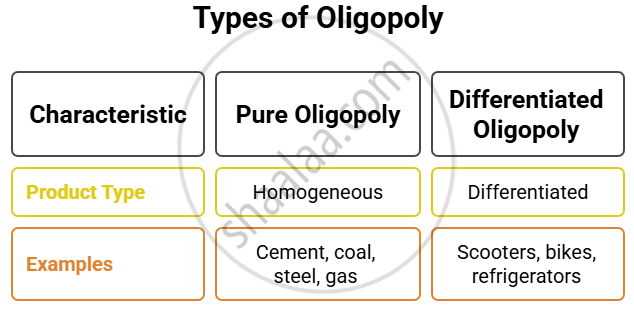
Classification
| Basis | Type | Short explanation | Example |
|---|---|---|---|
| Product differentiation | Pure (Perfect) oligopoly | Firms produce identical/homogeneous products | Cement industry |
| Differentiated oligopoly | Firms produce close but not identical substitutes | Cars, soaps, soft drinks | |
| Entry of new firms | Open oligopoly | New firms are allowed to enter the industry | Some consumer goods markets |
| Closed oligopoly | Entry is restricted; a few firms control the market | Industries with licences | |
| Agreement among firms | Collusive oligopoly | Firms agree on price and output to reduce competition | Cartels, informal agreements |
| Non‑collusive oligopoly | No agreement; each firm acts independently | Aggressive brand rivalry | |
| Price leadership | Partial oligopoly | One dominant firm acts as price leader; others follow | Dominant firm–followers |
| Full oligopoly | No clear leader; all firms have similar influence | Few similar‑sized firms |
Indeterminacy of Price and Output under Oligopoly
- There is no single, general theory that explains price and output for all types of oligopoly.
- Because firms are few and interdependent, the demand curve of each firm is not clearly known.
- Hence, price and output under oligopoly are called “indeterminate” (not uniquely determined).
Reasons for Indeterminate Price and Output
1] Conflicting behaviour of firms
- Firms can either:
Cooperate (collude) to maximise joint profits, or
Compete fiercely to gain market share. - Many possible behaviour patterns make outcomes uncertain.
2] Indeterminate demand curve
- Each firm’s demand depends on rivals’ reactions, which are uncertain.
- If one firm changes price, others may match it, ignore it or over‑react.
- Because of this, a stable, definite demand curve cannot be drawn.
3] Profit maximisation is not the only motive
- Besides profit, firms may aim for:
(i) Sales maximisation,
(ii) Market share growth,
(iii) Risk minimisation,
(iv) Long‑term security and stability. - Multiple motives make prediction of price–output decisions difficult.
4] Different institutional arrangements
- Oligopolistic industries may have:
(i) Tacit or open collusion,
(ii) Gentlemen’s agreements,
(iii) Dominant firm (price leader) structures,
(iv) Various informal understandings. - Because arrangements differ across industries, there is no single rule for price and output.
5] Oligopolistic interdependence
- Every firm knows its decisions affect others and that others will respond.
- This mutual dependence complicates each firm’s decision‑making process.
6] Oligopolistic uncertainty and “outguessing”
- Managers must think about how rivals will react and how rivals think they will react.
- Firms try to “outguess” each other, which increases uncertainty.
7] Price rigidity and non‑price competition
- Prices are often rigid: once set, they remain unchanged for long periods.
- Reasons:
(i) If a firm raises price, it may lose customers.
(ii) If it cuts price, rivals may also cut, starting a price war. - Therefore, firms keep price stable and compete using quality, design, service and advertising.
- The kinked demand curve model is one attempt to explain this price rigidity.
8] Existence of non‑profit motives
- Real‑world firms may not always calculate exact marginal cost and marginal revenue.
- Non‑profit objectives (stability, survival, and risk reduction) also influence decisions.
- This makes it hard to get a clear, unique equilibrium price and output.
9] Conflicting attitudes of firms
- Sometimes firms see the benefit of cooperation and move towards joint profit maximisation.
- At other times, they focus on beating rivals and increasing their own profits.
- This constant tension between cooperation and conflict leads to indeterminacy.
Real-Life Application
- Telecom services in India: A few major companies like Jio, Airtel and Vi dominate the mobile services market.
- Automobile industry in India: Car markets are largely controlled by a small number of big firms such as Maruti Suzuki, Hyundai, Tata Motors and Mahindra.
- Soft drink market (global): The market is mainly dominated by Coca‑Cola and Pepsi, which is a duopoly (a special case of oligopoly).
CISCE: Class 12
Key Points: Oligopoly
- Oligopoly: A market with a few dominant firms, high interdependence, and barriers to entry.
- Firms compete both by price and by non‑price methods (advertising, quality, branding).
- Price rigidity and non‑price competition are typical features of oligopolistic markets.