हिंदी

Propensity to Save

Advertisements

Topics

Estimated time: 9 minutes
  • Saving function
  • Formula: Average propensity to save
  • Formula: Marginal propensity to save
  • Relationships between Consumption and Saving Functions
  • Deriving Saving Function Graphically
CISCE: Class 12

Saving function

A saving function shows the relationship between the level of saving and the level of income.
In Keynesian economics, saving is taken as a function of income, just like consumption.

Symbolically:
S = f(Y)

  • S = saving
  • Y = income

In a simple two-sector economy (only households and firms), the part of income that is not spent on consumption is saved.

Algebraically:

  • C = consumption expenditure

This means:

  • Every unit of income is either consumed or saved.
  • There is no third use of income in this simplified model.
CISCE: Class 12

Formula: Average propensity to save

\[\mathrm{APS}=\frac{S}{Y}\]

Where:

  • S = total saving
  • Y = total income
CISCE: Class 12

Formula: Marginal propensity to save

\[\mathrm{MPS}=\frac{\Delta S}{\Delta Y}\]

Where:

  • ΔS = change in saving
  • ΔY = change in income
CISCE: Class 12

Relationships between Consumption and Saving Functions

Average Propensities: APC + APS = 1
Why? From Y = C + S, divide by Y: CY+SY=1.
Example: APC = 0.9, then APS = 0.1 (or vice versa).

Marginal Propensities: MPC + MPS = 1
Why? Extra income ΔY = ΔC + ΔS, divide by ΔY: ΔCΔY+ΔSΔY=1.
Example: MPC = 0.8, then MPS = 0.2.

Quick Formulas: APC = 1 - APS; MPS = 1 - MPC.
Propensity Pair Equation Table 12.1 Example
APC + APS = 1 0.9 + 0.1 = 1
MPC + MPS = 1 0.8 + 0.2 = 1
Real-Life: ₹10,000 salary hike—spend ₹8,000 (MPC=0.8), save ₹2,000 (MPS=0.2).
CISCE: Class 12

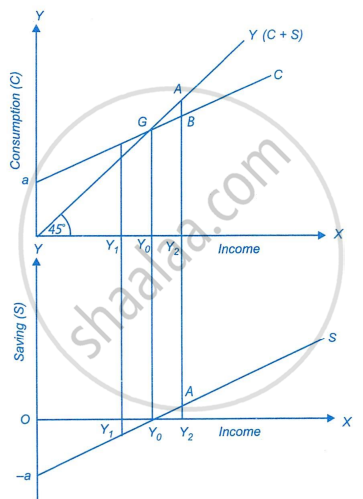
Deriving Saving Function Graphically


Saving curve (S) comes straight from consumption curve (C) using the 45° income line (Y = C + S).
Key Insight: Vertical gap between 45° line and C-curve = saving amount.

Step-by-Step:

  1. Plot C-curve (starts at 'a' >0, slopes <45°).
  2. Draw 45° line from origin (all income points).
  3. S = distance between them (negative left, zero at intersection, positive right).

Visual Description:

  • Upper panel: C below 45° line right of OY₀ (saving positive).
  • Lower panel: S-line mirrors gaps—dissaving (OY₁), zero (OY₀), saving (OY₂).
    Gap widens rightward as income rises.

Analogy: 45° line is your full paycheck envelope; C is what you spend—remainder (gap) is pocketed.

Test Yourself

Shaalaa.com | Determination of income and employment Part 2

Shaalaa.com


Next video


Shaalaa.com


Determination of income and employment Part 2 [00:21:29]
S
Advertisements
Share
Notifications

Englishहिंदीमराठी


      Forgot password?
Use app×