Topics
Introduction to Macro Economics
- Limitations of Macroeconomics
- Economy and Its Types
- Economic Systems
- Macroeconomics
- Circular Flow of Income
National Income
- Concept of National Income
- Income Method
- Significance or Importance of National Income
- National Income and Social Accounting
Theories of Employment and Income
- The Concept of Full Employment
- Types of Unemployment
- Classical Theory of Employment
- Keynes's View on Full Employment
- Comparison of Classicism and Keynesianism
Consumption and Investment Functions
- Introduction to Consumption and Investment Functions
- Consumption
- Investment
- Multiplier
- The Accelerator Principle
- Super Multiplier: (K and β Interaction)
Monetary Economics
- Monetary Economics
- Concept of Money
- Supply of Money
- Quantity Theories of Money
- Inflation
- Meaning of Deflation, Disinflation and Stagflation
- Trade Cycle
Banking
- Banking
- The Historical Development of Banks in India
- Commercial Banks
- Non-banking Financial Institution (NBFI)
- Central Bank
- The Agricultural Refinance Development Corporation (ARDC)
- Regional Rural Banks (RRBs)
- National Bank for Agriculture and Rural Development (NABARD)
- Reserve Bank of India and Industrial Finance
- Monetary Policy
- Recent Advancements in Banking Sector
- Capital Market
- Demonetisation
International Economics
- Introduction to International Economics
- Meaning of International Economics
- Subject Matter of International Economics
- Concept of Trade
- Theories of International Trade
- Gains from International Trade
- Terms of Trade
- Balance of Trade Vs Balance of Payments
- Exchange Rate
- Foreign Direct Investment (FDI) and Trade
International Economic Organisations
- Introduction to International Economic Organisations
- International Monetary Fund (IMF)
- World Bank
- World Trade Organisation (WTO)
- Trade Blocks
- South Asian Association for Regional Co-operation (SAARC)
- Association of South East Asian Nations (ASEAN)
- BRICS
Fiscal Economics
- Introduction to Fiscal Economics
- Introduction to Public Finance
- Subject Matter / Scope of Public Finance
- Difference Between Public Finance and Private Finance
- Functions of Modern State
- Public Expenditure
- Types of Taxes
- Structure (Types) of Public Debt
- Introduction to Budget
- Federal Finance
- History of Finance Commission
- Local Finance
Environmental Economics
- Introduction to Environmental Economics
- Meaning of Environment
- Linkage Between Economy and Environment
- Environmental Quality
- Pollution
- Climate Change
- e-wastes
- Concept of Sustainable Development
- Green Initiatives
- Types of Farming in India > Organic Farming
- Tree Plantation
- Seed Ball
Economics of Development and Planning
- Meaning of Development and Underdevelopment
- Difference Between Economic Growth and Economic Development
- Measurement of Economic Development
- Determinants of Economic Development
- Economic and Non-economic Factors
- Causes of Poverty
- Types of Planning
- NITI Aayog (National Institution for Transforming India)
Introduction to Statistical Methods and Econometrics
- Etymology and Milestones of Statistics in Global Level
- Evolution of Statistics in India
- Definitions of Statistics
- Characteristics and Functions of Statistics
- Nature of Statistics
- Scope of Statistics for Economics
- Limitations of Statistics
- Types of Statistics
- Data
- Standard Deviation
- Correlation
- Regression
- Introduction to Econometrics
- Official Statistics
- Definition: Full Employment
- Definition: Natural Employment
- Keyne's View on Employment
- Effective Demand
- Keynesian View on Employment Determination
- Explanation of Flowchart
- Key Points: Keynes's View on Full Employment
Definition: Full Employment
- “Full employment is a situation in which everyone who want to work is working except for those who frictionally and structurally unemployed.”
— Prof. Spencer
Definition: Natural Employment
“The natural rate of unemployment is the rate of unemployment arising from normal labour market frictions that exist when the labour market is in equilibrium. Natural unemployment, refers to frictional unemployment and structural unemployment.” — Ruffin and Gregory
Keyne's View on Employment
J.M. Keynes was a famous 20th-century economist. He explained his theory of employment in his book The General Theory of Employment, Interest and Money. His main arguments were:
- There is no automatic full employment in the economy. Instead, underemployment (less-than-full employment) exists.
- This happens because of a lack of Aggregate Demand — people and businesses are not spending enough.
- Government intervention (State action) is needed to remove unemployment by raising the level of investment.
Think of it this way: Imagine a school canteen that can serve 500 students, but only 300 students show up to buy food. The canteen has the supply (capacity to serve 500), but the demand is only 300. The canteen will use fewer cooks and less food — that's underemployment caused by low demand.
Effective Demand
Effective demand is the core idea of Keynes' theory. It is the level of total demand in the economy where:
Aggregate Demand (AD) = Aggregate Supply (AS)
At this point, whatever goods and services producers are willing to supply are exactly matched by what consumers and businesses are willing to buy.
Why does it matter? Because the level of employment in the economy depends on effective demand. More effective demand → more production → more jobs. Less effective demand → less production → unemployment.
Keynesian View on Employment Determination
According to Keynes, in the short run, the total production and national income of the economy depend on the level of employment. Here is the chain of reasoning from the source material:
Step 1: National income depends on employment
Y = f(N)
National Income or Output (Y) is a function of the Level of Employment (N) — meaning, the more people who are employed, the more the economy produces.
Step 2: Employment depends on effective demand
N = f(ED)
The Level of Employment (N) is a function of Effective Demand (ED) — meaning, employment rises when effective demand rises, and falls when effective demand falls.
Step 3: Effective demand is where AD meets AS
ED → AD = AS
Effective Demand (ED) is the equilibrium point where Aggregate Demand (AD) equals Aggregate Supply (AS).
Explanation of Flowchart
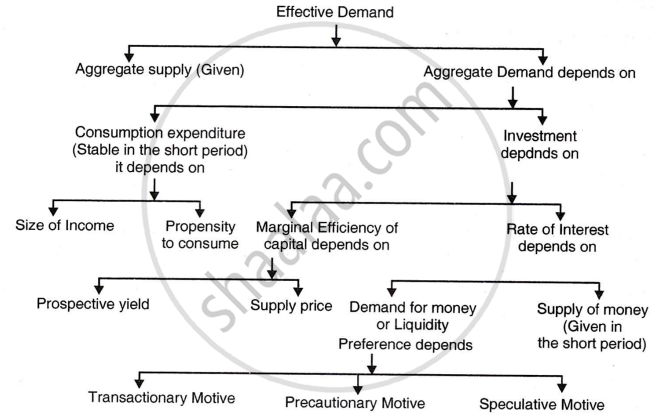
The source material includes a flow chart that shows what effective demand depends on. Here is a simplified breakdown of each branch:
Branch 1: Aggregate Supply (Left Side)
-
Aggregate Supply is given (fixed) in the short run — it doesn't change quickly because technology, machinery, and resources stay the same in the short period.
Branch 2: Aggregate Demand (Right Side)
Aggregate demand depends on two things:
A. Consumption Expenditure
This is how much households spend on goods and services. It is stable in the short period and depends on:
B. Investment Expenditure
This is how much businesses spend on new machines, factories, and equipment. It depends on:
i) Marginal Efficiency of Capital (MEC) — the expected rate of return from a new investment. MEC itself depends on:
If the expected earnings (prospective yeild) are high and the cost (supply price) is low, the MEC will be high → businesses will invest more.
ii) Rate of Interest — the cost of borrowing money. It depends on:
Demand for Money (Liquidity Preference) — how much people want to hold cash instead of investing it. Keynes identified three motives for holding money:
Supply of Money — the total money available in the economy, which is given (fixed) in the short period, as it is controlled by the central bank.
If the rate of interest is low, borrowing is cheap → businesses invest more → employment rises.
If the rate of interest is high, borrowing is expensive → businesses invest less → employment falls.
Key Points: Keynes's View on Full Employment
- Keynes argued that economies usually face underemployment, not full employment, due to deficiency of aggregate demand.
- Full employment does not mean zero unemployment; frictional and structural unemployment always exist (natural rate of unemployment).
- Employment is determined by effective demand, i.e., where aggregate demand equals aggregate supply (AD = AS).
- To achieve full employment, state intervention and increased investment are necessary.
