Topics
National Income and Related Aggregates
- Macroeconomics Vs Microeconomics
- Representative Goods and Sectors
- Macroeconomic Agents and Government Role
- Emergence of Macroeconomics
- Context of the Present Book of Macroeconomics
- Meaning of Economic Wealth and Final Goods
- Stocks, Flows, and Depreciation
- Capital Formation, Trade-off & Circular Flow of Income
- Circular Flow of Income and Methods of Calculating National Income
- Output Method/Product Method
- Expenditure Method
- Income Method
- Factor Cost, Basic Prices and Market Prices
- Some Macroeconomic Identities
- National Disposable Income
- Private Income
- National Income Aggregates
- Real GDP and Nominal GDP
- GDP and Welfare
Introductory Macroeconomics
Introduction
- A Simple Economy
- Central Problems of an Economy
- Concepts of Production Possibility Frontier
- Organisation of Economic Activities
- Positive and Normative Economics
- Macroeconomics Vs Microeconomics
Development Experience (1947-90) and Economic Reforms since 1991
- India's Economy Before Independence
- Low Level of Economic Development Under the Colonial Rule
- Agricultural Sector in India
- Industrial Sector
- Foreign Trade of India
- Demographic Condition
- Occupational Structure
- Infrastructure
- Post-Independence Economic Systems and Planning
- Five Year Plans (FYP)
- Agriculture
- Industry and Trade
- Trade Policy: Import Substitution
- The 1991 Economic Crisis and Reforms
- Background of the New Economic Policy
- Liberalisation
- Privatisation
- Globalisation
- World Trade Organisation (WTO)
- Impact of the Economic Reforms
Money and Banking
- Concept of Money
- Functions of Money
- Demand for Money and Supply of Money
- Money Creation by Banking System
- Limits to Credit Creation and Money Multiplier
- Policy Tools To Control Money Supply
- Demand and Supply for Money : A Detailed Discussion
- The Transaction Motive
- The Speculative Motive
- Various Measures of Supply of Money
- Narrow and Broad Money
- Demonetisation
Theory of Consumer Behaviour
- Consumer Behaviour: The Problem of Choice
- Basic Concepts of Microeconomics > Utility
- Cardinal Approach (Utility Analysis)
- Derivation of Demand Curve in the Case of a Single Commodity
- Ordinal Utility Analysis/Indifference Curve Analysis
Indian Economic Development
Current Challenges Facing Indian Economy
- Concept of Human Capital
- Sources of Human Capital
- Human Capital and Economic Growth
- Human Capital and Human Development
- State of Human Capital Formation in India
- Growth of Education Sector in India
- Challenges and Future Prospects in Education
- Rural Development in India
- Credit and Marketing in Rural Areas
- Agricultural Market System
- Diversification into Productive Activities
- Sustainable Development and Organic Farming
- The Nature and Importance of Work in Society
- Workers and Employment
- Participation of People in Employment
- Self-employed and Hired Workers
- Employment in Firms, Factories and Offices
- Growth and Changing Structure of Employment
- Informalisation of Indian Workforce
- Concept of Unemployment
- Government and Employment Generation
- Environment and Sustainable Development in India
- State of India’s Environment
- Concept of Sustainable Development
- Strategies for Sustainable Development
Development Experience of India – a Comparison with Neighbours
Determination of Income and Employment
- Aggregate Demand and Its Components
- Consumption
- Investment
- Determination of Income in Two-sector Model
- Determination of Equilibrium Income in the Short Run
- Macroeconomic Equilibrium with Price Level Fixed
- Effect of an Autonomous Change in Aggregate Demand on Income and Output
- The Multiplier Mechanism
- Paradox of Thrift
- Equilibrium Output and Employment
Introductory Microeconomics
Production and Costs
- Production Function
- Concept of Production
- Some Basic Concepts - Total, Average and Marginal Physical Products
- Relation Between Total, Average and Marginal Product
- Law of Variable Proportions
- Average and Marginal Physical Products
- Changes in Production
- Fixed Cost and Variable Cost
- Behaviour of Cost in the Short - Run
- Relationship Between Average Variable Cost and Average Total Cost and Marginal Cost
- Opportunity Cost
- Revenue Concepts
- Producer's Equilibrium
- Law of Supply
- Supply Schedule
- Distinction Between Supply and Stock
- Determinants of Supply
- Movement Along the Supply Curve Or Expansion and Contraction of Supply
- Measurement of Elasticity of Supply > Percentage Method
- Methods of Measurement of National Income
- Marginal Cost (MC)
- The Law of Diminishing Marginal Product
- Shapes of Product Curves
- Costs in Long Run Period
- Returns to Scale
Government Budget and the Economy
The Theory of the Firm Under Perfect Competition
- Concept of Market
- Market Equilibrium
- Determination of Market Equilibrium
- Effects of Changes (Shifts) in Demand on Equilibrium Price and Equilibrium Quantity
- Perfect Competition
- Imperfect Competition
- Factors Determining Market Forms
- Oligopoly
- Market Forms - Perfect Oligopoly
- Market Forms - Imperfect Oligopoly
- Equilibrium Price
- Applications of Tools of Demand and Supply Price Control
- Price Ceiling
- Price Floor
- Revenue Concepts
- Profit Maximisation Objective
- Determinants of a Firm’s Supply Curve
- Supply Schedule
- Price Elasticity of Supply
Balance of Payments
- Open Economy and Its Linkages
- Concept of Balance of Payments
- Current Account
- Capital Account
- Balance of Payments Surplus and Deficit
- Foreign Exchange Market
- Foreign Exchange Rate
- Determination of the Exchange Rate
- Merits and Demerits of Flexible and Fixed Exchange Rate Systems
- Managed Floating Exchange Rate System
Market Equilibrium
- Simple Monopoly in the Commodity Market
- Other Non - Perfectly Competitive Markets
CISCE: Class 12
Introduction to Investment
In macroeconomics, investment has a specific, narrower meaning. It refers to the addition to the stock of physical capital (machines, buildings, roads, factories) and changes in the inventory (stock of finished goods) of a producer. This is called real investment or economic investment. Investment goods like machines are part of final goods — they are not "used up" in one production cycle but yield services over many years.
Definitions: Investment
- "Investment refers to the increment of capital equipment." — J.M. Keynes
- "By investment we do not mean the purchase of existing paper securities, bonds, debentures or equities, but the purchase of new factories, machines and the like". — Stonier and Hague
- "Investment expenditure includes expenditure for producer’s durable equipment, new construction and the change in inventories." — Peterson
CISCE: Class 12
Formula: Investment Function
The relationship between investment and the rate of interest can be written as:
I = f(r)
Here:
- I = Investment, the planned amount of investment; it is the dependent variable.
- r = Rate of interest; it is the independent variable that influences investment.
This notation means that the level of investment depends on the rate of interest.
Formula: Propensity to Invest
PI = `I / Y`
PI = Propensity to invest, I = Aggregate Investment, Y = Aggregate Income
CISCE: Class 12
Autonomous Investment
Autonomous investment is expenditure on capital formation that does not depend on the level of income or profit in the economy. Its key features:
- Income-inelastic — remains the same whether the economy is booming or in recession
- Primarily undertaken by the government for welfare and infrastructure
- Driven by factors like new technology, population growth, or long-term policy goals — not by profit motive
- Graphically represented as a horizontal straight line parallel to the X-axis
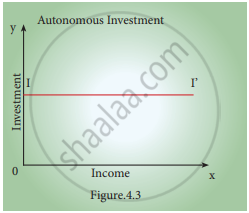
Real-life example: The Indian government's investment in building the Delhi-Mumbai Expressway continues regardless of whether GDP growth is 4% or 8%. Similarly, construction of government schools, rural roads under PMGSY, and public hospitals are autonomous investments — they happen for welfare, not profit.
Tamil Nadu Board of Secondary Education: Class 12
Induced Investment
Induced investment is expenditure on fixed assets and stocks that changes with the level of income and demand in the economy. Its key features:
- Income-elastic — as national income rises, induced investment rises; as income falls, it falls
- Undertaken by private firms to earn profits
- Driven by profit expectations and rising consumer demand
- Graphically represented as an upward-sloping line from left to right
- Falls sharply during economic depression because profit expectations are low
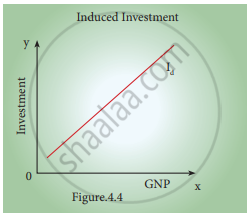
Real-life example: When Indians' incomes rose post-COVID, demand for smartphones surged. Seeing this, companies like Foxconn and Samsung invested billions in new manufacturing plants in India. If demand falls, they would delay expansion. This is induced investment — it responds to income changes.
Gross Investment vs. Net Investment
1) Gross Investment (Ig): Total expenditure on new capital goods plus replacement of worn-out capital in a given period.
2) Net Investment (In): The portion of gross investment that actually adds to the capital stock (after subtracting depreciation).
3) Replacement Investment (Ir): Expenditure on replacing depreciated or worn-out capital goods. Also called depreciation.
Key Formulas
Ig=In+Ir
In=Ig−Ir
Numerical Example
Important Rules:
- When Ig > Ir → Net investment is positive → Capital accumulation (economy is growing)
- When Ig = Ir → Net investment is zero → Economy is merely maintaining existing capital
- When Ig < Ir → Net investment is negative → Economy's capital stock is shrinking (decay)
Planned (Ex-ante) Investment
Ex-ante means "before the event." Ex-ante investment is the amount of investment that firms plan or intend to make during a given period. It is based on:
- Expected future demand and profit opportunities
- Desire to reduce production costs by adopting new technology
- Government targets for employment or economic growth
Example: At the start of the financial year, Tata Steel plans to invest ₹500 crore in a new blast furnace. This is an ex-ante investment.
Unplanned (Ex-post) Investment
Ex-post means "after the event." Ex-post investment is the actual investment that takes place, including unintended changes in inventory.
Example: A shoe manufacturer produces 10,000 pairs, expecting to sell all of them. Due to a sudden drop in demand, only 7,000 sell. The 3,000 unsold pairs are unplanned inventory investment — the firm didn't want this stock, but it counts as investment.
Propensity to Invest
Average Propensity to Invest (API)
The ratio between total investment and total income:
\[API=\frac{I}{Y}\]
Marginal Propensity to Invest (MPI)
The ratio of change in investment to change in income:
\[MPI=\frac{\Delta I}{\Delta Y}\]
Example: If national income rises from ₹1,000 Cr to ₹1,200 Cr and investment rises from ₹200 Cr to ₹230 Cr, then MPI = 30/200 = 0.15. This means for every additional ₹1 of income, ₹0.15 goes into investment.
CISCE: Class 12
Tamil Nadu Board of Secondary Education: Class 12
Key Points: Investment
- Economic investment = addition to physical capital + change in inventories — NOT buying shares/bonds
- Autonomous investment is income-inelastic, welfare-driven, mostly by government; drawn as a horizontal line
- Induced investment is income-elastic, profit-driven, mostly private; drawn as an upward-sloping line
- Gross Investment = Net Investment + Depreciation; net investment positive means capital accumulation
- Ex-ante = planned; Ex-post = actual; equilibrium requires ex-ante S = ex-ante I
- Investment function I = f(r) is downward-sloping — higher interest means less investment
- Invest when MEI > Rate of Interest; stop when MEI = Rate of Interest
