Topics
Roman Numerals
Number Work
Addition and Subtraction
Multiplication and Division
Fractions
- Types of Fractions
- Concept of Equivalent Fractions
- Like and Unlike Fraction
- Concept of Mixed Fractions
- Concept of Proper and Improper Fractions
- Conversion between Improper and Mixed fraction
- Conversion between Unlike and Like Fractions
- Comparing Fractions
- Addition of Fraction
- Subtraction of Fraction
- Multiplication of Fraction
- Using Operator 'Of' with Multiplication and Division
Angles
Circles
Multiples and Factors
Decimal Fractions
Measuring Time
Problems on Measurement
Perimeter and Area
Three Dimensional Objects and Nets
Pictographs
Patterns
Preparation for Algebra
Maharashtra State Board: Class 5
Using Letters
Mathematical symbols simplify expressions and make writing concise. For example, instead of writing "Division of 75 by 15 gives us 5," we use the symbolised form:
75 ÷ 15 = 5
Similarly, letters (variables) can be used to generalise mathematical properties.
1. Commutative Property of Addition
The sum of two numbers remains the same regardless of their order:
(a + b) = (b + a) for all values of a and b
Example: 9 + 4 = 4 + 9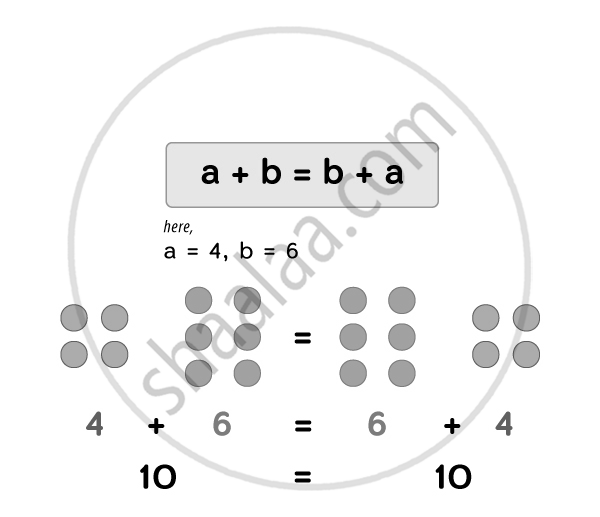
2. Multiplicative Identity
Any number multiplied by 1 remains unchanged:
a × 1 = a
1 × a = a
Example: 7 × 1 = 7
1 × 7 = 7
3. Non-Commutativity of Division
The order of division affects the result:
(a ÷ b) ≠ (b ÷ a) for a ≠ b
Example: 8 ÷ 4 = 2, but 4 ÷ 8 = 0.5
