Topics
Reproduction in Lower and Higher Plants
- Reproduction
- Asexual Reproduction
- Asexual Reproduction in Unicellular Organisms > Binary Fission
- Binary Fission > Simple Binary Fission
- Binary Fission > Transverse Binary Fission
- Binary Fission > Longitudinal Binary Fission
- Asexual Reproduction in Unicellular Organisms > Multiple Fission
- Asexual Reproduction in Unicellular Organisms > Budding
- Asexual Reproduction in Multicellular Organisms > Budding
- Asexual Reproduction in Multicellular Organisms > Gemmule Formation
- Asexual Reproduction in Multicellular Organisms > Regeneration
- Asexual Reproduction in Multicellular Organisms > Fragmentation
- Asexual Reproduction in Multicellular Organisms > Spore Formation
- Vegetative Reproduction or Vegetative Propagation
- Natural Vegetative Propagation
- Artificial Vegetative Propagation
- Sexual Reproduction
- Flower - a Fascinating Organ of Angiosperms
- Structure and Development of Anther
- Microsporogenesis
- Structure and Development of Male Gametophyte
- Structure and Development of Ovule
- Types of Ovules (Based on Orientation)
- Types of Ovules (Based on Integuments)
- Megasporogenesis
- Development of Female Gametophyte or Embryo Sac
- Pollination
- Self-pollination
- Autogamy
- Cross-pollination
- Geitonogamy
- Agents and Types of Cross-pollination
- Anemophily
- Hydrophily
- Entomophily
- Ornithophily
- Cheiropteriphily
- Malacophily
- Outbreeding Devices
- Fertilization
- Pollen Pistil Interaction
- Artificial Hybridization or Artificial Fertilization
- Double Fertilization and Triple Fusion
- Endosperm
- Embryo
- Seed and Fruit Development
- Apomixis
- Parthenocarpy
- Polyembryony
- Overview of Reproduction in Lower and Higher Plants
Reproduction in Lower and Higher Animals
- Reproduction
- Sexual Reproduction
- The Male Reproductive System
- Menstrual Cycle (Ovarian Cycle)
- Gametogenesis
- Fertilization in Human
- Embryonic Development in Human
- Implantation in Human
- Pregnancy in Humans
- Placenta (Growth) in Human
- Parturition (Birth) in Human
- Lactation in Human
- Sexually Transmitted Diseases (STD) or Sexually Transmitted Infections (STI)
- Infertility
- Population Stabilisation and Birth Control
- Gastrulation in humans
- Human Reproduction
- Induced Abortion or Medical Termination of Pregnancy (MTP)
- Overview of Reproduction in Lower and Higher Animals
Inheritance and Variation
- Heredity
- Genes and Genetic
- Back Cross and Test Cross
- Deviations from Mendel’s Findings
- Chromosomal Theory of Inheritance
- Chromosomes - The Carriers of Heredity
- Linkage and Crossing Over
- Autosomal Inheritance
- Sex Determination
- Sex Linked Inheritance
- Human Genetic Disorders
- Exceptions to Mendel's Principles > Multiple alleles
- Linkage
- Types of Linkage > Complete Linkage
- Types of Linkage > Incomplete Linkage
- Crossing Over
- Colour blindness
- Haemophilia
- Sex Determination in Birds
- Down's syndrome (Mongolian Idiocy)
- Turner's Syndrome
- Klinefelter's Syndrome
- Overview of Inheritance and Variation
Molecular Basis of Inheritance
- Deoxyribonucleic Acid (DNA)
- Griffith’s Experiment
- Packaging of DNA Helix
- DNA Replication
- Protein Synthesis
- Regulation of Gene Expression
- The Lac Operon
- Genomics
- Human Genome Project
- DNA Fingerprinting
- Genetic Code
- Mechanism of Translation
- Overview of Molecular Basis of Inheritance
Origin and Evolution of Life
- Origin and Evolution of Universe and Earth
- Theories of Origin of Life
- Chemical Evolution of Life (Self-assembly Theory of the Origin of Life)
- Darwin’s Theory of Natural Selection (Darwinism)
- Mutation Theory
- Modern Synthetic Theory of Evolution
- Organic Evolution
- Hardy Weinberg’s Principle
- Adaptive Radiation
- Evidence of Evolution > Morphological Evidences
- Speciation
- Geological Time Scale
- Theories of Biological Evolution
- Overview of Origin and Evolution of Life
Plant Water Relation
- Plant Water Relation
- Properties of Water
- Water Available to Roots for Absorption
- Imbibition
- Diffusion
- Osmosis
- Osmotic Pressure
- Turgidity and Flaccidity (Plasmolysis)
- Passive Transport
- Water Potential (ψ)
- Concept of Transpiration
- Path of Water Across the Root
- Kinds of Transpiration
- Forces Contributing to Ascent of Sap
- Transport of Mineral Ions
- Structure of Stomatal Apparatus
- Significance of Transpiration
- Transportation of Food and Other Substances
- Overview of Plant Water Relation
Plant Growth and Mineral Nutrition
- Plant Growth
- Phases of Plant Growth
- Conditions Necessary for Plant Growth
- Plant Growth Rate
- Plant Growth Curve
- Differentiation, De-differentiation, Re- Differentiation
- Plant Development
- Plant Plasticity
- Plant Hormones
- Auxins
- Gibberellins
- Cytokinins
- Ethylene
- Abscisic Acid (ABA)
- Photoperiodism
- Vernalization (Yarovization)
- Plant Mineral Nutrition
- Nitrogen Cycle
- Overview of Plant Growth and Mineral Nutrition
Respiration and Circulation
- Cellular Respiration
- Organs of Respiratory Exchange
- Human Respiratory System
- Mechanism of respiration-Breathing
- Regulation of Breathing / Respiration
- Modified Respiratory Movements
- Disorders of Respiratory System
- Transportation in Living Organisms
- Circulation in Animals
- Types of Closed Circulation
- Blood Circulatory System
- Composition of Blood > Plasma (The Liquid Portion of Blood)
- Composition of Blood > Cellular Elements: Red Blood Cells (Erythrocytes)
- Composition of Blood > Cellular Elements: White Blood Cells (Leukocytes)
- Composition of Blood > Cellular Elements: Blood Platelets (Thrombocytes)
- Human Heart
- Working mechanism of human heart
- Blood Vessels
- Blood Pressure (B.P.)
- Electrocardiogram (ECG)
- Lymph and Lymphatic System
- Mechanism of respiration - Internal respiration
- Mechanism of respiration - External respiration
- Cellular Respiration
- Overview of Respiration and Circulation
Control and Co-ordination
- Control and Co-ordination
- Nervous System in Hydra
- Nervous System in Planaria (Flatworm)
- Neural Tissue
- Neuron (Or Nerve Cell)
- Neuroglial Cells (Or Glial Cells)
- Human Nervous System
- Central Nervous System (CNS)
- The Human Brain
- The Spinal Cord
- Peripheral Nervous System > Somatic Nervous System
- Sensory Receptors
- The Human Eye
- Human Ear
- Disorders of Nervous System
- Chemical Coordination
- Human Endocrine System
- The Hypothalamus
- Pituitary Gland or Hypophysis Gland
- The Pineal Gland
- Thyroid Gland
- Parathyroid Gland
- Thymus Gland
- Adrenal Gland (Suprarenal Gland)
- Pancreas (Islets of Langerhans)
- Reproductive Glands (Gonads)
- Synapse
- Types of Synapse
- Transmission of Nerve Impulse
- Generation of nerve impulse
- Reflex Action
- Peripheral Nervous System > Autonomic Nervous System
- Diffuse Endocrine Glands
- Overview of Control and Co-ordination
Human Health and Diseases
- Defence System in Our Body: Immune System
- Structure of Antibody
- Disease
- Protozoan Diseases
- Helminthic Diseases
- Bacterial Diseases
- Viral Diseases
- Fungal Diseases
- Vector Borne Diseases
- Cancer
- Drug Abuse
- Concept of Adolescence
- Addiction
- Vaccines and Vaccination
- Blood Transfusion and Blood Groups (ABO and Rh system)
Human Reproduction
Enhancement of Food Production
- Improvement in Food Production
- Plant Breeding
- Tissue Culture
- Single Cell Protein (SCP)
- Biofortification
- Animal Husbandry (Livestock)
- Animal Husbandry (Livestock) > Animal Breeding
- Dairy (Livestock) Farm Management
- Poultry Farm Management
- Animal Husbandry (Livestock) > Apiculture (Bee Farming)
- Animal Husbandry (Livestock) > Pisciculture (Fish Farming)
- Sericulture
- Lac Culture
- Microbes in Human Welfare
- Microbes in Industrial Products
- Microbes in Sewage Treatment
- Microbes in Energy Generation
- Microbes as Biocontrol Agents
- Microbes as Biofertilizers
- Microbial Role in Dairy Products
- Overview of Enhancement of Food Production
Biotechnology
- Biotechnology
- Principles of Biotechnology
- Methodology for rDNA Technology
- Crop Biotechnology > Hybrid Seeds
- Bioethics
- Effects of Biotechnology on the Environment
- Biopiracy
- Transgenic Plants
- Effects of Biotechnology on Human Health
- Tools and techniques for gene cloning/ rDNA technology
- Crop Biotechnology > Genetically Modified Organisms (GMOs)
- Overview of Biotechnology
Organisms and Populations
- Organisms and the Environment Around
- Habitat
- Niche
- Adaptations and Its Types
- Population
- Population Interactions
- Organisms and Populations
- Population Growth
- Positive Interactions > Mutualism (Symbiosis)
- Negative Interactions > Competition
- Negative Interactions > Parasitism
- Negative Interactions > Predation
- Positive Interactions > Commensalism
- Overview of Organisms and Populations
Ecosystems and Energy Flow
Biodiversity, Conservation and Environmental Issues
- Biodiversity
- Levels of Biodiversity
- Patterns of Biodiversity
- Biodiversity Current Scenario
- Loss of Biodiversity
- Conservation of Wildlife
- Biological Diversity Act, 2002
- Environmental Issues
- Noise Pollution
- Green House Effect
- Preventive Measures of Green House Effect
- Deforestation and Its Causes
- Global Warming
- Preventive Measures of Global Warming
- Mission Harit Maharashtra
- Conservation of Biodiversity
- Overview of Biodiversity, Conservation and Environmental Issues
- Key Points: The Human Eye
Image Formation and Light Control
Image Formation in the Human Eye: The process of vision involves light refraction, focusing, and signal transmission to the brain.
Steps of Image Formation
- Light enters through the cornea and is refracted (bent).
- It passes through the aqueous humour, pupil, and crystalline lens, which adjusts focus.
- The vitreous humour further directs the light toward the retina.
- Retina's rod and cone cells detect light intensity and colour.
- Optic nerve transmits electrical signals to the brain.
- The brain processes the image, correcting its inversion to provide a clear visual experience.
- This process is similar to a convex lens, where light converges to form an inverted image on the retina.

Role of the Iris and Pupil in Light Control:
- The iris adjusts the pupil size based on the intensity of light.
- Bright light: The pupil contracts to allow less light into the eye.
- Dim light: The pupil expands to allow more light to enter.
- This mechanism protects the retina from excessive light and ensures clear vision in different lighting conditions.
Accommodation of the Eye:
The ciliary muscles adjust the lens curvature to change its focal length, helping to focus on objects at different distances.
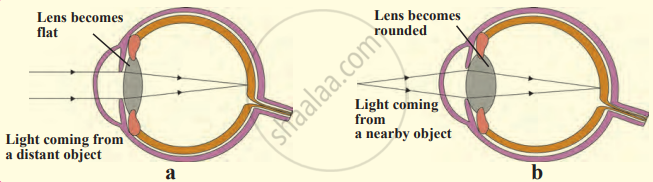
The change in the shape of the lens while seeing distant and nearby objects
Focusing on Distant and Near Objects
1. For distant objects:
Ciliary muscles relax → Lens becomes thin → Focal length increases → Objects appear clear.
2. For nearby objects:
Ciliary muscles contract → Lens becomes thicker → Focal length decreases → Objects appear clear.
This adjustment in focal length is known as accommodation.
Vision Range and Optical Properties
Vision Range and Limits: Near Point and Far Point
- Near Point (Least Distance of Distinct Vision): The minimum distance at which an object is seen clearly without strain. For a normal eye: 25 cm.
- Far Point: The maximum distance at which objects can be seen clearly. For a normal eye: Infinity.
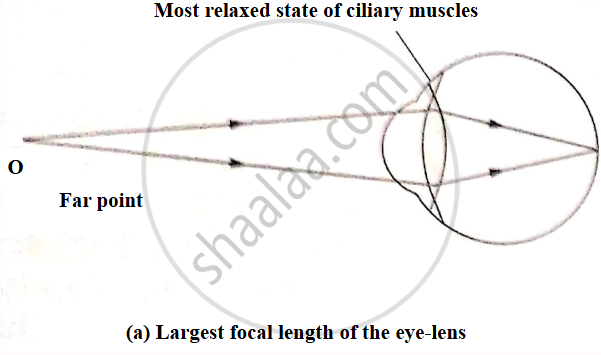
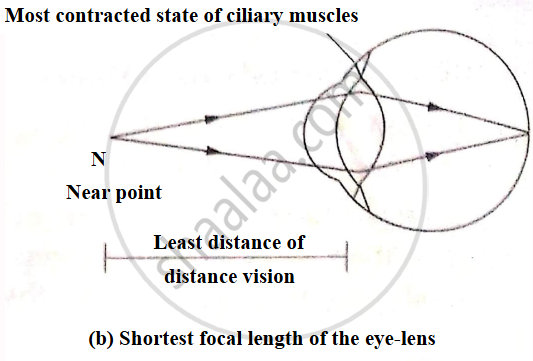
Effect of Age on Near Point:
- With age, the eye’s ability to accommodate decreases.
- For older individuals (~60 years), the near point increases to about 200 cm, requiring corrective lenses.
Refractive Index of Eye Components: Different parts of the eye have varying refractive indices, allowing light to bend and focus correctly on the retina.
| Eye Part | Refractive Index |
| Cornea | 1.376 |
| Aqueous Humour | 1.336 |
| Lens | 1.386 - 1.406 |
| Vitreous Humour | 1.336 |
These differences ensure proper refraction and image formation.
Persistence of Vision:
- The image on the retina does not disappear instantly after the object is removed.
- The image remains for about 1/16th of a second after the object is no longer in sight. This continuation of visual sensation is called persistence of vision.
Application in Motion Pictures: Movies and animations use 24 frames per second to create a smooth visual effect. This ensures that images blend smoothly without flickering, giving the illusion of continuous motion.
Maharashtra State Board: Class 10
CISCE: Class 10
Key Points: Human Eye
- The human eye works like a camera, forming a real and inverted image on the retina, which is light-sensitive.
- The cornea allows light to enter the eye and performs most of the refraction, while the lens fine‑tunes the focus.
- The iris controls the pupil, regulating the amount of light entering the eye—contracting in bright light and widening in dim light.
- The power of accommodation is the ability of the eye lens to change its focal length by altering its curvature using the ciliary muscles.
- For a normal eye, the near point is 25 cm and the far point is at infinity.
