Topics
Chemical Substances-Nature and Behaviour
Chemical Reactions and Equations
- Chemical Reaction
- Characteristics of Chemical Reactions
- Chemical Equations
- Balanced and Unbalanced Chemical Equations
- Balancing Chemical Equation
- Types of Chemical Reactions > Combination Reaction
- Types of Chemical Reactions > Decomposition Reaction
- Types of Chemical Reactions > Single Displacement Reaction
- Types of Chemical Reactions > Double Displacement Reaction
- Types of Chemical Reactions > Reversible and Irreversible Reactions
- Types of Chemical Reactions > Oxidation and Reduction Reactions
- Corrosion of Metals
- Rancidity
World of Living
Acids, Bases and Salts
- Introduction to Acids, Bases and Indicators
- Indicators for Testing Acids and Bases
- Acids
- Properties of Acids
- Common Properties of Acids
- Uses of Acids
- Bases
- Properties of Bases
- Uses of Bases
- Chemical Properties of Acids and Bases
- Common Properties of Acids and Bases
- Strength of Acid and Base Solutions : pH Scale
- Universal Indicator
- Importance of pH in Everyday Life
- Salts
- Salts > Family of Salts
- Salts > pH of Salts
- Common Salt
- Sodium hydroxide
- Washing Soda
- Baking Soda
- Bleaching Powder
- Plaster of Paris
- Water of Crystallisation: Hydrated Salts
Natural Phenomena
Metals and Non-metals
Carbon and its Compounds
Effects of Current
Natural Resources
Life Processes
- Characteristics of Living Things
- Life Processes in Living Organisms
- Nutrition
- Autotrophic Nutrition
- Heterotrophic Nutrition
- Nutrition in Plants
- Experiments on Photosynthesis
- Raw Materials for Photosynthesis
- Site of Photosynthesis
- Nutrition in Animals
- Nutrition in Amoeba
- Nutrition in Human Beings
- Respiration
- Aerobic Respiration
- Anaerobic Respiration
- Respiration in Plant
- Respiration in Animals
- Human Respiratory System
- Transportation in Living Organisms
- Transportation in Plants
- Transportation in Human Beings
- Blood
- Human Circulatory System
- Blood Pressure (B.P.)
- Lymph and Lymphatic System
- Excretion
- Excretion in Plants
- Excretion in Animals
- Excretion in Human Beings
- Renal Failure (Kidney Failure)
- Organ and Body Donation
Control and Coordination
- Response to Stimuli
- Coordination in Plants
- Plant Hormones
- Plant Movements
- Tropic Movements in Plants
- Phototropism
- Geotropism
- Chemotropism
- Hydrotropism
- Thigmotropism
- Nastic Movements
- Thigmonasty
- Photonasty
- Coordination in Animals
- Human Nervous System
- Peripheral Nervous System (PNS)
- Central Nervous System (CNS)
- Autonomic Nervous System (ANS)
- Voluntary Nervous System
- The Human Brain
- The Spinal Cord
- Biomolecules in the Cell > Hormones
- Endocrine Glands
- Human Endocrine System
How do Organisms Reproduce?
- DNA Copying and Variation
- The Importance of Variation
- Reproduction
- Modes of Reproduction
- Asexual Reproduction
- Asexual Reproduction in Unicellular Organisms > Binary Fission
- Binary Fission > Simple Binary Fission
- Binary Fission > Longitudinal Binary Fission
- Binary Fission > Transverse Binary Fission
- Asexual Reproduction in Unicellular Organisms > Multiple Fission
- Asexual Reproduction in Multicellular Organisms > Fragmentation
- Asexual Reproduction in Multicellular Organisms > Regeneration
- Asexual Reproduction in Unicellular Organisms > Budding
- Asexual Reproduction in Multicellular Organisms > Budding
- Asexual Reproduction in Multicellular Organisms > Spore Formation
- Vegetative Reproduction or Vegetative Propagation
- Natural Vegetative Propagation
- Artificial Vegetative Propagation
- Tissue Culture
- Sexual Reproduction
- Sexual Reproduction in Plants
- Pollination
- Self-pollination
- Cross-pollination
- Fertilisation in Flowering Plants
- Formation of Seed and Fruit
- Seed Germination
- Sexual Reproduction in Animals
- Puberty
- The Male Reproductive System
- The Female Reproductive System
- Fertilization in Humans
- Menstrual Cycle (Ovarian Cycle)
- Major Events of Menstrual Cycle
- Menarche and Menopause
- Birth Control
- Natural Contraceptive Methods
- Artificial Contraceptive Methods
- Induced Abortion or Medical Termination of Pregnancy (MTP)
- Sexually Transmitted Diseases (STD) or Sexually Transmitted Infections (STI)
- Concept of Reproductive Health
Heredity
- Heredity
- Variation
- Accumulation of Variation During Reproduction
- Gregor Johann Mendel – Father of Genetics
- Monohybrid Cross
- Dihybrid Cross
- Characteristics (or Traits) Transmitted to Progeny
- Inheritance of Blood Groups
- Sex Determination in Humans
- Acquired and Inherited Traits
Light – Reflection and Refraction
- Nature of Light
- Reflection of Light
- Reflection of Light from Plane Surfaces: Plane Mirror
- Law of Reflection of Light
- Regular Reflection and Diffuse Reflection of Light
- Objects and Images
- Images Formed by a Plane Mirrors
- The Position of Image Formed in a Plane Mirror
- Uses of Plane Mirrors
- Spherical Mirrors
- Image Formation by Spherical Mirrors
- Rules for Obtaining Images Formed by Concave Mirrors
- Formation of Different Types of Images by a Concave Mirror
- Representation of Images Formed by Spherical Mirrors Using Ray Diagrams
- Sign Convention for Reflection by Spherical Mirrors
- Mirror Formula and Magnification
- Rules for Obtaining Images Formed by Convex Mirrors
- Formation of Image by a Convex Mirror
- Refraction of Light
- Effects of Refraction of Light
- Laws of Refraction of Light
- Refraction through a Rectangular Glass Slab
- The Refractive Index
- Refraction by Spherical Lenses
- Rules for Obtaining Images Formed by Convex Lenses
- Formation of Different Types of Images by a Convex Lens
- Image Formation by Lenses
- Image Formation in Lenses Using Ray Diagrams
- Sign Convention for Reflection by Spherical Mirrors
- Lens Formula and Magnification
- Lens Formula and Magnification Formulae for a Concave Lens
- Power of a Lens
The Human Eye and the Colourful World
- Human Eye
- Working of the Eye
- Rods and Cones
- Power of Accommodation
- Range of Vision of a Normal Human Eye
- Advantages of Having Two Eyes for Vision
- Defects of Vision and Their Corrections > Myopia
- Defects of Vision and Their Corrections > Hypermetropia
- Defects of Vision and Their Corrections > Presbyopia
- Glass Prism
- Refraction of Light through a Prism
- Dispersion of Light Through a Prism
- The Rainbow
- Atmospheric Refraction
- Scattering of Light
Electricity
- Electric Charges
- Conductors and Insulators
- Electric Potential and Potential Difference
- Electric Current
- Electric Circuit
- Circuit Diagram
- Ohm's Law
- Resistance of a Conductor
- Graph Between V and I
- Experiment to Verify Ohm's Law
- Good Conductors, Resistors and Insulators
- Factors Affecting the Resistance of a Conductor
- Resistivity
- Resistance of a System of Resistors
- Resistors in Series
- Resistors in Parallel
- Domestic Electric Circuits
- Heating Effect of Electric Current
- Practical Applications of Heating Effect of Electric Current
- Electric Power
- Commercial Unit of Electrical Energy
- Effects Produced by Electric Current
- Applications of the Heating Effect of Current
Magnetic Effects of Electric Current
- Introduction to Magnets and Their Properties
- Electromagnetism
- Magnetic Field and Field Lines
- Magnetic Field of Earth
- Magnetic Effect of Current (or Electromagnetism)
- Magnetic Field Due to a Current-Carrying Conductor
- Magnetic Field due to a Current through a Straight Conductor
- Right-hand Thumb Rule
- Magnetic Field due to a Current through a Circular Loop
- Magnetic Field due to a Current in a Solenoid
- Electromagnet
- Magnetism in Human Beings
- Force on a Current-Carrying Conductor in a Magnetic Field
- Domestic Electric Circuits
Our Environment
- Introduction
- Components of Nervous System
- Need of Nervous System
- Key Points: Human Nervous System
Introduction:
The nervous system connects the brain to all parts of the body through a network of nerves. Nerves carry messages between the brain and different parts of the body. The brain sends instructions to the body, and the body sends information back to the brain. The brain and the network of nerves are together called the nervous system. The nervous system helps us coordinate all our body functions, like moving, feeling, and reacting to things.
Components of Nervous System:
The nervous system in humans can be divided into three main parts
1. Central Nervous System: The central nervous system comprises the brain and the spinal cord. The brain controls all the functions in the human body. The spinal cord is the relay channel for signals between the brain and the peripheral nervous system.
2. Peripheral Nervous System: The peripheral nervous system comprises the cranial and spinal nerves. There are 12 pairs of cranial nerves, which come out of the brain and go to the organs in the head region. There are 31 pairs of spinal nerves, which come out of the spinal cord and go to the organs below the head region.
3. Autonomous Nervous System: The autonomous nervous system comprises a chain of nerve ganglions that run along the spinal cord. It controls all the involuntary actions in the human body. The autonomic nervous system can be divided into two parts :
- Sympathetic Nervous System: It is a part of the autonomic nervous system that prepares the body for action by increasing the activity of certain organs. For example, during exercise like running, it increases the heart rate and breathing rate to supply more oxygen to the body, helping meet the increased demand. It activates the "fight or flight" response during stressful or active situations.
- Parasympathetic Nervous System: It is a part of the autonomic nervous system that helps the body relax and conserve energy by slowing down organ activity. For example, during sleep, it reduces the heart rate and breathing rate, promoting rest and recovery. It is often called the "rest and digest" system, as it supports relaxation and energy conservation.
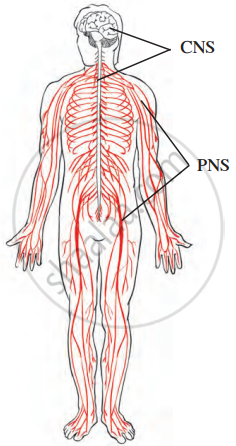
Human nervous system
Need of Nervous System:
- The nervous system's basic function is to send signals between cells or different parts of the body.
- Signals can be sent through hormones (chemical signals) or through neurons (specific point-to-point connections).
- Neurons send signals much faster and with greater precision compared to hormones, with some nerve signals travelling over 100 meters per second.
- The nervous system controls the body by gathering information from the environment through sensory receptors, processing it in the central nervous system, and sending signals to muscles or glands for appropriate responses.
- This system enables advanced abilities like vision, quick organ coordination, and integrated signal processing in animals.
- In humans, it supports complex functions like language, abstract thinking, social interactions, cultural development, and advanced perception, made possible by the highly evolved brain.
Maharashtra State Board: Class 12
Key Points: Human Nervous System
- Receptors present in sense organs detect changes in the environment and send signals to the brain through neurons.
- A neuron has three parts — dendrites (receive signals), cell body (processes signals), and axon (transmits signals) — which work together to carry electrical impulses.
- The electrical impulse always travels in one fixed direction: dendrite → cell body → axon → axon terminal, ensuring a controlled flow of information.
- At the synapse, special chemicals called neurotransmitters are released to pass the impulse from one neuron to the next, or to a muscle or gland.
- The neuromuscular junction is where a nerve meets a muscle fibre; when the impulse reaches this point, it causes the muscle to contract and produce a response.
Video Tutorials
Shaalaa.com | Control & Co-ordination part 11 (Nervous System: Introduction)
Series: series 1
00:09:31 undefined
00:12:35 undefined
00:09:34 undefined
00:05:07 undefined
00:09:51 undefined
00:06:30 undefined
