Topics
The Living World: Adaptations and Classification
- Adaptations of Plants
- Adaptation in Aquatic Plants (Hydrophytes)
- Adaptation in Desert Plants (Xerophytes)
- Adaptation in plants of snowy regions
- Adaptation in Forest Plants
- Adaptation in Grassland Plants (Mesophytes)
- Adaptation for Ingestion of Food in Plants
- Adaptation in Animals
- Adaptation in Aquatic Animals
- Adaptation in Forest and Grassland Animals
- Adaptation in Desert Animals
- Adaptation in animals of snowy regions
- Adaptation in Aerial Animals
- Adaptation in Reptiles
- Adaptation for Food in Animals
- Adaptation for Blending with the Surroundings
- Classification of Living Organisms
- Taxonomic Hierarchy of Living Organisms: Unit of Classification
- Nomenclature
Plants: Structure and Function
Properties of Natural Resources
Nutrition in Living Organisms
- Nutrients and Nutrition
- Autotrophic Plants
- Symbiotic Plants
- Heterotrophic Plants
- Insectivorous Plants
- Saprophytic Plants
- Role of nutrients and effects of their deficiency on plants
- Transport System in Plants
- Nitrogen Fixation
- Nutrition in Animals
- Mode of Nutrition in Animals
- Holozoic Nutrition
- Saprozoic Nutrition
- Parasitic Nutrition
Food Safety
Measurement of Physical Quantities
Motion, Force and Work
Static Electricity
Heat
Disaster Management
Cell Structure and Micro-organisms
- Cell: Structural and Functional Unit of Life
- Measurement and observation of cells
- Plant Cell Vs Animal Cell
- Endoplasmic Reticulum (ER)
- Golgi Apparatus - "The delivery system of the cell"
- Lysosome - “Suicidal Bag”
- Mitochondria - “Power House of the Cell”
- Non-living Substances Or Cell Inclusion
- Plastids
- Microorganisms (Microbes) and Microbiology
- Useful micro-organisms
- Harmful Microorganisms
- Microbial Pathogenesis and Portals of Entry
The Muscular System and Digestive System in Human Beings
- Muscular System
- Muscles and Its Types
- Human Digestive System
- The Mouth and Buccal Cavity
- The Teeth and Its Structure
- The Salivary Glands
- The Food Pipe/Oesophagus
- Pharynx/Throat
- The Stomach
- The Small Intestine
- Pancreas (Islets of Langerhans)
- Human Digestive System
- The Large Intestine
- Important Glands of the Digestive System
- Effects of Tobacco, Alcohol, Smoking, on the Digestive System
Changes – Physical and Chemical
- Changes-Physical and Chemical
- Classification of Change: Natural and Man-made Changes
- Classification of Change: Harmful and Useful Changes
- Classification of Change: Slow and Fast Changes
- Classification of Change: Reversible and Irreversible Changes
- Classification of Change: Periodic and Non-periodic Changes
- Classification of Change: Physical Changes
- Classification of Change: Chemical Changes
- Corrosion of Metals
Elements, Compounds and Mixtures
Materials We Use
Natural Resources
Effects of Light
Sound : Production of Sound
Properties of a Magnetic Field
In the World of Stars
Maharashtra State Board: Class 7
Cement:
Cement is an important material in construction, used to make sheets, blocks, pillars, and pipes. It is a greenish-grey powder with very fine particles. Made from silica (sand), alumina (aluminium oxide), lime (calcium oxide), iron oxide, and magnesia (magnesium oxide).
- Portland Cement: The most common type of cement is used for construction. It is named after Portland stone from England, which has a similar appearance.
- Made of 60% lime (calcium oxide), 25% silica (silicon dioxide), 5% alumina (aluminium oxide), iron oxide and gypsum (calcium sulphate), the mixture is complete.
- History of Cement: The Romans made cement by mixing volcanic ash with moistened lime to create a strong, durable material. This technique was lost after the fall of the Roman Empire.
- John Smeaton, a British engineer, discovered the process of making aqueous cement in 1756.
- Concrete: Cement, water, sand, and gravel are all combined to make concrete. To create strong and leak-proof slabs, other substances are sometimes added to the concrete mix. Concrete is essential for building strong structures like floors, walls, and bridges.
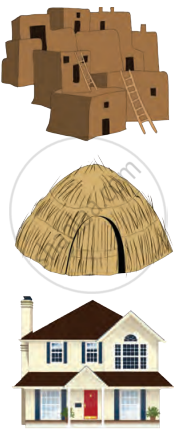
Houses
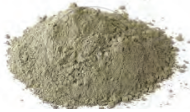
Cement
