Advertisements
Chapters
2: Locating Places on Earth
3: Movements of the Earth
4: Structure of the Earth
5: Rocks
6: Landforms of the Earth
7: Earthquakes
8: Volcanoes
9: Weathering and Denudation
10: Hydrosphere
11: Composition and Structure of Atmosphere
12: Insolation
▶ 13: Atmospheric Pressure and Winds
14: Humidity
15: Pollution-Types and Sources
16: Effects of Pollution
17: Pollution—Preventive Measures
18: Natural Regions of the World
*: Map Based Questions
![Rachna Sapra solutions for Geography [English] Class 9 ICSE chapter 13 - Atmospheric Pressure and Winds - Shaalaa.com](/images/geography-english-class-9-icse_6:e1464ff004d844649e81e9e1e11e08a5.jpg "Rachna Sapra solutions for Geography [English] Class 9 ICSE chapter 13 - Atmospheric Pressure and Winds")
Advertisements
Solutions for Chapter 13: Atmospheric Pressure and Winds
Below listed, you can find solutions for Chapter 13 of CISCE Rachna Sapra for Geography [English] Class 9 ICSE.
Rachna Sapra solutions for Geography [English] Class 9 ICSE 13 Atmospheric Pressure and Winds SOLVE AND SCORE [Pages 139 - 142]
Multiple Choice Questions (MCQs):
Statement (X): The air pressure decreases with increasing latitude.
Statement (Y): The air pressure has an inverse relationship with temperature if the two places are located at the same latitude.
Both statements X and Y both are true
Both statements X and Y both are false
Statement X is true, and statement Y is false
Statement X is false, and statement Y is true
The lines joining places having the same atmospheric pressure are called ______.
Isotherms
Isobars
Isohytes
Isohalines
The velocity of winds depends upon ______.
Pressure gradient
Friction
Coriolis force
All of these.
Coriolis force is an outcome of ______.
Rotation of the Earth
Revolution of the Earth
Temperature difference
None of these
Coriolis force is maximum at ______.
Poles
Equator
Tropics
Equal everywhere
Due to Coriolis effect, the winds deflect towards ______ in the northern hemisphere.
Right
Left
No deflection
Reverses
Which region of the world is called the Doldrums?
Equatorial region
Tropical region
Polar region
Coastal region
Which region of the world is called ‘Horse latitudes’?
Equatorial low pressure belt
Sub-tropical high pressure belt
Sub-polar low pressure belt
Polar-high pressure belt
Ferrel cell exists between ______.
0° − 30° N and S
30° − 60° N and S
60° − 90° N and S
None of these.
During summers in the northern hemisphere, the pressure belt shifts ______.
Northward
Southward
No movement
May move north or south
Which of the following wind types belongs to the primary wind circulation?
Loo
Monsoon
Cyclones
Westerlies
Roaring forties is the name given to ______ winds.
Trade
Westerlies
Polar Easterlies
Monsoons
Katabatic winds refer to the ______.
Land breeze
Sea breeze
Mountain breeze
Valley breeze
Monsoon winds are experienced only in the ______ region.
Equatorial
Tropical
Temperate
Polar
Mistral is a local wind which blows in ______.
France
USA
Switzerland
West Bengal
Statement (X): Rising air forms an area of high pressure.
Statement (Y): Sinking air forms an area of low pressure.
Both statements X and Y both are true
Both statements X and Y both are false
Statement X is true, and statement Y is false
Statement X is false, and statement Y is true
Match the two columns correctly.
| Column 1 | Column 2 | ||
| (i) | NE Trade winds | A. | Temperate region |
| (ii) | ITCZ | B. | Tropical zone |
| (iii) | Ferrel cell | C. | Subtropical high-pressure belt |
| (iv) | Horse latitudes | D. | Equatorial region |
(i) B, (ii) A, (iii) D, (iv) C
(i) B, (ii) D, (iii) A, (iv) C
(i) D, (ii) B, (iii) C, (iv) A
(i) A, (ii) C, (iii) B, (iv) D
Match the two columns correctly.
| Column 1 | Column 2 | ||
| (i) | Convection cell | A. | Mountain breeze |
| (ii) | Doldrums | B. | Measures atmospheric pressure |
| (iii) | Barometer | C. | Equatorial low-pressure belt |
| (iv) | Kalabatic winds | D. | Vertical movement of air |
(i) B, (ii) C, (iii) A, (iv) D
(i) C, (ii) D, (iii) A, (iv) B
(i) D, (ii) C, (iii) B, (iv) A
(i) A, (ii) B, (iii) C, (iv) D
Assertion-Reason Based Questions:
Assertion (A): A sea-facing flat in Mumbai has some clothes hung on a clothesline in the balcony. The clothes will be blown towards the sea during the afternoon.
Reason (R): The sea breeze blows during the day.
Both A and R are true, and R is the correct reason for A.
Both A and R are true, but R is not the correct reason for A.
A is true, and R is false.
A is false, and R is true.
Assertion (A): The smoke always rises.
Reason (R): Smoke is lighter than air.
Both A and R are true, and R is the correct reason for A.
Both A and R are true, but R is not the correct reason for A.
A is true, and R is false.
A is false, and R is true.
Assertion (A): The equatorial region always experiences low pressure belt.
Reason (R): The equatorial region always experiences direct rays of the sun.
Both A and R are true, and R is the correct reason for A.
Both A and R are true, but R is not the correct reason for A.
A is true, and R is false.
A is false, and R is true.
Assertion (A): The pressure belts are not fixed.
Reason (R): The pressure belts move southward in the summer season.
Both A and R are true, and R is the correct reason for A.
Both A and R are true, but R is not the correct reason for A.
A is true, and R is false.
A is false, and R is true.
Assertion (A): The Coriolis effect deflect the winds to the right hand side in the northern hemisphere.
Reason (R): The Coriolis effect takes place due to the rotation of the Earth.
Both A and R are true, and R is the correct reason for A.
Both A and R are true, but R is not the correct reason for A.
A is true, and R is false.
A is false, and R is true.
Source-based Questions:
Read the picture carefully and answer the following questions.
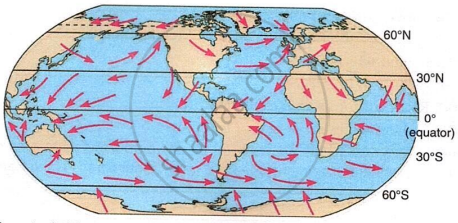
- Name the winds blowing between 0° to 30° N.
- Name the degree of latitudes between which the Northwesterly winds blow.
- Name the winds blowing in the North polar region.
Read the picture carefully and answer the following questions.
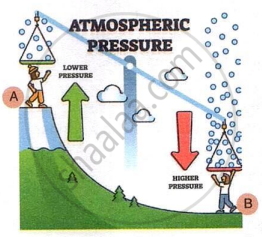
- Which of the two persons is experiencing lower atmospheric pressure?
- Will he face a problem in breathing?
- If yes, what should he do to ensure comfortable breathing for himself?
Answer the following questions.
Name the four major pressure belts of the world.
Mention in which ways the anticyclones affect the weather conditions.
Between which latitudes and in which hemisphere, the winds are called “Roaring Forties”?
State the Ferrel’s Law.
Name the instrument used to measure atmospheric pressure.
Name the latitudes which are called Doldrums.
Mention the characteristics of Doldrums.
Why do the Monsoon winds come in the category of seasonal winds?
What is the Inter-Tropical Convergence Zone?
Give three differences between Cyclones and Anticyclones.
What do you mean by Coriolis Force?
How does this force vary from lower to higher latitudes?
Define the term ‘Atmospheric Pressure’.
To which category of winds ‘Chinook and Foehn winds’ belong? Why?
Name the cold wind that prevails over the northwest of the Mediterranean Sea.
Define the term Isobars.
Define the term Front.
Why are Trade winds so called?
What are the Jet Streams?
Name the two types of Jet Streams.
What is the meaning of the term ‘pressure gradient’?
What is the reason for the equable/maritime climate in the coastal area?
How do the land and sea breezes make the coastal climate less extreme?
Explain briefly the factors that affect Atmospheric Pressure.
There is a strong similarity between Monsoon winds and land and sea breeze. Explain that similarity.
Give a reason why the westerlies in the southern hemisphere blow with a greater force than those in the northern hemisphere.
Give the effects of tropical cyclones on life and property in the coastal area.
Name the two types of variable winds.
Name the two types of cyclones.
Name an area where typhoons are experienced.
What does the term eye of a storm mean?
Name the weather conditions associated with the cyclones.
What are the Roaring Forties?
What are Furious Fifties?
Why are the Roaring Forties called that?
Why are the Furious Fifties called that?
Name the Planetary Winds.
What is the other term used for the Planetary winds?
Where do Blizzards blow?
What are Mango showers?
Differentiate between Katabatic and Anabatic winds.
Name two hot local winds.
Bring out three differences between the Trade winds and the Westerly winds.
Give two examples of tertiary winds.
How does the atmospheric pressure get affected by a change in altitude?
Moist air exerts less pressure than dry air. Why?
What causes the winds to blow?
Define the term Polar cell.
Define the term Ferrel Cell.
Define the term Hadley Cell.
What causes the seasonal shifting of pressure belts?
What is the unit of measuring atmospheric pressure?
Ira visited Ladakh during summer vacation. She experienced nose bleeding as soon as she got down from the plane. Can you guess the reason for it?
We feel discomfort in our ears at the time of take-off of a flight. This happens due to the fact that the atmospheric pressure decreases with increasing altitude. Keeping this concept in mind, explain the reason for the discomfort in the ears.
Which of the following places is most likely to experience tropical cyclones?
Goa, Ahmedabad, Bhubaneshwar, Kochi
Give a reason for your answer.
Solutions for 13: Atmospheric Pressure and Winds
Rachna Sapra solutions for Geography [English] Class 9 ICSE chapter 13 - Atmospheric Pressure and Winds
Shaalaa.com has the CISCE Mathematics Geography [English] Class 9 ICSE CISCE solutions in a manner that help students grasp basic concepts better and faster. The detailed, step-by-step solutions will help you understand the concepts better and clarify any confusion. Rachna Sapra solutions for Mathematics Geography [English] Class 9 ICSE CISCE 13 (Atmospheric Pressure and Winds) include all questions with answers and detailed explanations. This will clear students' doubts about questions and improve their application skills while preparing for board exams.
Further, we at Shaalaa.com provide such solutions so students can prepare for written exams. Rachna Sapra textbook solutions can be a core help for self-study and provide excellent self-help guidance for students.
Concepts covered in Geography [English] Class 9 ICSE chapter 13 Atmospheric Pressure and Winds are .
Using Rachna Sapra Geography [English] Class 9 ICSE solutions Atmospheric Pressure and Winds exercise by students is an easy way to prepare for the exams, as they involve solutions arranged chapter-wise and also page-wise. The questions involved in Rachna Sapra Solutions are essential questions that can be asked in the final exam. Maximum CISCE Geography [English] Class 9 ICSE students prefer Rachna Sapra Textbook Solutions to score more in exams.
Get the free view of Chapter 13, Atmospheric Pressure and Winds Geography [English] Class 9 ICSE additional questions for Mathematics Geography [English] Class 9 ICSE CISCE, and you can use Shaalaa.com to keep it handy for your exam preparation.
