Advertisements
Advertisements
Question
When rays of light are incident on a glass slab then the incident ray and emergent ray are _________ each other.
- perpendicular
- parallel
- opposite
- concurrent
Advertisements
Solution
(b) Parallel
When rays of light are incident on a glass slab, the incident and the emergent rays are parallel to each other. However, the emergent ray is displaced from the actual line of the incident ray. This is called lateral shift.
APPEARS IN
RELATED QUESTIONS
A student traces the path of a ray of light passing through a rectangular glass slab and marks the angle of incidence i, angle of refraction r and angle of emergence e, as shown.
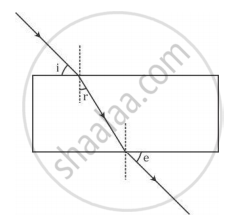
The correctly marked angle(s) is/are
(A) ∠ i only
(B) ∠ e only
(C) ∠ r only
(D) ∠ i and ∠ e
On the basis of the experiment, "To trace the path of a ray of light through a rectangular glass slab", students of a class arrived at which one of the following conclusions?
(A) Angle of incidence is greater than the angle of emergence.
(B) Angle of emergence is smaller than the angle of refraction.
(C) Emergent ray is parallel to the refracted ray.
(D) Incident ray and emergent ray are parallel to each other.
A student very cautiously traces the path of a ray through a glass slab for different values of the angle of incidence (∠i). He then measures the corresponding values of the angle of refraction (∠r) and the angle of emergence (∠e) for every value of the angle of incidence. On analysing these measurements of angles, his conclusion would be
(A) ∠i > ∠r > ∠e
(B) ∠i = ∠e > ∠r
(C) ∠i < ∠r < ∠e
(D) ∠i = ∠e < ∠r
Name one factor that affects the lateral displacement of light as it passes through a rectangular glass slab.
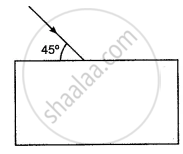
Draw the diagram given below and clearly show the path taken by the emergent ray.
A ray of light passes from water to air. How does the speed of light change?
Which of the above wavelengths has a higher frequency?
How must light travel out of a substance if it is not going to be refracted?
A monochromatic ray of light passes from air to glass. The wavelength of light in air is λ, the speed of light in air is c and in glass is V. If the absolute refractive index of glass is 1.5, write down
- the relationship between c and V,
- the wavelength of light in glass.
A ray of light strikes the surface of a rectangular glass block such that the angle of incidence in
air is 0°.
In each case, draw diagram to show the path taken by the ray as it passes through the glass block and emerges from it.
How does the speed of light change when it passes from glass to water?
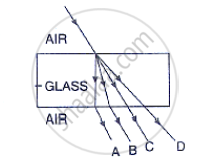
In fig 4.18, name the ray which represents the correct path of light while emerging out through a glass block.
Name the colour of white light which is deviated the most on passing through a prism.
What is meant by the statement the critical angle for diamond is 24°?
The refractive index of glass is 1.5. From a point P inside a glass block, draw rays PA, PB and PC incident on the glass air surface at an angle of incidence 30°, 42° and 60° respectively.
- In the diagram show the approximate direction of these rays as they emerge out of the block.
- What is the angle of refraction for the ray PB?
`("Take" sin 42° =2/3)`
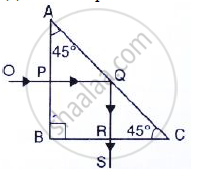
A ray of light OP passes through a right angles prism as shown in the adjacent diagram.
(a) State the angles of incidence at the faces AC and BC.
(b) Name the phenomenon which the ray suffers at the face AC.
A total reflecting right angled isosceles prism can be used to deviate a ray of light through:
(a) 30° (b) 60° (c) 75° (d) 90°.
Select from the following the best experimental set-up for tracing the path of a ray of light through a glass slab: (A) I
(A) I
(B) II
(C) III
(D) IV
Which of the following has the highest refractive index:
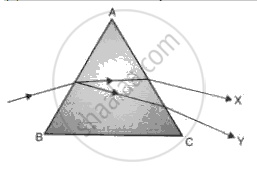
Fig. shows a ray of white light that passes through a prism and produces a spectrum.
(a) Name the phenomenon that is taking place.
(b) What colour would you see at X and Y?
(c) What radiation would you detect above X and below Y?
The critical angle for glass-air interface is :
A total reflecting equilateral prism can be used to deviate a ray of light through:
What is the refractive index of vacuum
Comment on the statement ‘The refractive index of glass is 3/2.’
Explain briefly what causes the twinkling of stars at night.
What do you understand by the deviation produced by a prism?
Draw ray of light bending towards the normal while passing from air to glass. Label your diagrams.
After a robbery, if a window has been broken, there will be tiny particles of glass. Some of these will be found at the scene of the crime and some may be caught in the thief’s clothing. If the police can prove that these particles are identical, they have a strong case.
A method of doing this is to suspend the particles of glass in a special liquid. Light of a single colour is thrown through the liquid and the particles viewed through a microscope. The temperature of the liquid is then slowly altered. This alters the speed of light through the liquid (i.e., it alters the refractive index). At one particular temperature, the particles of glass disappear. It this happens at the same temperature for both sets of glass particles, they probably came from the same broken pane of glass.
Complete and copy the diagram to show how light bends when it travels from the liquid to the glass and back to the liquid, If the light slows down in the glass.
The figure shows two prisms A and B. A monochromatic ray of light PO is incident at the face of the prism A. Complete the diagram to show the path of the ray till it emerges out of the prism B.

In the diagram alongside a ray of light, PQ is incident normally on one face AB of an equilateral glass prism. What is the angle of incidence at the faces AB and AC?

A ray of monochromatic light is incident from the air on a glass slab:
(i) Draw a labelled ray diagram showing the change in the path of the ray till it emerges from the glass slab.
(ii) Name the two rays that are parallel to each other.
(iii) Mark the lateral displacement in your diagram.
A ray of light PQ is incident normally on the hypotenuse of a right-angled prism ABC as shown in the diagram given below:

(i) Copy the diagram and complete the path of the ray PQ till it emerges from the prism.
(ii) What is the value of the angle of deviation of the ray?
(iii) Name an instrument where this action of the prism is used.
Which colour of white light travels fastest in any medium except air?
