Advertisements
Advertisements
Question
What type of bond is present in hydrogen chloride?
Advertisements
Solution
A covalent bond is the chemical bond present in a hydrogen chloride molecule.
APPEARS IN
RELATED QUESTIONS
Choose the correct answer from the options given below:
Which of the following is a common characteristic of a covalent compound?
1) high melting point
2) consists of molecules
3) always soluble in water
4) Conducts electricity when it is in the molten state
Name the following:
The property of element by virtue of which atoms of the element can link to each other in the form of a long chain or ring structure.
Name the element whose one of the allotropic forms is buckminsterfullerene.
Buckminsterfullerene is a spherical molecule in which 60 carbon atoms are arranged in interlocking hexagonal and pentagonal rings of carbon atoms.
- How many hexagons of carbon atoms are present in one molecule of buckminsterfullerene?
- How many pentagons of carbon atoms are present in one molecule of buckminsterfullerene?
State one major difference between covalent and ionic bonds.
The form of carbon which is known as black lead is ______.
Give one example of the following:
A molecule containing a single covalent bond.
The general formula CnH2n for cycloalkanes is the same as that of ______.
Explain why, ionic compounds conduct electricity in solution whereas covalent compounds do not conduct electricity.
Name one covalent compound containing chlorine.
How will you find out which of the water soluble compound A or B is ionic?
Give the formula of the compound that would be formed by the combination of the following pair of elements:
Al and Cl2
Which inert gas does the H atom in HCl resemble in electron arrangement?
Draw the electron-dot structure of the following compound and state the type of bonding in the given case:
CO2
Explain why, diamond has a high melting point.
The number of covalent bonds in pentane (molecular formula C5H12) is ______.
A covalent molecule having a double bond between its atoms is ______.
Which of the following has a triple bond as well as single bonds?
Two non-metals combine with each other by the sharing of electrons to form a compound X.
- What type of chemical bond is present in X?
- State whether X will have a high melting point or low melting point.
- Will it be a good conductor of electricity or not?
- Will it dissolve in an organic solvent or not?
A hydrocarbon having one double bond has 100 carbon atoms in its molecule. The number of hydrogen atoms in its molecule will be ______.
An element A has 4 valence electrons in its atom whereas element B has only one valence electron in its atom. The compound formed by A and B does not conduct electricity. What is the nature of chemical bond in the compound formed? Give its electron-dot structure.
What are the conditions necessary for the formation of covalent molecules?
Explain the following term with an example.
Unsaturated hydrocarbon
Explain the following term with example.
Homopolymer
The carbon compound is used in daily life is ______.
Taking hydrogen chloride and methane as examples, distinguish between a polar covalent bond and a non polar covalent bond.
The electronic configuration of N2 is 2, 5. How many electrons in the outer shell of a N atom are not involved in the formation of a nitrogen molecule?
Compare the compounds carbon tetrachloride and sodium chloride with regard to solubility in water and electrical conductivity.
An element L consists of molecules.
Why L is heated with iron metal, it forms a compound FeL. What chemical term would you use to describe the change undergone by L?
Electrons are getting added to an element Y.
- Is Y getting oxidized or reduced?
- Which electrode will Y migrate to during the process of electrolysis?
Name two compounds that are covalent when taken pure but produce ions when dissolved in water.
Define a covalent bond.
Name gas with a rotten egg smell.
Define the functional group and complete the following table.
| S.I. No. | Functional Group | Compound | Formula |
| (1) | ______________ | _______________ |
C2H5OH |
| (2) | _______________ | _______________ | CH3CHO |
The molecular masses of a carbon compound spread over a range of _______.
Your body is made up of carbon.
Complete the following activity.
Write the names of the hydrocarbons for the following structural formula.
(isobutylene, cyclohexane, propene, cyclohexene, cyclopentane, benzene, propyne, isobutane, propane)
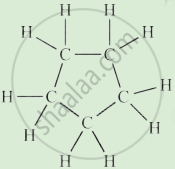 |
Mineral acids are stronger acids than carboxylic acids because
- mineral acids are completely ionised
- carboxylic acids are completely ionised
- mineral acids are partially ionised
- carboxylic acids are partially ionised
