Advertisements
Advertisements
Question
Which of the following has a triple bond as well as single bonds?
Options
ethene
methane
ethyne
nitrogen
Advertisements
Solution
Ethyne
Explanation:
Ethyne (C2H2) consists of two carbon atoms connected to each other by a central covalent triple bond (C ≡ C). Additionally, each carbon atom is connected to a hydrogen atom via a single covalent bond (C-H). Therefore, the entire molecule simultaneously contains one triple bond and two single bonds to satisfy the valency requirements of all atoms.
APPEARS IN
RELATED QUESTIONS
Choose the most appropriate answer from the following list of oxides which fit the description.
A covalent oxide of a metalloid.
An element L consists of molecules.
What type of bonding is present in the particles that make up L?
What do you call the compounds having the same molecular formula but different structural arrangements of atoms?
What type of bonds are present in a water molecule?
What type of bond is present in methane (CH4)?
Two chlorine atoms combine to form a molecule. The bond between them is known as ______.
In forming N2 molecule, ______ electrons are shared by each atom of nitrogen.
What is buckminsterfullerene?
Explain why, ionic compounds conduct electricity in solution whereas covalent compounds do not conduct electricity.
Friedrich Wohler converted an inorganic compound into an organic compound in the laboratory.
- Give the name and formula of inorganic compound.
- Write the name and formula of organic compound formed.
Draw the electron-dot structure of a hydrogen chloride molecule:
- Which inert gas does the H atom in HCl resemble in electron arrangement?
- Which inert gas does the Cl atom in HCl resemble in electron arrangement?
Draw the electron-dot structure of the following compound and state the type of bonding in the given case:
NH3
Explain why, diamond can be used in rock drilling equipment but graphite cannot.
Of what substance is graphite made?
Why are covalent compounds generally poor conductors of electricity?
The pencil leads are made of mainly ______.
What happens when methane (natural gas) burns in air? Write the chemical equation of the reaction involved.
What are the conditions necessary for the formation of covalent molecules?
What is the difference between ionic compounds and covalent compounds?
Give the characteristic properties of covalent compounds.
Give two example in following case:
Gaseous non polar covalent compound.
Draw an electron dot structure of the following molecule. (Without showing the circle) :
Ethene
Draw all possible structural formulae of the compound from its molecular formula given below.
C3H4
Explain the following term with example.
Hetero atom in a carbon compound
Explain the following term with example.
Alkane
Explain the following term with example.
Homopolymer
Write answer as directed.
What causes the existance of very large number of carbon compound ?
Explain the following briefly:
Cl2 is a non polar molecule, while HCl is a polar molecule.
Explain the structure of Ammonium ion.
Draw the electron dot diagram and structure of nitrogen molecule.
State the type of bond formed, and draw Lewis structure of water.
Element A has 2 electrons in its M shell. Element B has atomic number 7.
- Write equations to show how A and B form ions.
- If B is a diatomic gas, write the equation for the direct combination of A and B to form a compound.
- If the compound formed between A and B is melted and an electric current is passed through the molten compound, the element A will be obtained at the ______ and B at the ______ of the electrolytic cell.
Name two compounds that are covalent when taken pure but produce ions when dissolved in water.
Name a greenish-yellow gas which also bleaches.
Write the molecular formula of the given compound.
Acetic acid
Write an Explanation.
Alkane
Complete the following activity.
Write the names of the hydrocarbons for the following structural formula.
(isobutylene, cyclohexane, propene, cyclohexene, cyclopentane, benzene, propyne, isobutane, propane)
| \[\begin{array}{cc} \phantom{.........}\ce{H}\\ \phantom{.........}|\\ \ce{H - C ≡ C - C - H}\\ \phantom{.........}|\\ \phantom{.........}\ce{H} \end{array}\] |
Complete the following activity.
Write the names of the hydrocarbons for the following structural formula.
(isobutylene, cyclohexane, propene, cyclohexene, cyclopentane, benzene, propyne, isobutane, propane)
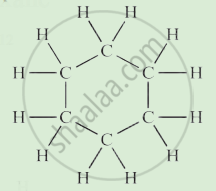 |
Discuss in brief about the properties of coordinate covalent compounds.
