Advertisements
Advertisements
Question
Name a greenish-yellow gas which also bleaches.
Advertisements
Solution
Chlorine gas (Cl2)
APPEARS IN
RELATED QUESTIONS
Give one example of the following:
A molecule containing a triple covalent bond.
Give the formula of the compound that would be formed by the combination of the following pair of elements:
K and H
The solution of one of the following compounds will not conduct electricity. This compound is:
State the type of bonding in the following molecule.
Hydroxyl ion
Draw the electron dot diagram and structure of methane.
Write scientific reason.
Carbon has the property of forming many compounds.
Complete the following activity.
Write the names of the hydrocarbons for the following structural formula.
(isobutylene, cyclohexane, propene, cyclohexene, cyclopentane, benzene, propyne, isobutane, propane)
| \[\begin{array}{cc} \phantom{..}\ce{H}\phantom{...}\ce{H}\phantom{...}\ce{H}\\ \phantom{..}|\phantom{....}|\phantom{....}|\\ \ce{H - C - C- C- H}\\ \phantom{.}|\phantom{....}|\phantom{....}|\\ \ce{H - C - H}\\ |\\\ce{H}\end{array}\] |
Complete the following activity.
Write the names of the hydrocarbons for the following structural formula.
(isobutylene, cyclohexane, propene, cyclohexene, cyclopentane, benzene, propyne, isobutane, propane)
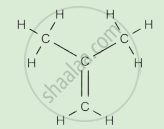 |
Mineral acids are stronger acids than carboxylic acids because
- mineral acids are completely ionised
- carboxylic acids are completely ionised
- mineral acids are partially ionised
- carboxylic acids are partially ionised
Carbon forms four covalent bonds by sharing its four valence electrons with four univalent atoms, e.g. hydrogen. After the formation of four bonds, carbon attains the electronic configuration of
