Advertisements
Advertisements
Question
One of the following contains a double bond as well as single bonds. This is:
Options
CO2
O2
C2H4
C2H2
Advertisements
Solution
C2H4
Explanation:
Ethene (C2H4) consists of two carbon atoms connected to each other by a covalent double bond (C = C). Additionally, each carbon atom is bonded to two hydrogen atoms via two single covalent bonds (C-H). Therefore, the entire molecule simultaneously contains one double bond and four single bonds, thereby achieving full structural stability.
APPEARS IN
RELATED QUESTIONS
Write the number of covalent bonds in the molecule of butane, C4H10.
List three characteristic properties of covalent compounds.
What would be the electron dot structure of a molecule of sulphur which is made up of eight atoms of sulphur? (Hint – the eight atoms of sulphur are joined together in the form of a ring.)
Give appropriate scientific reasons for Carbon tetrachloride does not conduct electricity.
What type of chemical bond is formed between:
Carbon and bromine
What type of bonds are present in a water molecule?
What type of bond is present in the following molecule?
Cl2
Which inert gas electron configuration do the Cl atoms in Cl2 molecule resemble? What is this electron configuration?
Explain the formation of a chlorine molecule on the basis of electronic theory of valency.
Explain why, ionic compounds conduct electricity in solution whereas covalent compounds do not conduct electricity.
What type of bonding would you expect between the following pair of elements?
Carbon and Chlorine
Using electron-dot diagrams which show only the outermost shell electrons, show how a molecule of oxygen, O2, is formed from two oxygen atoms. What name is given to this type of bonding?
(At. No. of oxygen = 8)
State one use of diamond which depends on its ‘extraordinary brilliance’ and one use of graphite which depends on its being ‘black and quite soft’.
What is the difference between ionic compounds and covalent compounds?
Methane molecule is non-polar molecule. Explain.
State the type of bonding in the following molecule.
Hydroxyl ion
State the type of bonding in the following molecule.
Methane
Give two example in following case:
Solid covalent compounds
Distinguish between ionic and covalent compounds under the following properties:
(i) Strength of forces between constituent elements
(ii) Solubility of compounds in water
(iii) Electrical conduction in substances
Draw an electron dot structure of the following molecule. (Without showing the circle) :
Water
The following structural formula belongs to which carbon compound?
Explain the following briefly.
Pure water does not conduct electricity, but on adding sodium chloride to it, it starts conducting electricity.
Choose the correct answer from the options given below
Condition favorable for formation of a covalent bond is
(a) Compound X consists of molecules.
Choose the letter corresponding to the correct answer from the choices (a), (b), (c) and (d) given below
X is likely to have a :
Fill in the blank with correct word from the bracket.
Melting and boiling points of covalent compounds are generally ______ (low, high).
Electrons are getting added to an element Y.
- Is Y getting oxidized or reduced?
- Which electrode will Y migrate to during the process of electrolysis?
State the type of bond formed, and draw Lewis structure of water.
Name the anion present in the following compound:
When a barium chloride solution is added to a solution of compound B, a white precipitate insoluble in dilute hydrochloric acid is formed.
Number of valence electrons in a carbon atom is _______.
Complete the following activity.
Write the names of the hydrocarbons for the following structural formula.
(isobutylene, cyclohexane, propene, cyclohexene, cyclopentane, benzene, propyne, isobutane, propane)
| \[\begin{array}{cc} \phantom{.........}\ce{H}\\ \phantom{.........}|\\ \ce{H - C ≡ C - C - H}\\ \phantom{.........}|\\ \phantom{.........}\ce{H} \end{array}\] |
Give an example for each of the following statement.
A compound in which three covalent bonds are formed.
When ethyl alcohol and acetic acid are mixed, the resulting ester has a chemical formula ______.
Cation is formed when ______.
The I.U.P.A.C name of CH3CH2CH = CH2 is?
Two carbon atoms can always form one or two covalent bonds.
The table shows the electronic structures of four elements.
| Element | Electronic Structure |
| P | 2, 6 |
| Q | 2, 8, 1 |
| R | 2, 8, 7 |
| S | 2, 8, 8 |
- Identify which element(s) will form covalent bonds with carbon.
- “Carbon reacts with an element in the above table to form several compounds.” Give suitable reason.
Name the following:
\[\ce{CH3 - CH2CH = CH2}\]
Show the covalent bond formation in nitrogen molecule.
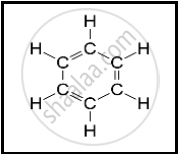
The number of single and double bonds present in a molecule of benzene (C6H6) respectively, are ______.
