Advertisements
Advertisements
Question
The molecules having triple bond in them are ______.
Options
oxygen and ethyne
carbon dioxide and ammonia
methane and ethene
nitrogen and ethyne
Advertisements
Solution
The molecules having triple bond in them are nitrogen and ethyne.
Explanation:
A nitrogen molecule (N2) forms a triple bond because each nitrogen atom shares three pairs of electrons to complete its octet. Similarly, an ethyne molecule (C2H2) contains a carbon-to-carbon triple bond (C ≡ C) because the two carbon atoms share three pairs of electrons with each other to achieve stability. The other choices contain only single bonds, double bonds, or a combination of both.
APPEARS IN
RELATED QUESTIONS
Write structural formula of Methane.
What are covalent compounds?
Explain the nature of the covalent bond using the bond formation in CH3Cl.
Name a carbon containing molecule which has two double bonds.
What type of chemical bond is formed between:
Carbon and bromine
Which inert gas electron configuration do the Cl atoms in Cl2 molecule resemble? What is this electron configuration?
Give one example of the following:
A molecule containing a single covalent bond.
What type of chemical bond is present in the chlorine molecule? Explain your answer.
Explain why:
Covalent compounds have generally low melting points.
Explain why, ionic compounds conduct electricity in solution whereas covalent compounds do not conduct electricity.
Friedrich Wohler converted an inorganic compound into an organic compound in the laboratory.
- Give the name and formula of inorganic compound.
- Write the name and formula of organic compound formed.
Give the formula of the compound that would be formed by the combination of the following pair of elements:
K and H
Draw the electron-dot structure of the following compound and state the type of bonding in the given case:
NH3
Draw the electron-dot structure of the following compound and state the type of bonding in the given case:
N2
State one use of diamond which depends on its ‘extraordinary brilliance’ and one use of graphite which depends on its being ‘black and quite soft’.
Describe the structure of diamond. Draw a s imple diagram to show the arrangement of carbon atoms in diamond.
Out of KCl, HCl, CCl4 and NaCl, the compounds which are not ionic are:
Two non-metals combine with each other by the sharing of electrons to form a compound X.
- What type of chemical bond is present in X?
- State whether X will have a high melting point or low melting point.
- Will it be a good conductor of electricity or not?
- Will it dissolve in an organic solvent or not?
What do you understand by polar covalent compounds?
State the type of bonding in the following molecule.
Water
State the type of bonding in the following molecule.
Methane
Draw an electron dot structure of the following molecule. (Without showing the circle) :
Water
Draw electron - dot structure and structural formula of methane.
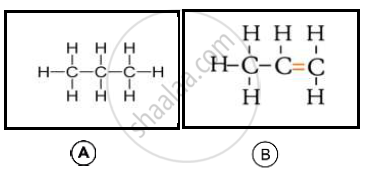
Observe the straight chain hydrocarbons given below and answer the following
questions :
i) Which of the straight chain compounds from A and B is saturated and unsaturated straight chains?
ii) Name these straight chains.
iii) Write their chemical formulae and number of – CH2 - units.
Explain the following briefly:
Sodium chloride dissolves in water but carbon tetra chloride is insoluble in water.
Choose the correct answer from the options given below
Which one is not example of polar covalent compound?
Compound X consists of molecules.
Choose the letter corresponding to the correct answer from the options A, B, C and D given below:
The type of bonding in X will be ______.
Compound X consists of molecules.
Choose the letter corresponding to the correct answer from the options A, B, C and D given below:
X is likely to have a ______.
Number of valence electrons in a carbon atom is _______.
The molecular masses of a carbon compound spread over a range of _______.
Write an Explanation.
Alkene
Complete the following activity.
Write the names of the hydrocarbons for the following structural formula.
(isobutylene, cyclohexane, propene, cyclohexene, cyclopentane, benzene, propyne, isobutane, propane)
| \[\begin{array}{cc}\phantom{......}\ce{H}\phantom{...}\ce{H}\phantom{...}\ce{H}\phantom{..}\\ \phantom{.....}|\phantom{....}|\phantom{....}|\\ \ce{H - C - C = C}\\\phantom{.....}|\phantom{.........}|\\ \phantom{.....}\ce{H}\phantom{........}\ce{H}\end{array}\] |
Complete the following activity.
Write the names of the hydrocarbons for the following structural formula.
(isobutylene, cyclohexane, propene, cyclohexene, cyclopentane, benzene, propyne, isobutane, propane)
| \[\begin{array}{cc}\ce{H}\phantom{...}\ce{H}\phantom{...}\ce{H}\\ |\phantom{....}|\phantom{....}|\\\ce{H - C - C - C - H}\\ |\phantom{....}|\phantom{....}|\\\ce{H}\phantom{...}\ce{H}\phantom{...}\ce{H} \end{array}\] |
Complete the following activity.
Write the names of the hydrocarbons for the following structural formula.
(isobutylene, cyclohexane, propene, cyclohexene, cyclopentane, benzene, propyne, isobutane, propane)
| \[\begin{array}{cc} \phantom{.........}\ce{H}\\ \phantom{.........}|\\ \ce{H - C ≡ C - C - H}\\ \phantom{.........}|\\ \phantom{.........}\ce{H} \end{array}\] |
Complete the following activity.
Write the names of the hydrocarbons for the following structural formula.
(isobutylene, cyclohexane, propene, cyclohexene, cyclopentane, benzene, propyne, isobutane, propane)
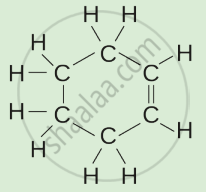 |
Considering MgCl2 as ionic compound and CH4 as covalent compound give any two differences between these two compounds.
Cation is formed when ______.
The I.U.P.A.C name of CH3CH2CH = CH2 is?
Statement (A): Covalent compounds are bad conductors of electricity.
Reason (B): Covalent compounds contain charged particles (ions)
Assertion (A): Melting point and boiling point of ethanol are lower than that of sodium chloride.
Reason (R): The forces of attraction between the molecules of ionic compounds are very strong.
