Advertisements
Advertisements
Question
A covalent molecule having a double bond between its atoms is ______.
Options
Hydrogen
Oxygen
water
ammonia
Advertisements
Solution
A covalent molecule having a double bond between its atoms is oxygen.
Explanation:
An oxygen atom (atomic number 8) has 6 valence electrons and requires 2 more electrons to achieve a stable octet configuration. When two oxygen atoms combine, they mutually share two pairs of electrons between themselves. This sharing of two electron pairs results in the formation of a strong covalent double bond (O = O) within the (O2) molecule.
APPEARS IN
RELATED QUESTIONS
What are covalent compounds?
Elements forming ionic compounds attain noble gas configuration by either gaining or losing electrons from their outermost shells. Give reason to explain why carbon cannot attain noble gas configuration in this manner to form its compounds.
Give appropriate scientific reasons for Carbon tetrachloride does not conduct electricity.
Choose the most appropriate answer from the following list of oxides which fit the description.
A covalent oxide of a metalloid.
Why are most carbon compounds poor conductors of electricity?
Name the element whose one of the allotropic forms is buckminsterfullerene.
State one major difference between covalent and ionic bonds.
Give one example of the following:
A molecule containing a triple covalent bond.
Two atoms of the same element combine to form a molecule. The bond between them is known as ______ bond.
Give two general properties of ionic compounds.
State one test by which sodium chloride can be distinguished from sugar.
will CS2 conduct electricity or not?
give reason for your choice.
Draw the electron-dot structure of a hydrogen chloride molecule:
- Which inert gas does the H atom in HCl resemble in electron arrangement?
- Which inert gas does the Cl atom in HCl resemble in electron arrangement?
Draw the electron-dot structure of the following compound and state the type of bonding in the given case:
N2
What is graphite?
Give the formulae of the chlorides of the elements X and Y having atomic numbers of 3 and 6 respectively. Will the properties of the two chlorides be similar or different? Explain your answer.
State the type of bonding in the following molecule.
Water
Give two example in following case:
Gaseous polar covalent compound.
The following structural formula belongs to which carbon compound?
Draw electron - dot structure and structural formula of methane.
The carbon compound is used in daily life is ______.
Name a neutral covalent molecule which contains one lone pair of electrons.
Compound X consists of molecules.
Choose the letter corresponding to the correct answer from the options A, B, C and D given below:
X is likely to have a ______.
Draw the electron dot diagram and structure of magnesium chloride.
State the type of bond formed when the combining atom has small E.N. difference.
Potassium chloride is an electrovalent compound, while hydrogen chloride is a covalent compound, But, both conduct electricity in their aqueous solutions. Explain.
Name gas with a rotten egg smell.
Generally, the melting and boiling point of carbon compounds are found to be less than _______ °C.
The number of electrons in the valence shell of a carbon atom is 4.
Write scientific reason.
Benzene compounds are called aromatic compounds.
Explain covalent bond with example.
Complete the following activity.
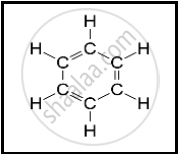
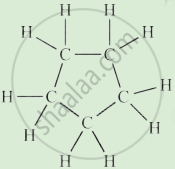
Write the names of the hydrocarbons for the following structural formula.
(isobutylene, cyclohexane, propene, cyclohexene, cyclopentane, benzene, propyne, isobutane, propane)
 |
Consider the coordination compound, K2[Cu(CN)4]. A coordinate covalent bond exists between:
When ethyl alcohol and acetic acid are mixed, the resulting ester has a chemical formula ______.
Although metals form basic oxides, which of the following metals form an amphoteric oxide?
The correct structural formula of butanoic acid is
Write notes on the characteristics of covalent compounds.
"Carbon prefers to share its valence electrons with other atoms of carbon or with atoms of other elements rather than gaining or losing the valence electrons in order to attain noble gas configuration." Give reasons to justify this statement.
