A covalent molecule having a double bond between its atoms is ______.
Advertisements
Advertisements
प्रश्न
A covalent molecule having a double bond between its atoms is ______.
विकल्प
Hydrogen
Oxygen
water
ammonia
Advertisements
उत्तर
A covalent molecule having a double bond between its atoms is oxygen.
Explanation:
An oxygen atom (atomic number 8) has 6 valence electrons and requires 2 more electrons to achieve a stable octet configuration. When two oxygen atoms combine, they mutually share two pairs of electrons between themselves. This sharing of two electron pairs results in the formation of a strong covalent double bond (O = O) within the (O2) molecule.
APPEARS IN
संबंधित प्रश्न
What would be the electron dot structure of a molecule of sulphur which is made up of eight atoms of sulphur? (Hint – the eight atoms of sulphur are joined together in the form of a ring.)
Choose the most appropriate answer from the following list of oxides which fit the description.
A covalent oxide of a metalloid.
Buckminsterfullerene is spherical molecule in which 60 carbon atoms are arranged in interlocking hexagonal and pentagonal rings of carbon atoms.
How many pentagons of carbon atoms are present in one molecule of buckminsterfullerene?
What do you call the compounds having the same molecular formula but different structural arrangements of atoms?
What type of bonds are present in a water molecule?
What type of bond is present in the following molecule?
Cl2
The form of carbon which is known as black lead is ______.
Why does carbon form compounds mainly by covalent bonding?
Explain why:
Covalent compounds have generally low melting points.
Why is graphite used for making dry cell electrodes but diamond is not?
What type of bonding would you expect between the following pair of elements?
Carbon and Chlorine
Using electron-dot diagrams which show only the outermost shell electrons, show how a molecule of oxygen, O2, is formed from two oxygen atoms. What name is given to this type of bonding?
(At. No. of oxygen = 8)
Explain why, graphite can be used as a lubricant but diamond cannot.
State one use of diamond which depends on its ‘extraordinary brilliance’ and one use of graphite which depends on its being ‘black and quite soft’.
State any two uses of diamond.
Describe the structure of graphite with the help of a labelled diagram.
The number of covalent bonds in pentane (molecular formula C5H12) is ______.
Explain the following:
polar covalent compounds electricity.
Complete the following:
When the nuclei of two different reacting atoms are of ______ mass, then a bond so formed is called ______ covalent bond. (equal, unequal, polar, non-polar)
Give two example in following case:
Solid covalent compounds
Draw an electron dot structure of the following molecule. (Without showing the circle) :
Methane
Draw an electron dot structure of the following molecule. (Without showing the circle) :
Water
Draw all possible structural formulae of the compound from its molecular formula given below.
C3H4
Write answer as directed.
Saturated hydrocarbons are classified into three types. Write these names giving one example each.
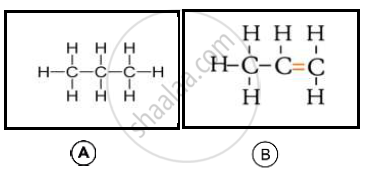
Observe the straight chain hydrocarbons given below and answer the following
questions :
i) Which of the straight chain compounds from A and B is saturated and unsaturated straight chains?
ii) Name these straight chains.
iii) Write their chemical formulae and number of – CH2 - units.
Taking hydrogen chloride and methane as examples, distinguish between a polar covalent bond and a non polar covalent bond.
Choose the correct answer from the options given below
Which one is not example of polar covalent compound?
Acids dissolve in water to produce positively charged ions. Draw the structure of these positive ions.
Electrons are getting added to an element Y.
- Is Y getting oxidized or reduced?
- Which electrode will Y migrate to during the process of electrolysis?
Acids dissolve in water and produce positively charged ions. Draw the structure of these positive ions.
What do you understand by dipole (polar) molecule?
Explain the following:
Water is a polar covalent molecule.
Explain the following:
Polar covalent compounds conduct electricity?
Give an example of the covalent bond formed by
(i) Similar atoms (ii) Dissimilar atoms
Name the anion present in the following compound:
When a barium chloride solution is added to a solution of compound B, a white precipitate insoluble in dilute hydrochloric acid is formed.
Complete the following activity.
Write the names of the hydrocarbons for the following structural formula.
(isobutylene, cyclohexane, propene, cyclohexene, cyclopentane, benzene, propyne, isobutane, propane)
| \[\begin{array}{cc}\ce{H}\phantom{...}\ce{H}\phantom{...}\ce{H}\\ |\phantom{....}|\phantom{....}|\\\ce{H - C - C - C - H}\\ |\phantom{....}|\phantom{....}|\\\ce{H}\phantom{...}\ce{H}\phantom{...}\ce{H} \end{array}\] |
Which of the following statements are usually correct for carbon compounds? These
- are good conductors of electricity
- are poor conductors of electricity
- have strong forces of attraction between their molecules
- do not have strong forces of attraction between their molecules.
Which of the following is the formula of Butanoic acid?
