Advertisements
Advertisements
प्रश्न
Explain the following:
Water is a polar covalent molecule.
Advertisements
उत्तर
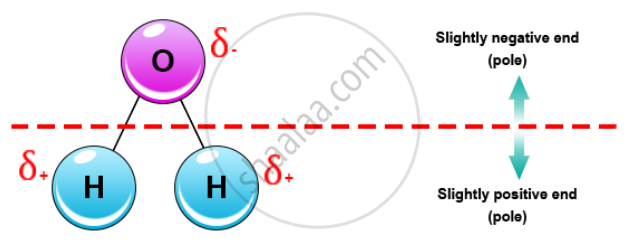
This means that in the water molecule, one side is positively charged and the other side is negatively charged. Since the water molecule (comprising two atoms of Hydrogen and one of Oxygen) is formed by covalent bonds, the electrons are shared.
This sharing causes the electrons to stay closer to the oxygen atom giving it a slight negative charge while the hydrogen atoms, as a consequence, have a slight positive charge.
APPEARS IN
संबंधित प्रश्न
Ethane, with the molecular formula C2H6 has ______.
Name a carbon containing molecule which has two double bonds.
The molecules having triple bond in them are ______.
Which of the following has a triple bond as well as single bonds?
Two non-metals combine with each other by the sharing of electrons to form a compound X.
- What type of chemical bond is present in X?
- State whether X will have a high melting point or low melting point.
- Will it be a good conductor of electricity or not?
- Will it dissolve in an organic solvent or not?
What is the term defined below?
A bond formed by a shared pair of electrons, each bonding atom contributing one electron to the pair.
A molecule of ammonia (NH3) has
What is a covalent bond?
Non-polar covalent compounds are ______ conductors of heat and electricity.
In covalent compounds, the bond is formed due to ______ of electrons.
