Advertisements
Advertisements
प्रश्न
Explain why:
Covalent compounds have generally low melting points.
Advertisements
उत्तर
Covalent compounds generally have low melting points because the molecules in these compounds are held together by weak intermolecular forces. Only a small amount of heat energy is required to overcome these forces and separate the molecules.
APPEARS IN
संबंधित प्रश्न
What would be the electron dot structure of carbon dioxide which has the formula CO2?
Butanone is a four-carbon compound with the functional group:
State the type of bonding in the following molecule.
Water
Buckminsterfullerene is spherical molecule in which 60 carbon atoms are arranged in interlocking hexagonal and pentagonal rings of carbon atoms.
How many pentagons of carbon atoms are present in one molecule of buckminsterfullerene?
How does graphite act as a lubricant?
The form of carbon which is known as black lead is ______.
Two atoms of the same element combine to form a molecule. The bond between them is known as ______ bond.
The number of single covalent bonds in C2H2 molecule are ______.
What type of bond exists in CCl4?
Explain the formation of a chlorine molecule on the basis of electronic theory of valency.
Give two general properties of ionic compounds.
Friedrich Wohler converted an inorganic compound into an organic compound in the laboratory.
- Give the name and formula of inorganic compound.
- Write the name and formula of organic compound formed.
Give the formula of the compound that would be formed by the combination of the following pair of elements:
Al and Cl2
Using electron-dot diagrams which show only the outermost shell electrons, show how a molecule of nitrogen, N2, is formed from two nitrogen atoms. What name is given to this type of bonding?
(Atomic number of nitrogen is 7)
Using electron-dot diagrams which show only the outermost shell electrons, show how a molecule of oxygen, O2, is formed from two oxygen atoms. What name is given to this type of bonding?
(At. No. of oxygen = 8)
State one use of diamond which depends on its ‘extraordinary brilliance’ and one use of graphite which depends on its being ‘black and quite soft’.
Explain why, diamond has a high melting point.
State the type of bonding in the following molecule.
Hydroxyl ion
Draw an electron dot structure of the following molecule. (Without showing the circle) :
Methanol
Draw all possible structural formulae of the compound from its molecular formula given below.
C3H8
Write answer as directed.
What causes the existance of very large number of carbon compound ?
Explain the structure of Ammonium ion.
Choose the correct answer from the options given below
Which one is not example of polar covalent compound?
Fill in the blank with correct word from the bracket.
Melting and boiling points of covalent compounds are generally ______ (low, high).
The particles present in strong electrolytes are
Fill in the blank from the choice given in bracket.
The compound that does not have a lone pair of electrons is ___________. (Water, Ammonia, carbon tetrachloride)
Explain the following:
Water is a polar covalent molecule.
Name a greenish-yellow gas which also bleaches.
Fill in the blank and rewrite the completed statement:
Covalent compounds are generally soluble in _________ solvents.
Complete the following activity.
Write the names of the hydrocarbons for the following structural formula.
(isobutylene, cyclohexane, propene, cyclohexene, cyclopentane, benzene, propyne, isobutane, propane)
| \[\begin{array}{cc}\phantom{......}\ce{H}\phantom{...}\ce{H}\phantom{...}\ce{H}\phantom{..}\\ \phantom{.....}|\phantom{....}|\phantom{....}|\\ \ce{H - C - C = C}\\\phantom{.....}|\phantom{.........}|\\ \phantom{.....}\ce{H}\phantom{........}\ce{H}\end{array}\] |
Complete the following activity.
Write the names of the hydrocarbons for the following structural formula.
(isobutylene, cyclohexane, propene, cyclohexene, cyclopentane, benzene, propyne, isobutane, propane)
| \[\begin{array}{cc} \phantom{.........}\ce{H}\\ \phantom{.........}|\\ \ce{H - C ≡ C - C - H}\\ \phantom{.........}|\\ \phantom{.........}\ce{H} \end{array}\] |
Complete the following activity.
Write the names of the hydrocarbons for the following structural formula.
(isobutylene, cyclohexane, propene, cyclohexene, cyclopentane, benzene, propyne, isobutane, propane)
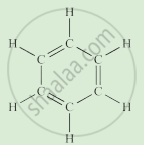 |
Complete the following activity.
Write the names of the hydrocarbons for the following structural formula.
(isobutylene, cyclohexane, propene, cyclohexene, cyclopentane, benzene, propyne, isobutane, propane)
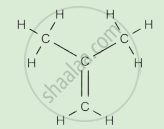 |
Give an example for each of the following statement.
Formation of coordinate covalent bond between NH3 ➝ BF3 molecules
Identify the incorrect statement and correct them.
- Like covalent compounds, coordinate compounds also contain charged particles (ions). So they are good conductors of electricity.
- Ionic bond is a weak bond when compared to Hydrogen bond.
- Ionic or electrovalent bonds are formed by mutual sharing of electrons between atoms.
- Loss of electrons is called Oxidation and gain of electron is called Reduction.
- The electrons which are not involved in bonding are called valence electrons.
______ is an example of a covalent compound having a high melting point.
In covalent bond formation, the sharing of ______ electrons takes place in their outermost shell.
Statement (A): Covalent compounds are bad conductors of electricity.
Reason (B): Covalent compounds contain charged particles (ions)
