Friedrich Wohler converted an inorganic compound into an organic compound in the laboratory. (i) Give the name and formula of inorganic compound. (ii) Write the name and formula of organic compound
Advertisements
प्रश्न
Friedrich Wohler converted an inorganic compound into an organic compound in the laboratory.
- Give the name and formula of inorganic compound.
- Write the name and formula of organic compound formed.
Advertisements
उत्तर
- Ammonium cyanate (NH4CNO)
- Urea (CO(NH2)2)
APPEARS IN
संबंधित प्रश्न
Write structural formula of Methane.
What would be the electron dot structure of a molecule of sulphur which is made up of eight atoms of sulphur? (Hint – the eight atoms of sulphur are joined together in the form of a ring.)
State the type of bonding in the following molecule.
Water
Choose the most appropriate answer from the following list of oxides which fit the description.
A covalent oxide of a metalloid.
Buckminsterfullerene is a spherical molecule in which 60 carbon atoms are arranged in interlocking hexagonal and pentagonal rings of carbon atoms.
- How many hexagons of carbon atoms are present in one molecule of buckminsterfullerene?
- How many pentagons of carbon atoms are present in one molecule of buckminsterfullerene?
Give one example of the following:
A molecule containing a double covalent bond.
Two chlorine atoms combine to form a molecule. The bond between them is known as ______.
In forming oxygen molecule, ______ electrons are shared by each atom of oxygen.
What is buckminsterfullerene?
Explain why, ionic compounds conduct electricity in solution whereas covalent compounds do not conduct electricity.
What type of bonding would you expect between the following pair of elements?
Carbon and Chlorine
Draw the electron-dot structure of the following compound and state the type of bonding in the given case:
CO2
Draw the electron-dot structure of the following compound and state the type of bonding in the given case:
H2O
Draw the electron-dot structure of the following compound and state the type of bonding in the given case:
N2
Write two points of difference in the structures of diamond and graphite.
Why is graphite a good conductor of electricity but diamond is a non-conductor of electricity?
State any two uses of graphite.
A saturated hydrocarbon has fifty hydrogen atoms in its moleucle. The number of carbon atoms in its molecule will be ______.
The number of isomers formed by the hydrocarbon with molecular formula C5H12 is ______.
Define a coordinate bond.
Complete the following:
When the nuclei of two different reacting atoms are of ______ mass, then a bond so formed is called ______ covalent bond. (equal, unequal, polar, non-polar)
Draw an electron dot diagram for the formation of the following. State the type of bonding present in them.
Hydroxyl ion
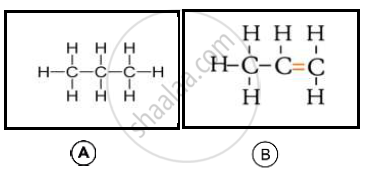
Observe the straight chain hydrocarbons given below and answer the following
questions :
i) Which of the straight chain compounds from A and B is saturated and unsaturated straight chains?
ii) Name these straight chains.
iii) Write their chemical formulae and number of – CH2 - units.
What do you understand by lone pair?
Explain the following:
Covalent compounds are generally gases or liquids or soft solids.
Acids dissolve in water to produce positively charged ions. Draw the structure of these positive ions.
Explain the bonding in methane molecule using electron dot structure.
Electrons are getting added to an element Y.
- Is Y getting oxidized or reduced?
- Which electrode will Y migrate to during the process of electrolysis?
Taking MgCl2 as an electrovalent compound, CCl4 as a covalent compound, give four difference between electrovalent and covalent compounds
Name two compounds that are covalent when taken pure but produce ions when dissolved in water.
Name gas with a rotten egg smell.
The bond between two oxygen atoms is _______ bond.
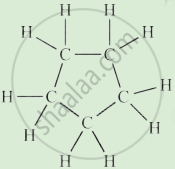
From the following hydrocarbon _______ is the cyclic hydrocarbon.
Write an Explanation.
Alkane
Complete the following activity.
Write the names of the hydrocarbons for the following structural formula.
(isobutylene, cyclohexane, propene, cyclohexene, cyclopentane, benzene, propyne, isobutane, propane)
 |
The I.U.P.A.C name of CH3CH2CH = CH2 is?
A molecule of ammonia (NH3) has
State the reasons, why carbon cannot
- Lose four electrons to form C4+ cation and
- Gain four electrons to form C4- anion.
How does carbon overcome this problem to form compounds?
