What is buckminsterfullerene?
Advertisements
प्रश्न
What is buckminsterfullerene?
Advertisements
उत्तर
Buckminsterfullerene is an allotrope of carbon. It is a spherical shaped molecule containing 60 carbon atoms, arranged in interlocking 20 hexagonal and 12 pentagonal rings of carbon atoms.
APPEARS IN
संबंधित प्रश्न
Write the number of covalent bonds in the molecule of butane, C4H10.
Elements forming ionic compounds attain noble gas configuration by either gaining or losing electrons from their outermost shells. Give reason to explain why carbon cannot attain noble gas configuration in this manner to form its compounds.
Buckminsterfullerene is a spherical molecule in which 60 carbon atoms are arranged in interlocking hexagonal and pentagonal rings of carbon atoms.
- How many hexagons of carbon atoms are present in one molecule of buckminsterfullerene?
- How many pentagons of carbon atoms are present in one molecule of buckminsterfullerene?
Name the hardest natural substance known.
What type of bond is present in hydrogen chloride?
What type of bond is present in the following molecule?
O2
Why does carbon form compounds mainly by covalent bonding?
Why is diamond used for making cutting tools (like glass cutters) but graphite is not?
Explain why, ionic compounds conduct electricity in solution whereas covalent compounds do not conduct electricity.
What type of bonding would you expect between the following pair of elements?
Hydrogen and Chlorine
Using electron-dot diagrams which show only the outermost shell electrons, show how a molecule of nitrogen, N2, is formed from two nitrogen atoms. What name is given to this type of bonding?
(Atomic number of nitrogen is 7)
Draw the electron-dot structure of the following compound and state the type of bonding in the given case:
CO2
Using electron-dot diagrams which show only the outermost shell electrons, show how a molecule of oxygen, O2, is formed from two oxygen atoms. What name is given to this type of bonding?
(At. No. of oxygen = 8)
Draw the electron-dot structure of the following compound and state the type of bonding in the given case:
N2
The number of covalent bonds in pentane (molecular formula C5H12) is ______.
One of the following contains a double bond as well as single bonds. This is:
The organic compound prepared by Wohler from an inorganic compound called ammonium cyanate was ______.
What are the conditions necessary for the formation of covalent molecules?
Give the characteristic properties of covalent compounds.
Draw all possible structural formulae of the compound from its molecular formula given below.
C3H8
Explain the Structural isomerism term with example.
Explain the following briefly.
Pure water does not conduct electricity, but on adding sodium chloride to it, it starts conducting electricity.
Give examples for the following:
Two liquid non polar compounds.
Explain why carbon tetrachloride does not dissolve in water.
Name a neutral covalent molecule which contains one lone pair of electrons.
In the formation of electrovalent compounds, electrons are transferred from one element to another. How are electrons involved in the formation of a covalent compound?
An element L consists of molecules.
- Which type of bond is present in the particles that make up L?
- When L is heated with iron metal, it forms a compound FeL. What chemical term would you use to describe change undergone by L?
Explain the following:
Water is a polar covalent molecule.
Name two compounds that are covalent when taken pure but produce ions when dissolved in water.
Potassium (Atomic No. 19) and chlorine (Atomic No. 17) react to form a compound. On the basis of electronic concept, explain
(i) oxidation
(ii) reduction
(iii)oxidising agent
(iv)reducing agent
Answer the following question.
What is methane? Draw its electron dot structure. Name the type of bonds formed in this compound. Why are such compounds:
(i) poor conductors of electricity? and
(ii) have low melting and boiling points? What happens when this compound burns in oxygen?
Write scientific reason.
Carbon has the property of forming many compounds.
Write scientific reason.
Benzene compounds are called aromatic compounds.
Complete the following activity.
Write the names of the hydrocarbons for the following structural formula.
(isobutylene, cyclohexane, propene, cyclohexene, cyclopentane, benzene, propyne, isobutane, propane)
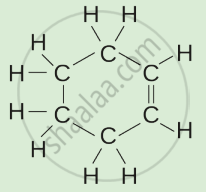 |
Consider the coordination compound, K2[Cu(CN)4]. A coordinate covalent bond exists between:
Cation is formed when ______.
Two carbon atoms can always form one or two covalent bonds.
Mineral acids are stronger acids than carboxylic acids because
- mineral acids are completely ionised
- carboxylic acids are completely ionised
- mineral acids are partially ionised
- carboxylic acids are partially ionised
Show the covalent bond formation in nitrogen molecule.
