Advertisements
Advertisements
प्रश्न
Give one example of the following:
A molecule containing a double covalent bond.
Advertisements
उत्तर
A molecule containing a double covalent bond is oxygen.
APPEARS IN
संबंधित प्रश्न
What would be the electron-dot structure of carbon dioxide which has the formula CO2?
What type of bond is present in methane (CH4)?
What type of bond is present in the following molecule?
CH4
Draw the electron-dot structure of the following compound and state the type of bonding in the given case:
NH3
Explain why, diamond can be used in rock drilling equipment but graphite cannot.
State one use of diamond which depends on its ‘extraordinary brilliance’ and one use of graphite which depends on its being ‘black and quite soft’.
Describe the structure of diamond. Draw a s imple diagram to show the arrangement of carbon atoms in diamond.
Why are covalent compounds generally poor conductors of electricity?
The solution of one of the following compounds will not conduct electricity. This compound is:
One of the following compounds is not ionic in nature. This compound is:
A covalent molecule having a double bond between its atoms is ______.
One of the following is not an allotrope of carbon. This is:
Which of the following cannot exhibit isomerism?
A solid element X has four electrons in the outermost shell of its atom. An allotrope Y of this element is used as a dry lubricant in machinery and also in making pencil leads.
(a) What is element X?
(b) Name the allotrope Y.
(c) State whether allotrope Y is a good conductor or non-conductor of electricity.
(d) Name one use of allotrope Y (other than lubrication and pencil leads)
(e) Name two other allotropes of element X.
What is the difference between ionic compounds and covalent compounds?
Complete the following:
In case of non-polar covalent bond, the covalent bond is formed in the ______ of atoms and shared electrons are ______ distributed. (corner, middle, equally, unequally)
Elements forming ionic compounds attain noble gas electronic configuration by either gaining or losing electrons from their valence shells. Explain giving reason why carbon cannot attain such a configuration in this manner to form its compounds. Name the type of bonds formed in ionic compounds and in the compounds formed by carbon. Also explain the reason why carbon compounds are generally poor conductors of electricity.
Explain the following term with example.
Hetero atom in a carbon compound
Molecular formula of Propane is C3H8 , write the structural formula of propane.
Choose and write the correct option.
Which type of carbon-carbon bonds are present in Vanaspati ghee?
In the formation of electrovalent compounds, electrons are transferred from one element to another. How are electrons involved in the formation of a covalent compound?
State the type of bonding in the following molecule.
Water
Electrons are getting added to an element Y:
Is Y getting oxidised or reduced?
Draw the electron dot structure of the covalent compound methane (non polar) and HCl (polar) and give two difference between them.
Name two compounds that are covalent when taken pure but produce ions when dissolved in water.
What is the difference between :
Ionic compounds and covalent compounds
Potassium (Atomic No. 19) and chlorine (Atomic No. 17) react to form a compound. On the basis of electronic concept, explain
(i) oxidation
(ii) reduction
(iii)oxidising agent
(iv)reducing agent
Name gas with a rotten egg smell.
Fill in the blank and rewrite the completed statement:
Covalent compounds are generally soluble in _________ solvents.
Complete the following activity.
Write the names of the hydrocarbons for the following structural formula.
(isobutylene, cyclohexane, propene, cyclohexene, cyclopentane, benzene, propyne, isobutane, propane)
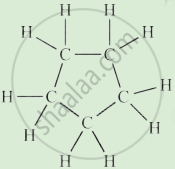 |
List two differences between the properties exhibited by covalent compounds and ionic compounds.
Give an example for each of the following statement
A compound in which two Covalent bonds are formed.
Which of the following is the formula of Butanoic acid?
Oils on treating with hydrogen in the presence of palladium or nickel catalyst form fats. This is an example of
Carbon forms four covalent bonds by sharing its four valence electrons with four univalent atoms, e.g. hydrogen. After the formation of four bonds, carbon attains the electronic configuration of
Write notes on the characteristics of covalent compounds.
Show the covalent bond formation in nitrogen molecule.
