What type of bond is present in methane (CH4)?
Advertisements
Advertisements
प्रश्न
What type of bond is present in methane (CH4)?
Advertisements
उत्तर
The chemical bond in methane (CH4) is covalent, as a carbon atom shares its four valence electrons with four hydrogen atoms to form a methane molecule.
APPEARS IN
संबंधित प्रश्न
What would be the electron dot structure of a molecule of sulphur which is made up of eight atoms of sulphur? (Hint – the eight atoms of sulphur are joined together in the form of a ring.)
State the type of bonding in the following molecule.
Water
Buckminsterfullerene is spherical molecule in which 60 carbon atoms are arranged in interlocking hexagonal and pentagonal rings of carbon atoms.
How many pentagons of carbon atoms are present in one molecule of buckminsterfullerene?
How does graphite act as a lubricant?
What type of bonds are present in a water molecule?
Two chlorine atoms combine to form a molecule. The bond between them is known as ______.
In forming N2 molecule, ______ electrons are shared by each atom of nitrogen.
Why is graphite used for making dry cell electrodes but diamond is not?
Draw the electron-dot structure of the following compound and state the type of bonding in the given case:
N2
A saturated hydrocarbon has fifty hydrogen atoms in its moleucle. The number of carbon atoms in its molecule will be ______.
Draw all possible structural formulae of the compound from its molecular formula given below.
C3H4
Explain the following term with an example.
Unsaturated hydrocarbon
Explain the following briefly:
Cl2 is a non polar molecule, while HCl is a polar molecule.
Explain the following:
Non-polar covalent compounds are insoluble in water.
(a) Compound X consists of molecules.
Choose the letter corresponding to the correct answer from the choices (a), (b), (c) and (d) given below
X is likely to have a :
(a) Compound X consists of molecules.
Choose the letter corresponding to the correct answer from the choices (a), (b), (c) and (d) given below
In the liquid state, X will
Name a neutral covalent molecule which contains one lone pair of electrons.
What is the term defined below?
A bond formed by a shared pair of electrons, each bonding atom contributing one electron to the pair.
Explain the bonding in methane molecule using electron dot structure.
An element L consists of molecules.
- Which type of bond is present in the particles that make up L?
- When L is heated with iron metal, it forms a compound FeL. What chemical term would you use to describe change undergone by L?
The particles present in strong electrolytes are
State the type of bonding in the following molecule.
Water
Elements Q and S react together to form an ionic compound. Under normal conditions, which physical state will the compound QS exist in?
What is the difference between :
Ionic compounds and covalent compounds
Potassium (Atomic No. 19) and chlorine (Atomic No. 17) react to form a compound. On the basis of electronic concept, explain
(i) oxidation
(ii) reduction
(iii)oxidising agent
(iv)reducing agent
Name two compounds that are covalent when taken pure but produce ions when dissolved in water.
Answer the following question.
What is methane? Draw its electron dot structure. Name the type of bonds formed in this compound. Why are such compounds:
(i) poor conductors of electricity? and
(ii) have low melting and boiling points? What happens when this compound burns in oxygen?
The number of electrons in the valence shell of a carbon atom is 4.
Write an Explanation.
Alkane
Write a short note.
Aromatic hydrocarbons
Complete the following activity.
Write the names of the hydrocarbons for the following structural formula.
(isobutylene, cyclohexane, propene, cyclohexene, cyclopentane, benzene, propyne, isobutane, propane)
| \[\begin{array}{cc}\phantom{......}\ce{H}\phantom{...}\ce{H}\phantom{...}\ce{H}\phantom{..}\\ \phantom{.....}|\phantom{....}|\phantom{....}|\\ \ce{H - C - C = C}\\\phantom{.....}|\phantom{.........}|\\ \phantom{.....}\ce{H}\phantom{........}\ce{H}\end{array}\] |
Complete the following activity.
Write the names of the hydrocarbons for the following structural formula.
(isobutylene, cyclohexane, propene, cyclohexene, cyclopentane, benzene, propyne, isobutane, propane)
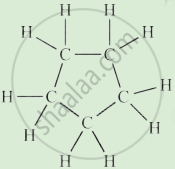 |
Carbon forms four covalent bonds by sharing its four valence electrons with four univalent atoms, e.g., hydrogen. After the formation of four bonds, carbon attains the electronic configuration of ______.
Which of the following statements are usually correct for carbon compounds? These
- are good conductors of electricity
- are poor conductors of electricity
- have strong forces of attraction between their molecules
- do not have strong forces of attraction between their molecules.
Which of the following statements are correct for carbon compounds?
- Most carbon compounds are good conductors of electricity.
- Most carbon compounds are poor conductors of electricity.
- Force of attraction between molecules of carbon compounds is not very strong.
- Force of attraction between molecules of carbon compounds is very strong.
The bond which is formed by the mutual sharing of electrons is called ______ bond.
In covalent bond formation, the sharing of ______ electrons takes place in their outermost shell.
"Carbon prefers to share its valence electrons with other atoms of carbon or with atoms of other elements rather than gaining or losing the valence electrons in order to attain noble gas configuration." Give reasons to justify this statement.
Carbon can neither form C4- cation nor C4 anion. Why?
In covalent compounds, the bond is formed due to ______ of electrons.
