Advertisements
Advertisements
प्रश्न
(a) Compound X consists of molecules.
Choose the letter corresponding to the correct answer from the choices (a), (b), (c) and (d) given below
X is likely to have a :
विकल्प
Low melting point and high boiling point
High melting point and low boiling point
Low melting point and low boiling point
High melting point and high boiling point
Advertisements
उत्तर
Low melting point and low boiling point
X is likely to have a:Low melting point and low boiling point
APPEARS IN
संबंधित प्रश्न
Name the black substance of pencil. Will the current flow through the electrical circuit when we use the sharpened ends of the pencil to complete the circuit?
Write the electron-dot structure for the following molecule:
Cl2
What type of bond is present in the following molecule?
Cl2
Explain why, ionic compounds conduct electricity in solution whereas covalent compounds do not conduct electricity.
Using electron-dot diagrams which show only the outermost shell electrons, show how a molecule of nitrogen, N2, is formed from two nitrogen atoms. What name is given to this type of bonding?
(Atomic number of nitrogen is 7)
Write two points of difference in the structures of diamond and graphite.
The electronic configurations of two elements A and B are given below:
| A | 2, 6 |
| B | 2, 8, 1 |
- What type of chemical bond is formed between the two atoms of A?
- What type of chemical bond will be formed between the atoms of A and B?
Name two carbon compounds used in day-to-day life.
Complete the following activity.
Write the names of the hydrocarbons for the following structural formula.
(isobutylene, cyclohexane, propene, cyclohexene, cyclopentane, benzene, propyne, isobutane, propane)
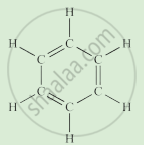 |
Consider the coordination compound, K2[Cu(CN)4]. A coordinate covalent bond exists between:
