Advertisements
Advertisements
प्रश्न
What type of bond is present in the following molecule?
CH4
Advertisements
उत्तर
A covalent bond is the chemical bond present in CH4, as a carbon atom shares its electrons with four hydrogen atoms.
APPEARS IN
संबंधित प्रश्न
Choose the most appropriate answer from the following list of oxides which fit the description.
A covalent oxide of a metalloid.
What type of bond is present in hydrogen chloride?
The form of carbon which is known as black lead is ______.
Two atoms of the same element combine to form a molecule. The bond between them is known as ______ bond.
What is a covalent bond?
Explain why:
Covalent compounds have generally low melting points.
Which inert gas does the H atom in HCl resemble in electron arrangement?
Draw the electron-dot structure of the following compound and state the type of bonding in the given case:
CO2
State one use of diamond which depends on its ‘extraordinary brilliance’ and one use of graphite which depends on its being ‘black and quite soft’.
Which of the following has a triple bond as well as single bonds?
Define a covalent bond.
For each compound mentioned above give the formulae of ions formed in aqueous solution.
State the type of bonding in the following molecule.
Ammonium ion
Distinguish between ionic and covalent compounds under the following properties:
(i) Strength of forces between constituent elements
(ii) Solubility of compounds in water
(iii) Electrical conduction in substances
Draw all possible structural formulae of the compound from its molecular formula given below.
C3H8
Write answer as directed.
Saturated hydrocarbons are classified into three types. Write these names giving one example each.
Choose the correct answer from the options given below
Condition favorable for formation of a covalent bond is
The electronic configuration of N2 is 2, 5. How many electrons in the outer shell of a N atom are not involved in the formation of a nitrogen molecule?
The molecule which contains a triple covalent bond is ______.
Elements Q and S react together to form an ionic compound. Under normal conditions, which physical state will the compound QS exist in?
State the type of bond formed when the combining atom has zero E.N. difference.
What is the difference between :
Ionic compounds and covalent compounds
Taking MgCl2 as an electrovalent compound, CCl4 as a covalent compound, give four difference between electrovalent and covalent compounds
Name gas with a rotten egg smell.
Write the molecular formula of the given compound.
Acetic acid
Write a short note.
Characteristics of carbon
Write a short note.
Aromatic hydrocarbons
Complete the following activity.
Write the names of the hydrocarbons for the following structural formula.
(isobutylene, cyclohexane, propene, cyclohexene, cyclopentane, benzene, propyne, isobutane, propane)
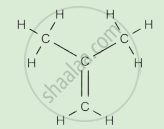 |
Give an example for each of the following statement.
Formation of coordinate covalent bond between NH3 ➝ BF3 molecules
Acetic acid was added to a solid X kept in a test tube. A colourless, odourless gas Y was evolved. The gas was passed through lime water, which turned milky. It was concluded that ______.
Which of the following statements are correct for carbon compounds?
- Most carbon compounds are good conductors of electricity.
- Most carbon compounds are poor conductors of electricity.
- Force of attraction between molecules of carbon compounds is not very strong.
- Force of attraction between molecules of carbon compounds is very strong.
Two carbon atoms can always form one or two covalent bonds.
Which of the following compound(s) possesses a high melting point?
Write notes on the characteristics of covalent compounds.
State the reasons, why carbon cannot
- Lose four electrons to form C4+ cation and
- Gain four electrons to form C4- anion.
How does carbon overcome this problem to form compounds?
It is observed that covalent compounds are had conductors of electricity. Give reason.
Carbon can neither form C4- cation nor C4 anion. Why?
The number of single and double bonds present in a molecule of benzene (C6H6) respectively, are ______.
