Advertisements
Advertisements
प्रश्न
One of the following compounds is not ionic in nature. This compound is:
विकल्प
Lithium chloride
Ammonium chloride
Calcium chloride
Carbon tetrachloride
Advertisements
उत्तर
Carbon tetrachloride
Explanation:
Carbon tetrachloride (CCl4) is formed exclusively between two non-metals: carbon and chlorine. Instead of transferring electrons, these atoms mutually share their valence electrons to achieve stability, resulting in a covalent compound. The lithium chloride, ammonium chloride, and calcium chloride all dissociate into oppositely charged ions, making them ionic in nature.
APPEARS IN
संबंधित प्रश्न
Elements forming ionic compounds attain noble gas configuration by either gaining or losing electrons from their outermost shells. Give reason to explain why carbon cannot attain noble gas configuration in this manner to form its compounds.
State the reason to explain why covalent compounds "have low melting and boiling points."
Name the element whose one of the allotropic forms is buckminsterfullerene.
Name the hardest natural substance known.
What type of bonds are present in a water molecule?
What type of bond is present in the following molecule?
CH4
What type of bond is present in oxygen?
How will you find out which of the water soluble compound A or B is ionic?
What type of bonding would you expect between the following pair of elements?
Hydrogen and Chlorine
Draw the electron-dot structure of the following compound and state the type of bonding in the given case:
CO2
Explain why, diamond can be used in rock drilling equipment but graphite cannot.
Describe the structure of diamond. Draw a s imple diagram to show the arrangement of carbon atoms in diamond.
An element E exists in three allotropic forms A, B and C. In allotrope A, the atoms of element E are joined to form spherical molecules. In allotrope B, each atom of element E is surrounded by three other E atoms to form a sheet like structure. În allotrope C, each atom of element E is surrounded by four other E atoms to form a rigid structure.
(a) Name the element E.
(b) What is allotrope A.
(c) What is allotrope B?
(d) What is allotrope C?
(e) Which allotrope is used in making jewellery?
(f) Which allotrope is used in making anode of a dry cell?
Give the characteristic properties of covalent compounds.
Explain the following:
polar covalent compounds electricity.
Explain the Structural isomerism term with example.
Explain the following term with example.
Hetero atom in a carbon compound
Explain the following term with an example.
Unsaturated hydrocarbon
The following structural formula belongs to which carbon compound?
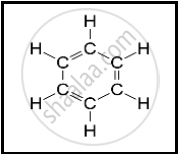
Choose and write the correct option.
Which type of carbon-carbon bonds are present in Vanaspati ghee?
Explain the structure of Hydronium ion.
Explain the following:
Covalent compounds have low melting and boiling point.
Explain the following:
Non-polar covalent compounds are insoluble in water.
(a) Compound X consists of molecules.
Choose the letter corresponding to the correct answer from the choices (a), (b), (c) and (d) given below
X is likely to have a :
Acids dissolve in water to produce positively charged ions. Draw the structure of these positive ions.
An element L consists of molecules.
- Which type of bond is present in the particles that make up L?
- When L is heated with iron metal, it forms a compound FeL. What chemical term would you use to describe change undergone by L?
Electrons are getting added to an element Y.
- Is Y getting oxidized or reduced?
- Which electrode will Y migrate to during the process of electrolysis?
Covalent bonds can be single, double or triple covalent bonds. How many electrons are shared in each? Give an example of each type.
Fill in the blank and rewrite the completed statement:
Covalent compounds are generally soluble in _________ solvents.
Name the types of Hydrocarbons.
Number of valence electrons in a carbon atom is _______.
Write an Explanation.
Alkane
Complete the following activity.
Write the names of the hydrocarbons for the following structural formula.
(isobutylene, cyclohexane, propene, cyclohexene, cyclopentane, benzene, propyne, isobutane, propane)
| \[\begin{array}{cc}\ce{H}\phantom{...}\ce{H}\phantom{...}\ce{H}\\ |\phantom{....}|\phantom{....}|\\\ce{H - C - C - C - H}\\ |\phantom{....}|\phantom{....}|\\\ce{H}\phantom{...}\ce{H}\phantom{...}\ce{H} \end{array}\] |
The correct structural formula of butanoic acid is -
In covalent bond formation, the sharing of ______ electrons takes place in their outermost shell.
"Carbon prefers to share its valence electrons with other atoms of carbon or with atoms of other elements rather than gaining or losing the valence electrons in order to attain noble gas configuration." Give reasons to justify this statement.
It is observed that covalent compounds are had conductors of electricity. Give reason.
Show the covalent bond formation in nitrogen molecule.
Non-polar covalent compounds are ______ conductors of heat and electricity.
