Advertisements
Advertisements
Question
One of the following compounds is not ionic in nature. This compound is:
Options
Lithium chloride
Ammonium chloride
Calcium chloride
Carbon tetrachloride
Advertisements
Solution
Carbon tetrachloride
Explanation:
Carbon tetrachloride (CCl4) is formed exclusively between two non-metals: carbon and chlorine. Instead of transferring electrons, these atoms mutually share their valence electrons to achieve stability, resulting in a covalent compound. The lithium chloride, ammonium chloride, and calcium chloride all dissociate into oppositely charged ions, making them ionic in nature.
APPEARS IN
RELATED QUESTIONS
What are covalent compounds?
Elements forming ionic compounds attain noble gas configuration by either gaining or losing electrons from their outermost shells. Give reason to explain why carbon cannot attain noble gas configuration in this manner to form its compounds.
What type of bond is present in hydrogen chloride?
In forming oxygen molecule, ______ electrons are shared by each atom of oxygen.
What type of bond exists in CCl4?
What type of bond is present in oxygen?
Which inert gas does the H atom in HCl resemble in electron arrangement?
What type of bonding would you expect between the following pair of elements?
Hydrogen and Chlorine
Why is graphite a good conductor of electricity but diamond is a non-conductor of electricity?
The atomic numbers of four elements P, Q, R and S are 6, 10, 12 and 17 respectively. Which two elements can combine to form a covalent compound?
Two non-metals combine with each other by the sharing of electrons to form a compound X.
- What type of chemical bond is present in X?
- State whether X will have a high melting point or low melting point.
- Will it be a good conductor of electricity or not?
- Will it dissolve in an organic solvent or not?
A hydrocarbon having one double bond has 100 carbon atoms in its molecule. The number of hydrogen atoms in its molecule will be ______.
A solid element X has four electrons in the outermost shell of its atom. An allotrope Y of this element is used as a dry lubricant in machinery and also in making pencil leads.
(a) What is element X?
(b) Name the allotrope Y.
(c) State whether allotrope Y is a good conductor or non-conductor of electricity.
(d) Name one use of allotrope Y (other than lubrication and pencil leads)
(e) Name two other allotropes of element X.
Methane molecule is non-polar molecule. Explain.
State the type of bonding in the following molecule.
Hydroxyl ion
Distinguish between ionic and covalent compounds under the following properties:
(i) Strength of forces between constituent elements
(ii) Solubility of compounds in water
(iii) Electrical conduction in substances
Explain the following term with example.
Covalent bond
Explain the following term with example.
Alkane
The carbon compound is used in daily life is ______.
Give examples for the following:
Two gaseous non polar compounds.
(a) Compound X consists of molecules.
Choose the letter corresponding to the correct answer from the choices (a), (b), (c) and (d) given below
The type of bonding in X will be
Compare the compounds carbon tetrachloride and sodium chloride with regard to solubility in water and electrical conductivity.
The molecule which contains a triple covalent bond is ______.
Electrons are getting added to an element Y:
Is Y getting oxidised or reduced?
Draw the electron dot diagram and structure of methane.
State the type of bond formed when the combining atom has zero E.N. difference.
Element A has 2 electrons in its M shell. Element B has atomic number 7.
- Write equations to show how A and B form ions.
- If B is a diatomic gas, write the equation for the direct combination of A and B to form a compound.
- If the compound formed between A and B is melted and an electric current is passed through the molten compound, the element A will be obtained at the ______ and B at the ______ of the electrolytic cell.
Element A has 2 electrons in its M shell. Element B has atomic number 7.
If B is a diatomic gas, write the equation for the direct combination of A and B to form a compound.
Name two compounds that are covalent when taken pure but produce ions when dissolved in water.
Explain the following:
Polar covalent compounds conduct electricity?
Name two compounds that are covalent when taken pure but produce ions when dissolved in water.
Name the anion present in the following compound:
When a barium chloride solution is added to a solution of compound B, a white precipitate insoluble in dilute hydrochloric acid is formed.
Generally, the melting and boiling point of carbon compounds are found to be less than _______ °C.
The bond between two oxygen atoms is _______ bond.
Write an Explanation.
Alkane
Complete the following activity.
Write the names of the hydrocarbons for the following structural formula.
(isobutylene, cyclohexane, propene, cyclohexene, cyclopentane, benzene, propyne, isobutane, propane)
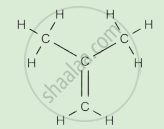 |
Identify the incorrect statement and correct them.
- Like covalent compounds, coordinate compounds also contain charged particles (ions). So they are good conductors of electricity.
- Ionic bond is a weak bond when compared to Hydrogen bond.
- Ionic or electrovalent bonds are formed by mutual sharing of electrons between atoms.
- Loss of electrons is called Oxidation and gain of electron is called Reduction.
- The electrons which are not involved in bonding are called valence electrons.
Discuss in brief about the properties of coordinate covalent compounds.
Statement (A): Covalent compounds are bad conductors of electricity.
Reason (B): Covalent compounds contain charged particles (ions)
In covalent compounds, the bond is formed due to ______ of electrons.
