Advertisements
Advertisements
प्रश्न
One of the following compounds is not ionic in nature. This compound is:
पर्याय
Lithium chloride
Ammonium chloride
Calcium chloride
Carbon tetrachloride
Advertisements
उत्तर
Carbon tetrachloride
Explanation:
Carbon tetrachloride (CCl4) is formed exclusively between two non-metals: carbon and chlorine. Instead of transferring electrons, these atoms mutually share their valence electrons to achieve stability, resulting in a covalent compound. The lithium chloride, ammonium chloride, and calcium chloride all dissociate into oppositely charged ions, making them ionic in nature.
APPEARS IN
संबंधित प्रश्न
Elements forming ionic compounds attain noble gas configuration by either gaining or losing electrons from their outermost shells. Give reason to explain why carbon cannot attain noble gas configuration in this manner to form its compounds.
Choose the correct answer from the options given below:
Which of the following is a common characteristic of a covalent compound?
1) high melting point
2) consists of molecules
3) always soluble in water
4) Conducts electricity when it is in the molten state
Name a carbon containing molecule which has two double bonds.
State one major difference between covalent and ionic bonds.
What type of bond is present in the following molecule?
CH4
Give one example of the following:
A molecule containing a single covalent bond.
Why is graphite used for making dry cell electrodes but diamond is not?
Using electron-dot diagrams which show only the outermost shell electrons, show how a molecule of oxygen, O2, is formed from two oxygen atoms. What name is given to this type of bonding?
(At. No. of oxygen = 8)
Explain why, diamond is hard while graphite is soft (though both are made of carbon atoms).
Explain why, diamond has a high melting point.
Out of KCl, HCl, CCl4 and NaCl, the compounds which are not ionic are:
The molecules having triple bond in them are ______.
The pencil leads are made of mainly ______.
A solid element X has four electrons in the outermost shell of its atom. An allotrope Y of this element is used as a dry lubricant in machinery and also in making pencil leads.
(a) What is element X?
(b) Name the allotrope Y.
(c) State whether allotrope Y is a good conductor or non-conductor of electricity.
(d) Name one use of allotrope Y (other than lubrication and pencil leads)
(e) Name two other allotropes of element X.
For each compound mentioned above give the formulae of ions formed in aqueous solution.
Give two example in following case:
Gaseous non polar covalent compound.
Match the pairs.
| Group 'A' | Group 'B' |
| a. C2H6 | 1. Unsaturated hydrocarbon |
| b. C2H2 | 2. Molecular formula of an alcohol |
| c. CH4O | 3. Saturated hydrocarbon |
| d. C3H6 | 4. Triple bond |
Explain the following term with example.
Alkane
Explain the structure of Hydronium ion.
Explain the following:
Covalent compounds have low melting and boiling point.
Acids dissolve in water to produce positively charged ions. Draw the structure of these positive ions.
In the formation of electrovalent compounds, electrons are transferred from one element to another. How are electrons involved in the formation of a covalent compound?
State the type of bonding in the following molecule.
Water
Draw an electron dot diagram to show the formation of the following compound.
Magnesium chloride
[Mg = 12, Cl = 17]
State the type of bond formed when the combining atom has small E.N. difference.
Element A has 2 electrons in its M shell. Element B has atomic number 7.
If the compound formed between A and B is melted and an electric current is passed through the molten compound, the element A will be obtained at the ______ and B at the ______ of the electrolytic cell.
Name two compounds that are covalent when taken pure but produce ions when dissolved in water.
What is the difference between a polar covalent compound and a non-polar covalent compound?
Name two compounds that are covalent when taken pure but produce ions when dissolved in water.
The molecular masses of a carbon compound spread over a range of _______.
Your body is made up of carbon.
Write an Explanation.
Alkene
Write a short note.
Aromatic hydrocarbons
Complete the following activity.
Write the names of the hydrocarbons for the following structural formula.
(isobutylene, cyclohexane, propene, cyclohexene, cyclopentane, benzene, propyne, isobutane, propane)
| \[\begin{array}{cc}\phantom{......}\ce{H}\phantom{...}\ce{H}\phantom{...}\ce{H}\phantom{..}\\ \phantom{.....}|\phantom{....}|\phantom{....}|\\ \ce{H - C - C = C}\\\phantom{.....}|\phantom{.........}|\\ \phantom{.....}\ce{H}\phantom{........}\ce{H}\end{array}\] |
Complete the following activity.
Write the names of the hydrocarbons for the following structural formula.
(isobutylene, cyclohexane, propene, cyclohexene, cyclopentane, benzene, propyne, isobutane, propane)
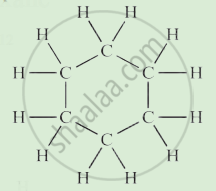 |
Give an example for each of the following statement
A compound in which two Covalent bonds are formed.
The number of pi-bonds present in benzoic acid molecule are ______.
