Advertisements
Advertisements
प्रश्न
The molecules having triple bond in them are ______.
पर्याय
oxygen and ethyne
carbon dioxide and ammonia
methane and ethene
nitrogen and ethyne
Advertisements
उत्तर
The molecules having triple bond in them are nitrogen and ethyne.
Explanation:
A nitrogen molecule (N2) forms a triple bond because each nitrogen atom shares three pairs of electrons to complete its octet. Similarly, an ethyne molecule (C2H2) contains a carbon-to-carbon triple bond (C ≡ C) because the two carbon atoms share three pairs of electrons with each other to achieve stability. The other choices contain only single bonds, double bonds, or a combination of both.
APPEARS IN
संबंधित प्रश्न
Name the type of bonds formed in ionic compounds and in the compounds formed by carbon.
Write any three features and give two examples of covalent compounds
Buckminsterfullerene is a spherical molecule in which 60 carbon atoms are arranged in interlocking hexagonal and pentagonal rings of carbon atoms.
- How many hexagons of carbon atoms are present in one molecule of buckminsterfullerene?
- How many pentagons of carbon atoms are present in one molecule of buckminsterfullerene?
What type of chemical bonds are formed by carbon? Why?
Friedrich Wohler converted an inorganic compound into an organic compound in the laboratory.
- Give the name and formula of inorganic compound.
- Write the name and formula of organic compound formed.
Which inert gas does the Cl atom in HCl resemble in electron arrangement?
Buckminsterfullerene is an allotropic form of the element:
Two non-metals combine with each other by the sharing of electrons to form a compound X.
- What type of chemical bond is present in X?
- State whether X will have a high melting point or low melting point.
- Will it be a good conductor of electricity or not?
- Will it dissolve in an organic solvent or not?
Give the formulae of the chlorides of the elements X and Y having atomic numbers of 3 and 6 respectively. Will the properties of the two chlorides be similar or different? Explain your answer.
Methane molecule is non-polar molecule. Explain.
Draw an electron dot diagram for the formation of the following. State the type of bonding present in them.
Hydroxyl ion
Match the pairs.
| Group 'A' | Group 'B' |
| a. C2H6 | 1. Unsaturated hydrocarbon |
| b. C2H2 | 2. Molecular formula of an alcohol |
| c. CH4O | 3. Saturated hydrocarbon |
| d. C3H6 | 4. Triple bond |
Explain the Structural isomerism term with example.
Explain the following term with an example.
Unsaturated hydrocarbon
Explain the structure of Hydronium ion.
Fill in the blank from the choice given in bracket.
The compound that does not have a lone pair of electrons is ___________. (Water, Ammonia, carbon tetrachloride)
Compound X consists of molecules.
Choose the letter corresponding to the correct answer from the options A, B, C and D given below:
The type of bonding in X will be ______.
Compound X consists of molecules.
Choose the letter corresponding to the correct answer from the options A, B, C and D given below:
X is likely to have a ______.
What are the term defined below?
A bond formed by share pair of electrons, each bonding atom contributing one electron to the pair.
State the type of bond formed when the combining atom has zero E.N. difference.
Draw the electron dot structure of the covalent compound methane (non polar) and HCl (polar) and give two difference between them.
Name two compounds that are covalent when taken pure but produce ions when dissolved in water.
Answer the following question.
What is methane? Draw its electron dot structure. Name the type of bonds formed in this compound. Why are such compounds:
(i) poor conductors of electricity? and
(ii) have low melting and boiling points? What happens when this compound burns in oxygen?
The molecular masses of a carbon compound spread over a range of _______.
Write an Explanation.
Alkane
Write an Explanation.
Alkyne
Complete the following activity.
Write the names of the hydrocarbons for the following structural formula.
(isobutylene, cyclohexane, propene, cyclohexene, cyclopentane, benzene, propyne, isobutane, propane)
| \[\begin{array}{cc}\ce{H}\phantom{...}\ce{H}\phantom{...}\ce{H}\\ |\phantom{....}|\phantom{....}|\\\ce{H - C - C - C - H}\\ |\phantom{....}|\phantom{....}|\\\ce{H}\phantom{...}\ce{H}\phantom{...}\ce{H} \end{array}\] |
Complete the following activity.
Write the names of the hydrocarbons for the following structural formula.
(isobutylene, cyclohexane, propene, cyclohexene, cyclopentane, benzene, propyne, isobutane, propane)
| \[\begin{array}{cc} \phantom{.........}\ce{H}\\ \phantom{.........}|\\ \ce{H - C ≡ C - C - H}\\ \phantom{.........}|\\ \phantom{.........}\ce{H} \end{array}\] |
Complete the following activity.
Write the names of the hydrocarbons for the following structural formula.
(isobutylene, cyclohexane, propene, cyclohexene, cyclopentane, benzene, propyne, isobutane, propane)
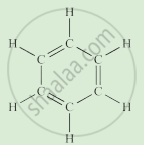 |
Complete the following activity.
Write the names of the hydrocarbons for the following structural formula.
(isobutylene, cyclohexane, propene, cyclohexene, cyclopentane, benzene, propyne, isobutane, propane)
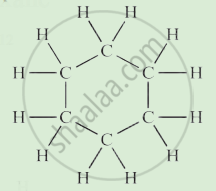 |
List two differences between the properties exhibited by covalent compounds and ionic compounds.
The number of pi-bonds present in benzoic acid molecule are ______.
The I.U.P.A.C name of CH3CH2CH = CH2 is?
Oils on treating with hydrogen in the presence of palladium or nickel catalyst form fats. This is an example of
The correct structural formula of butanoic acid is
The electron dot structure of chlorine molecule is:
It is observed that covalent compounds are had conductors of electricity. Give reason.
Carbon can neither form C4- cation nor C4 anion. Why?
