What type of chemical bonds are formed by carbon? Why?
Advertisements
प्रश्न
What type of chemical bonds are formed by carbon? Why?
Advertisements
उत्तर
Carbon always forms covalent bonds. This is because it is tetravalent and attain the inert gas configuration of 8 electrons in its outermost shell by sharing electrons.
APPEARS IN
संबंधित प्रश्न
List three characteristic properties of covalent compounds.
Give appropriate scientific reasons for Carbon tetrachloride does not conduct electricity.
Choose the most appropriate answer from the following list of oxides which fit the description.
A covalent oxide of a metalloid.
Name a carbon containing molecule which has two double bonds.
What type of chemical bond is formed between:
Carbon and bromine
What type of bond is present in the following molecule?
CH4
What type of bond is present in the following molecule?
O2
Two atoms of the same element combine to form a molecule. The bond between them is known as ______ bond.
What type of chemical bond is present in the chlorine molecule? Explain your answer.
How is buckminsterfullerene related to diamond and graphite?
Friedrich Wohler converted an inorganic compound into an organic compound in the laboratory.
- Give the name and formula of inorganic compound.
- Write the name and formula of organic compound formed.
will CCl4 conduct electricity or not?
give reason for your choice.
Draw the electron-dot structure of the following compound and state the type of bonding in the given case:
H2O
Draw the electron-dot structure of the following compound and state the type of bonding in the given case:
HCl
Explain why, graphite can be used as a lubricant but diamond cannot.
Which of the following cannot exhibit isomerism?
An element A has 4 valence electrons in its atom whereas element B has only one valence electron in its atom. The compound formed by A and B does not conduct electricity. What is the nature of chemical bond in the compound formed? Give its electron-dot structure.
Methane molecule is non-polar molecule. Explain.
Explain the following:
polar covalent compounds electricity.
Give two example in following case:
Solid covalent compounds
Elements forming ionic compounds attain noble gas electronic configuration by either gaining or losing electrons from their valence shells. Explain giving reason why carbon cannot attain such a configuration in this manner to form its compounds. Name the type of bonds formed in ionic compounds and in the compounds formed by carbon. Also explain the reason why carbon compounds are generally poor conductors of electricity.
Explain the following term with example.
Covalent bond
Explain the following term with example.
Hetero atom in a carbon compound
The following structural formula belongs to which carbon compound?
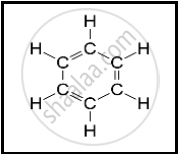
The carbon compound is used in daily life is ______.
Explain the following:
Non-polar covalent compounds are insoluble in water.
Choose the correct answer from the options given below
Which one is not example of polar covalent compound?
(a) Compound X consists of molecules.
Choose the letter corresponding to the correct answer from the choices (a), (b), (c) and (d) given below
X is likely to have a :
Name a neutral covalent molecule which contains one lone pair of electrons.
An element L consists of molecules.
- Which type of bond is present in the particles that make up L?
- When L is heated with iron metal, it forms a compound FeL. What chemical term would you use to describe change undergone by L?
Name the anion present in the following compound:
When a barium chloride solution is added to a solution of compound B, a white precipitate insoluble in dilute hydrochloric acid is formed.
Complete the following activity.
Write the names of the hydrocarbons for the following structural formula.
(isobutylene, cyclohexane, propene, cyclohexene, cyclopentane, benzene, propyne, isobutane, propane)
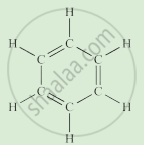 |
Complete the following activity.
Write the names of the hydrocarbons for the following structural formula.
(isobutylene, cyclohexane, propene, cyclohexene, cyclopentane, benzene, propyne, isobutane, propane)
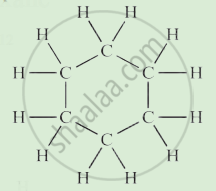 |
Discuss in brief about the properties of coordinate covalent compounds.
Carbon can neither form C4- cation nor C4 anion. Why?
