What is the atomic number of carbon. Write its electronic configuration.
Advertisements
प्रश्न
What is the atomic number of carbon. Write its electronic configuration.
Advertisements
उत्तर
The atomic number of carbon is 6.
Its electronic configuration is K L.
2 4
APPEARS IN
संबंधित प्रश्न
Write the number of covalent bonds in the molecule of butane, C4H10.
List three characteristic properties of covalent compounds.
Name the type of bonds formed in ionic compounds and in the compounds formed by carbon.
Explain the bonding in methane molecule using electron dot structure.
Choose the most appropriate answer from the following list of oxides which fit the description.
A covalent oxide of a metalloid.
Name the following:
The property of element by virtue of which atoms of the element can link to each other in the form of a long chain or ring structure.
Name a carbon containing molecule which has two double bonds.
Give one example of the following:
A molecule containing a double covalent bond.
Two atoms of the same element combine to form a molecule. The bond between them is known as ______ bond.
In forming oxygen molecule, ______ electrons are shared by each atom of oxygen.
What type of bond exists in CCl4?
Explain the formation of a chlorine molecule on the basis of electronic theory of valency.
Explain why:
Covalent compounds have generally low melting points.
Give two general properties of ionic compounds.
Give the formula of the compound that would be formed by the combination of the following pair of elements:
Al and Cl2
Buckminsterfullerene is an allotropic form of the element:
The molecules having triple bond in them are ______.
Which of the following cannot exhibit isomerism?
A solid element X has four electrons in the outermost shell of its atom. An allotrope Y of this element is used as a dry lubricant in machinery and also in making pencil leads.
(a) What is element X?
(b) Name the allotrope Y.
(c) State whether allotrope Y is a good conductor or non-conductor of electricity.
(d) Name one use of allotrope Y (other than lubrication and pencil leads)
(e) Name two other allotropes of element X.
Draw an electron dot structure of the following molecule. (Without showing the circle) :
Ethene
Give examples for the following:
Two liquid non polar compounds.
Explain the following:
Polar covalent compounds are good conductors of electricity.
(a) Compound X consists of molecules.
Choose the letter corresponding to the correct answer from the choices (a), (b), (c) and (d) given below
In the liquid state, X will
Draw an electron dot diagram to show the formation of the following compound.
Methane
[H = 1, C = 6]
What do you understand by dipole (polar) molecule?
What is the difference between :
Ionic compounds and covalent compounds
What is the difference between a polar covalent compound and a non-polar covalent compound?
Answer the following question.
What is methane? Draw its electron dot structure. Name the type of bonds formed in this compound. Why are such compounds:
(i) poor conductors of electricity? and
(ii) have low melting and boiling points? What happens when this compound burns in oxygen?
Name two carbon compounds used in day-to-day life.
Write an Explanation.
Alkene
Complete the following activity.
Write the names of the hydrocarbons for the following structural formula.
(isobutylene, cyclohexane, propene, cyclohexene, cyclopentane, benzene, propyne, isobutane, propane)
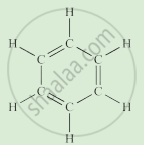 |
Complete the following activity.
Write the names of the hydrocarbons for the following structural formula.
(isobutylene, cyclohexane, propene, cyclohexene, cyclopentane, benzene, propyne, isobutane, propane)
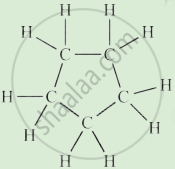 |
Give an example for each of the following statement.
Formation of coordinate covalent bond between NH3 ➝ BF3 molecules
Carbon forms four covalent bonds by sharing its four valence electrons with four univalent atoms, e.g., hydrogen. After the formation of four bonds, carbon attains the electronic configuration of ______.
Which of the following statements are correct for carbon compounds?
- Most carbon compounds are good conductors of electricity.
- Most carbon compounds are poor conductors of electricity.
- Force of attraction between molecules of carbon compounds is not very strong.
- Force of attraction between molecules of carbon compounds is very strong.
The correct structural formula of butanoic acid is
Statement (A): Covalent compounds are bad conductors of electricity.
Reason (B): Covalent compounds contain charged particles (ions)
Non-polar covalent compounds are ______ conductors of heat and electricity.
