Advertisements
Advertisements
प्रश्न
Explain why:
Covalent compounds have generally low melting points.
Advertisements
उत्तर
Covalent compounds generally have low melting points because the molecules in these compounds are held together by weak intermolecular forces. Only a small amount of heat energy is required to overcome these forces and separate the molecules.
APPEARS IN
संबंधित प्रश्न
Elements forming ionic compounds attain noble gas configuration by either gaining or losing electrons from their outermost shells. Give reason to explain why carbon cannot attain noble gas configuration in this manner to form its compounds.
Butanone is a four-carbon compound with the functional group:
Explain the bonding in methane molecule using electron dot structure.
Name the hardest natural substance known.
What type of bond is present in hydrogen chloride?
Give one example of the following:
A molecule containing a single covalent bond.
Two chlorine atoms combine to form a molecule. The bond between them is known as ______.
In forming N2 molecule, ______ electrons are shared by each atom of nitrogen.
What is buckminsterfullerene?
Give the formula of the compound that would be formed by the combination of the following pair of elements:
Al and Cl2
What is graphite?
Of what substance is graphite made?
A saturated hydrocarbon has fifty hydrogen atoms in its moleucle. The number of carbon atoms in its molecule will be ______.
A hydrocarbon having one double bond has 100 carbon atoms in its molecule. The number of hydrogen atoms in its molecule will be ______.
The electronic configurations of two elements A and B are given below:
| A | 2, 6 |
| B | 2, 8, 1 |
- What type of chemical bond is formed between the two atoms of A?
- What type of chemical bond will be formed between the atoms of A and B?
An element E exists in three allotropic forms A, B and C. In allotrope A, the atoms of element E are joined to form spherical molecules. In allotrope B, each atom of element E is surrounded by three other E atoms to form a sheet like structure. În allotrope C, each atom of element E is surrounded by four other E atoms to form a rigid structure.
(a) Name the element E.
(b) What is allotrope A.
(c) What is allotrope B?
(d) What is allotrope C?
(e) Which allotrope is used in making jewellery?
(f) Which allotrope is used in making anode of a dry cell?
State the type of bonding in the following molecule.
Methane
Give two example in following case:
Liquid non polar covalent compound.
Draw an electron dot structure of the following molecule. (Without showing the circle) :
Water
Explain the following term with example.
Covalent bond
(a) Compound X consists of molecules.
Choose the letter corresponding to the correct answer from the choices (a), (b), (c) and (d) given below
In the liquid state, X will
The particles present in strong electrolytes are
Explain why carbon tetrachloride does not dissolve in water.
Element A has 2 electrons in its M shell. Element B has atomic number 7.
- Write equations to show how A and B form ions.
- If B is a diatomic gas, write the equation for the direct combination of A and B to form a compound.
- If the compound formed between A and B is melted and an electric current is passed through the molten compound, the element A will be obtained at the ______ and B at the ______ of the electrolytic cell.
Explain the following:
Polar covalent compounds conduct electricity?
Name gas with a rotten egg smell.
Name the anion present in the following compound:
When a barium chloride solution is added to a solution of compound B, a white precipitate insoluble in dilute hydrochloric acid is formed.
Generally, the melting and boiling point of carbon compounds are found to be less than _______ °C.
Write a short note.
Characteristics of carbon
Complete the following activity.
Write the names of the hydrocarbons for the following structural formula.
(isobutylene, cyclohexane, propene, cyclohexene, cyclopentane, benzene, propyne, isobutane, propane)
| \[\begin{array}{cc} \phantom{..}\ce{H}\phantom{...}\ce{H}\phantom{...}\ce{H}\\ \phantom{..}|\phantom{....}|\phantom{....}|\\ \ce{H - C - C- C- H}\\ \phantom{.}|\phantom{....}|\phantom{....}|\\ \ce{H - C - H}\\ |\\\ce{H}\end{array}\] |
Complete the following activity.
Write the names of the hydrocarbons for the following structural formula.
(isobutylene, cyclohexane, propene, cyclohexene, cyclopentane, benzene, propyne, isobutane, propane)
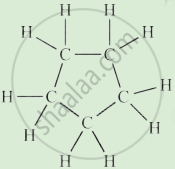 |
Give an example for each of the following statement.
Formation of coordinate covalent bond between NH3 ➝ BF3 molecules
Give an example for each of the following statement.
A compound in which three covalent bonds are formed.
The correct structural formula of butanoic acid is -
The I.U.P.A.C name of CH3CH2CH = CH2 is?
Which of the following compound(s) possesses a high melting point?
What is a covalent bond?
Name the following:
\[\ce{CH3 - CH2CH = CH2}\]
