Advertisements
Advertisements
Question
Explain why:
Covalent compounds have generally low melting points.
Advertisements
Solution
Covalent compounds generally have low melting points because the molecules in these compounds are held together by weak intermolecular forces. Only a small amount of heat energy is required to overcome these forces and separate the molecules.
APPEARS IN
RELATED QUESTIONS
Explain the nature of the covalent bond using the bond formation in CH3Cl.
Name the following:
The property of element by virtue of which atoms of the element can link to each other in the form of a long chain or ring structure.
Name the hardest natural substance known.
State one major difference between covalent and ionic bonds.
Two chlorine atoms combine to form a molecule. The bond between them is known as ______.
In forming oxygen molecule, ______ electrons are shared by each atom of oxygen.
What type of bond is present in oxygen?
Why is diamond used for making cutting tools (like glass cutters) but graphite is not?
Give the formula of the compound that would be formed by the combination of the following pair of elements:
Al and Cl2
Which inert gas does the Cl atom in HCl resemble in electron arrangement?
Explain why, diamond has a high melting point.
Of what substance is graphite made?
Why is graphite a good conductor of electricity but diamond is a non-conductor of electricity?
Which of the following has a triple bond as well as single bonds?
Which of the following cannot exhibit isomerism?
The number of isomers formed by the hydrocarbon with molecular formula C5H12 is ______.
Define a covalent bond.
For each compound mentioned above give the formulae of ions formed in aqueous solution.
Define a coordinate bond.
Draw an electron dot diagram for the formation of the following. State the type of bonding present in them.
Hydroxyl ion
Give two example in following case:
Gaseous polar covalent compound.
Write answer as directed.
Saturated hydrocarbons are classified into three types. Write these names giving one example each.
Choose the correct answer from the options given below
Condition favorable for formation of a covalent bond is
What are the term defined below?
A bond formed by share pair of electrons, each bonding atom contributing one electron to the pair.
Draw the electron dot diagram and structure of nitrogen molecule.
Draw the electron dot structure of the covalent compound methane (non polar) and HCl (polar) and give two difference between them.
What are Allotropes? Name any two allotropic forms of carbon. Give one use of it.
Name the types of Hydrocarbons.
The molecular masses of a carbon compound spread over a range of _______.
Complete the following activity.
Write the names of the hydrocarbons for the following structural formula.
(isobutylene, cyclohexane, propene, cyclohexene, cyclopentane, benzene, propyne, isobutane, propane)
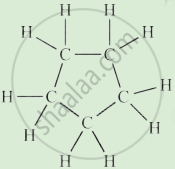 |
When ethyl alcohol and acetic acid are mixed, the resulting ester has a chemical formula ______.
The correct structural formula of butanoic acid is -
Acetic acid was added to a solid X kept in a test tube. A colourless, odourless gas Y was evolved. The gas was passed through lime water, which turned milky. It was concluded that ______.
Which of the following is the formula of Butanoic acid?
______ is an example of a covalent compound having a high melting point.
Which of the following compound(s) possesses a high melting point?
Write notes on the characteristics of covalent compounds.
"Carbon prefers to share its valence electrons with other atoms of carbon or with atoms of other elements rather than gaining or losing the valence electrons in order to attain noble gas configuration." Give reasons to justify this statement.
Non-polar covalent compounds are ______ conductors of heat and electricity.
