What type of chemical bonds are formed by carbon? Why?
Advertisements
प्रश्न
What type of chemical bonds are formed by carbon? Why?
Advertisements
उत्तर
Carbon always forms covalent bonds. This is because it is tetravalent and attain the inert gas configuration of 8 electrons in its outermost shell by sharing electrons.
APPEARS IN
संबंधित प्रश्न
Give reason why carbon compounds are generally poor conductors of electricity.
What would be the electron dot structure of a molecule of sulphur which is made up of eight atoms of sulphur? (Hint – the eight atoms of sulphur are joined together in the form of a ring.)
How does graphite act as a lubricant?
State one major difference between covalent and ionic bonds.
The form of carbon which is known as black lead is ______.
In forming N2 molecule, ______ electrons are shared by each atom of nitrogen.
What type of chemical bond is present in the chlorine molecule? Explain your answer.
What is buckminsterfullerene?
How is buckminsterfullerene related to diamond and graphite?
How will you find out which of the water soluble compound A or B is ionic?
Give the formula of the compound that would be formed by the combination of the following pair of elements:
Al and Cl2
Using electron-dot diagrams which show only the outermost shell electrons, show how a molecule of oxygen, O2, is formed from two oxygen atoms. What name is given to this type of bonding?
(At. No. of oxygen = 8)
State one use of diamond which depends on its ‘extraordinary brilliance’ and one use of graphite which depends on its being ‘black and quite soft’.
What is graphite?
Which of the following has a triple bond as well as single bonds?
The electronic configurations of three elements X, Y and Z are as follows:
| X | 2, 4 |
| Y | 2, 7 |
| Z | 2, 1 |
- Which two elements will combine to form an ionic compound?
- Which two elements will react to form a covalent compound?
Give reasons for your choice.
An element E exists in three allotropic forms A, B and C. In allotrope A, the atoms of element E are joined to form spherical molecules. In allotrope B, each atom of element E is surrounded by three other E atoms to form a sheet like structure. În allotrope C, each atom of element E is surrounded by four other E atoms to form a rigid structure.
(a) Name the element E.
(b) What is allotrope A.
(c) What is allotrope B?
(d) What is allotrope C?
(e) Which allotrope is used in making jewellery?
(f) Which allotrope is used in making anode of a dry cell?
What happens when methane (natural gas) burns in air? Write the chemical equation of the reaction involved.
Give two example in following case:
Gaseous non polar covalent compound.
Which element exhibits the property of catenation to maximum extent and why?
Draw an electron dot structure of the following molecule. (Without showing the circle) :
Methanol
Explain the following term with example.
Hetero atom in a carbon compound
The following structural formula belongs to which carbon compound?
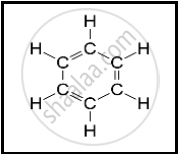
Choose the correct answer from the options given below
Which one is not example of polar covalent compound?
Fill in the blank with correct word from the bracket.
Melting and boiling points of covalent compounds are generally ______ (low, high).
Which of the following is a common characteristic of a covalent compound?
State the type of bonding in the following molecule.
Water
Electrons are getting added to an element Y.
- Is Y getting oxidized or reduced?
- Which electrode will Y migrate to during the process of electrolysis?
What is the difference between a polar covalent compound and a non-polar covalent compound?
Covalent bonds can be single, double or triple covalent bonds. How many electrons are shared in each? Give an example of each type.
The bond between two oxygen atoms is _______ bond.
Write a short note.
Aromatic hydrocarbons
Complete the following activity.
Write the names of the hydrocarbons for the following structural formula.
(isobutylene, cyclohexane, propene, cyclohexene, cyclopentane, benzene, propyne, isobutane, propane)
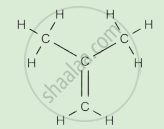 |
Complete the following activity.
Write the names of the hydrocarbons for the following structural formula.
(isobutylene, cyclohexane, propene, cyclohexene, cyclopentane, benzene, propyne, isobutane, propane)
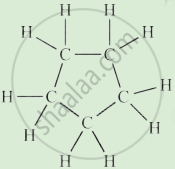 |
Which of the following is the purest form of carbon?
Carbon can neither form C4- cation nor C4 anion. Why?
Name the following:
\[\ce{CH3 - CH2CH = CH2}\]
Show the covalent bond formation in nitrogen molecule.
