Friedrich Wohler converted an inorganic compound into an organic compound in the laboratory. (i) Give the name and formula of inorganic compound. (ii) Write the name and formula of organic compound
Advertisements
प्रश्न
Friedrich Wohler converted an inorganic compound into an organic compound in the laboratory.
- Give the name and formula of inorganic compound.
- Write the name and formula of organic compound formed.
Advertisements
उत्तर
- Ammonium cyanate (NH4CNO)
- Urea (CO(NH2)2)
APPEARS IN
संबंधित प्रश्न
Name the type of bonds formed in ionic compounds and in the compounds formed by carbon.
State the reason to explain why covalent compounds "have low melting and boiling points."
Butanone is a four-carbon compound with the functional group:
What type of bonds are present in a water molecule?
The form of carbon which is known as black lead is ______.
What type of chemical bond is present in the chlorine molecule? Explain your answer.
Explain why:
Covalent compounds have generally low melting points.
State one test by which sodium chloride can be distinguished from sugar.
How will you find out which of the water soluble compound A or B is ionic?
Draw the electron-dot structure of a hydrogen chloride molecule:
- Which inert gas does the H atom in HCl resemble in electron arrangement?
- Which inert gas does the Cl atom in HCl resemble in electron arrangement?
Which inert gas does the Cl atom in HCl resemble in electron arrangement?
What is graphite?
Of what substance is graphite made?
State any two uses of graphite.
Why are covalent compounds generally poor conductors of electricity?
One of the following compounds is not ionic in nature. This compound is:
The pencil leads are made of mainly ______.
The electronic configurations of two elements A and B are given below:
| A | 2, 6 |
| B | 2, 8, 1 |
- What type of chemical bond is formed between the two atoms of A?
- What type of chemical bond will be formed between the atoms of A and B?
An element E exists in three allotropic forms A, B and C. In allotrope A, the atoms of element E are joined to form spherical molecules. In allotrope B, each atom of element E is surrounded by three other E atoms to form a sheet like structure. În allotrope C, each atom of element E is surrounded by four other E atoms to form a rigid structure.
(a) Name the element E.
(b) What is allotrope A.
(c) What is allotrope B?
(d) What is allotrope C?
(e) Which allotrope is used in making jewellery?
(f) Which allotrope is used in making anode of a dry cell?
Methane molecule is non-polar molecule. Explain.
State the type of bonding in the following molecule.
Methane
Distinguish between ionic and covalent compounds under the following properties:
(i) Strength of forces between constituent elements
(ii) Solubility of compounds in water
(iii) Electrical conduction in substances
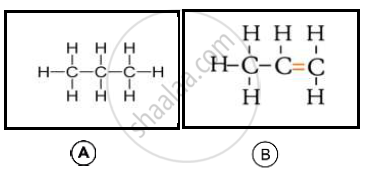
Observe the straight chain hydrocarbons given below and answer the following
questions :
i) Which of the straight chain compounds from A and B is saturated and unsaturated straight chains?
ii) Name these straight chains.
iii) Write their chemical formulae and number of – CH2 - units.
Give the appropriate term defined by the statement given below:
The covalent bond in which the electrons are shared equally between the combining atoms.
Explain the following briefly:
Cl2 is a non polar molecule, while HCl is a polar molecule.
Choose the correct answer from the options given below
Which one is not example of polar covalent compound?
What is the term defined below?
A bond formed by a shared pair of electrons, each bonding atom contributing one electron to the pair.
What do you understand by dipole (polar) molecule?
State the type of bond formed, and draw Lewis structure of water.
Explain the following:
Water is a polar covalent molecule.
Name two compounds that are covalent when taken pure but produce ions when dissolved in water.
Give an example of the covalent bond formed by
(i) Similar atoms (ii) Dissimilar atoms
Name the types of Hydrocarbons.
Name two carbon compounds used in day-to-day life.
From the following hydrocarbon _______ is the cyclic hydrocarbon.
Complete the following activity.
Write the names of the hydrocarbons for the following structural formula.
(isobutylene, cyclohexane, propene, cyclohexene, cyclopentane, benzene, propyne, isobutane, propane)
| \[\begin{array}{cc}\ce{H}\phantom{...}\ce{H}\phantom{...}\ce{H}\\ |\phantom{....}|\phantom{....}|\\\ce{H - C - C - C - H}\\ |\phantom{....}|\phantom{....}|\\\ce{H}\phantom{...}\ce{H}\phantom{...}\ce{H} \end{array}\] |
Which of the following compounds of carbon does not consist of ions?
Although metals form basic oxides, which of the following metals form an amphoteric oxide?
