Why are covalent compounds generally poor conductors of electricity?
Advertisements
Advertisements
प्रश्न
Why are covalent compounds generally poor conductors of electricity?
Advertisements
उत्तर
Covalent compounds are generally poor conductors of electricity because they are composed of neutral molecules. They do not contain free-moving ions or delocalized electrons to carry an electric charge.
APPEARS IN
संबंधित प्रश्न
Why covalent compounds are different from ionic compounds?
List three characteristic properties of covalent compounds.
Write the electron-dot structure for the following molecule:
Cl2
What type of bond is present in the following molecule?
Cl2
Giving one example, state what are covalent compounds.
will CCl4 conduct electricity or not?
give reason for your choice.
Draw the electron-dot structure of the following compound and state the type of bonding in the given case:
HCl
Draw the electron-dot structure of the following compound and state the type of bonding in the given case:
NH3
Draw the electron-dot structure of the following compound and state the type of bonding in the given case:
N2
What is diamond?
The atomic numbers of four elements P, Q, R and S are 6, 10, 12 and 17 respectively. Which two elements can combine to form a covalent compound?
The solution of one of the following compounds will not conduct electricity. This compound is:
One of the following is not an allotrope of carbon. This is:
Give the formulae of the chlorides of the elements X and Y having atomic numbers of 3 and 6 respectively. Will the properties of the two chlorides be similar or different? Explain your answer.
State the type of bonding in the following molecule.
Water
Give two example in following case:
Solid covalent compounds
Give two example in following case:
Liquid non polar covalent compound.
Draw all possible structural formulae of the compound from its molecular formula given below.
C3H8
Explain the Structural isomerism term with example.
The following structural formula belongs to which carbon compound?
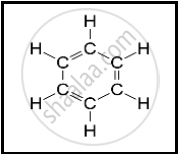
Explain the following briefly:
Sodium chloride dissolves in water but carbon tetra chloride is insoluble in water.
Explain the following briefly.
Pure water does not conduct electricity, but on adding sodium chloride to it, it starts conducting electricity.
Explain the following briefly:
Cl2 is a non polar molecule, while HCl is a polar molecule.
Choose the correct answer from the options given below
Which one is not example of polar covalent compound?
Explain the bonding in methane molecule using electron dot structure.
Draw an electron dot diagram to show the formation of the following compound.
Methane
[H = 1, C = 6]
Explain why carbon tetrachloride does not dissolve in water.
State the type of bond formed when the combining atom has zero E.N. difference.
Number of valence electrons in a carbon atom is _______.
The bond between two oxygen atoms is _______ bond.
Explain covalent bond with example.
Consider the coordination compound, K2[Cu(CN)4]. A coordinate covalent bond exists between:
Carbon forms four covalent bonds by sharing its four valence electrons with four univalent atoms, e.g., hydrogen. After the formation of four bonds, carbon attains the electronic configuration of ______.
The bond which is formed by the mutual sharing of electrons is called ______ bond.
Which of the following compound(s) possesses a high melting point?
"Carbon prefers to share its valence electrons with other atoms of carbon or with atoms of other elements rather than gaining or losing the valence electrons in order to attain noble gas configuration." Give reasons to justify this statement.
