The solution of one of the following compounds will not conduct electricity. This compound is:
Advertisements
Advertisements
प्रश्न
The solution of one of the following compounds will not conduct electricity. This compound is:
पर्याय
NaCl
CCl4
MgCl2
CaCl2
Advertisements
उत्तर
CCl4
Explanation:
Carbon tetrachloride (CCl4) is a covalent compound consisting of neutral molecules, whereas NaCl, MgCl2, and CaCl2 are all ionic compounds. When ionic compounds dissolve, they break apart into free-moving charged ions that easily carry an electric current. Since CCl4 does not contain or form any mobile ions, its solution is completely unable to conduct electricity.
APPEARS IN
संबंधित प्रश्न
Why covalent compounds are different from ionic compounds?
State the reason why carbon can neither form C4+ cations nor C4− anions but forms covalent compounds.
Give appropriate scientific reasons for Carbon tetrachloride does not conduct electricity.
State whether the following statement is true or false:
Diamond and graphite are the covalent compounds of carbon element (C).
Name the black substance of pencil. Will the current flow through the electrical circuit when we use the sharpened ends of the pencil to complete the circuit?
What would be the electron-dot structure of carbon dioxide which has the formula CO2?
In forming N2 molecule, ______ electrons are shared by each atom of nitrogen.
What type of chemical bond is present in the chlorine molecule? Explain your answer.
Giving one example, state what are covalent compounds.
will CS2 conduct electricity or not?
give reason for your choice.
Draw the electron-dot structure of the following compound and state the type of bonding in the given case:
H2O
Draw the electron-dot structure of the following compound and state the type of bonding in the given case:
N2
The atomic numbers of four elements P, Q, R and S are 6, 10, 12 and 17 respectively. Which two elements can combine to form a covalent compound?
One of the following contains a double bond as well as single bonds. This is:
Give the formulae of the chlorides of the elements X and Y having atomic numbers of 3 and 6 respectively. Will the properties of the two chlorides be similar or different? Explain your answer.
What are the conditions necessary for the formation of covalent molecules?
Give two example in following case:
Solid covalent compounds
Give two example in following case:
Gaseous polar covalent compound.
Which element exhibits the property of catenation to maximum extent and why?
Explain the following term with example.
Covalent bond
Explain the following term with example.
Homopolymer
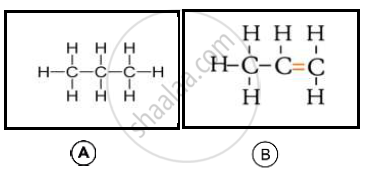
Observe the straight chain hydrocarbons given below and answer the following
questions :
i) Which of the straight chain compounds from A and B is saturated and unsaturated straight chains?
ii) Name these straight chains.
iii) Write their chemical formulae and number of – CH2 - units.
Choose and write the correct option.
Which type of carbon-carbon bonds are present in Vanaspati ghee?
Give examples for the following:
Two gaseous non polar compounds.
Name a neutral covalent molecule which contains one lone pair of electrons.
State the type of bonding in the following molecule.
Water
Elements Q and S react together to form an ionic compound. Under normal conditions, which physical state will the compound QS exist in?
Taking MgCl2 as an electrovalent compound, CCl4 as a covalent compound, give four difference between electrovalent and covalent compounds
From the following hydrocarbon _______ is the cyclic hydrocarbon.
Write the molecular formula of the given compound.
Propylene
Write scientific reason.
Benzene compounds are called aromatic compounds.
Complete the following activity.
Write the names of the hydrocarbons for the following structural formula.
(isobutylene, cyclohexane, propene, cyclohexene, cyclopentane, benzene, propyne, isobutane, propane)
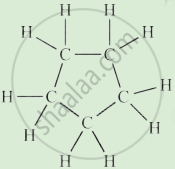 |
Complete the following activity.
Write the names of the hydrocarbons for the following structural formula.
(isobutylene, cyclohexane, propene, cyclohexene, cyclopentane, benzene, propyne, isobutane, propane)
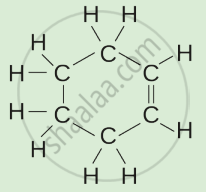 |
Give an example for each of the following statement
A compound in which two Covalent bonds are formed.
Carbon forms four covalent bonds by sharing its four valence electrons with four univalent atoms, e.g., hydrogen. After the formation of four bonds, carbon attains the electronic configuration of ______.
Oils on treating with hydrogen in the presence of palladium or nickel catalyst form fats. This is an example of
Molecular reactions are ______ in the covalent compound.
Assertion (A): Melting point and boiling point of ethanol are lower than that of sodium chloride.
Reason (R): The forces of attraction between the molecules of ionic compounds are very strong.
Non-polar covalent compounds are ______ conductors of heat and electricity.
Explain dipole (polar) molecule by taking hydrogen chloride as an example.
