The solution of one of the following compounds will not conduct electricity. This compound is:
Advertisements
Advertisements
प्रश्न
The solution of one of the following compounds will not conduct electricity. This compound is:
विकल्प
NaCl
CCl4
MgCl2
CaCl2
Advertisements
उत्तर
CCl4
Explanation:
Carbon tetrachloride (CCl4) is a covalent compound consisting of neutral molecules, whereas NaCl, MgCl2, and CaCl2 are all ionic compounds. When ionic compounds dissolve, they break apart into free-moving charged ions that easily carry an electric current. Since CCl4 does not contain or form any mobile ions, its solution is completely unable to conduct electricity.
APPEARS IN
संबंधित प्रश्न
Write the number of covalent bonds in the molecule of butane, C4H10.
What would be the electron dot structure of a molecule of sulphur which is made up of eight atoms of sulphur? (Hint – the eight atoms of sulphur are joined together in the form of a ring.)
Ethane, with the molecular formula C2H6 has ______.
Explain the nature of the covalent bond using the bond formation in CH3Cl.
Choose the correct answer from the options given below:
Which of the following is a common characteristic of a covalent compound?
1) high melting point
2) consists of molecules
3) always soluble in water
4) Conducts electricity when it is in the molten state
Why is graphite used for making dry cell electrodes but diamond is not?
Describe the structure of graphite with the help of a labelled diagram.
Out of KCl, HCl, CCl4 and NaCl, the compounds which are not ionic are:
What are the conditions necessary for the formation of covalent molecules?
Draw an electron dot structure of the following molecule. (Without showing the circle) :
Ethene
Draw an electron dot structure of the following molecule. (Without showing the circle) :
Methanol
Draw all possible structural formulae of the compound from its molecular formula given below.
C3H8
Write answer as directed.
Saturated hydrocarbons are classified into three types. Write these names giving one example each.
Observe the straight chain hydrocarbons given below and answer the following
questions :
i) Which of the straight chain compounds from A and B is saturated and unsaturated straight chains?
ii) Name these straight chains.
iii) Write their chemical formulae and number of – CH2 - units.
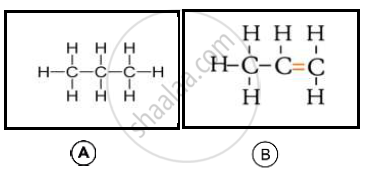
Explain the following:
Covalent compounds are generally gases or liquids or soft solids.
In the formation of electrovalent compounds, electrons are transferred from one element to another. How are electrons involved in the formation of a covalent compound?
What is the term defined below?
A bond formed by a shared pair of electrons, each bonding atom contributing one electron to the pair.
The particles present in strong electrolytes are
Draw an electron dot diagram to show the formation of the following compound.
Magnesium chloride
[Mg = 12, Cl = 17]
What is the difference between :
Ionic compounds and covalent compounds
Name two compounds that are covalent when taken pure but produce ions when dissolved in water.
In the formation of electrovalent compounds, electrons are transferred from one element to another. How are electrons involved in the formation of a covalent compound?
Define the functional group and complete the following table.
| S.I. No. | Functional Group | Compound | Formula |
| (1) | ______________ | _______________ |
C2H5OH |
| (2) | _______________ | _______________ | CH3CHO |
Name two carbon compounds used in day-to-day life.
Write the molecular formula of the given compound.
Propylene
Complete the following activity.
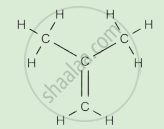
Write the names of the hydrocarbons for the following structural formula.
(isobutylene, cyclohexane, propene, cyclohexene, cyclopentane, benzene, propyne, isobutane, propane)
 |
Considering MgCl2 as ionic compound and CH4 as covalent compound give any two differences between these two compounds.
List two differences between the properties exhibited by covalent compounds and ionic compounds.
When ethyl alcohol and acetic acid are mixed, the resulting ester has a chemical formula ______.
The I.U.P.A.C name of CH3CH2CH = CH2 is?
Which of the following statements are correct for carbon compounds?
- Most carbon compounds are good conductors of electricity.
- Most carbon compounds are poor conductors of electricity.
- Force of attraction between molecules of carbon compounds is not very strong.
- Force of attraction between molecules of carbon compounds is very strong.
A molecule of ammonia (NH3) has
The table shows the electronic structures of four elements.
| Element | Electronic Structure |
| P | 2, 6 |
| Q | 2, 8, 1 |
| R | 2, 8, 7 |
| S | 2, 8, 8 |
- Identify which element(s) will form covalent bonds with carbon.
- “Carbon reacts with an element in the above table to form several compounds.” Give suitable reason.
Statement (A): Covalent compounds are bad conductors of electricity.
Reason (B): Covalent compounds contain charged particles (ions)
State the reasons, why carbon cannot
- Lose four electrons to form C4+ cation and
- Gain four electrons to form C4- anion.
How does carbon overcome this problem to form compounds?
