Advertisements
Advertisements
प्रश्न
The atomic numbers of four elements P, Q, R and S are 6, 10, 12 and 17 respectively. Which two elements can combine to form a covalent compound?
विकल्प
P and R
Q and S
P and S
R and S
Advertisements
उत्तर
P and S
Explanation:
APPEARS IN
संबंधित प्रश्न
List three characteristic properties of covalent compounds.
Give appropriate scientific reasons for Carbon tetrachloride does not conduct electricity.
Explain the bonding in methane molecule using electron dot structure.
What would be the electron-dot structure of carbon dioxide which has the formula CO2?
Which inert gas electron configuration do the Cl atoms in Cl2 molecule resemble? What is this electron configuration?
What is a covalent bond?
How is buckminsterfullerene related to diamond and graphite?
Name one covalent compound containing chlorine.
Draw the electron-dot structure of the following compound and state the type of bonding in the given case:
HCl
Using electron-dot diagrams which show only the outermost shell electrons, show how a molecule of oxygen, O2, is formed from two oxygen atoms. What name is given to this type of bonding?
(At. No. of oxygen = 8)
Explain why, diamond is hard while graphite is soft (though both are made of carbon atoms).
Draw the electron-dot structure of the following compound and state the type of bonding in the given case:
N2
State any two uses of diamond.
Which of the following has a triple bond as well as single bonds?
The number of carbon atoms joined in a spherical molecule of buckminsterfullerene is ______.
Give two example in following case:
Solid covalent compounds
Elements forming ionic compounds attain noble gas electronic configuration by either gaining or losing electrons from their valence shells. Explain giving reason why carbon cannot attain such a configuration in this manner to form its compounds. Name the type of bonds formed in ionic compounds and in the compounds formed by carbon. Also explain the reason why carbon compounds are generally poor conductors of electricity.
Draw an electron dot structure of the following molecule. (Without showing the circle) :
Water
Explain the following:
Covalent compounds are generally gases or liquids or soft solids.
Acids dissolve in water to produce positively charged ions. Draw the structure of these positive ions.
Explain why carbon tetrachloride does not dissolve in water.
State the type of bond formed when the combining atom has small E.N. difference.
Draw the electron dot structure of the covalent compound methane (non polar) and HCl (polar) and give two difference between them.
Covalent bonds can be single, double or triple covalent bonds. How many electrons are shared in each? Give an example of each type.
Give an example of the covalent bond formed by
(i) Similar atoms (ii) Dissimilar atoms
Your body is made up of carbon.
Write an Explanation.
Alkene
Write scientific reason.
Benzene compounds are called aromatic compounds.
Complete the following activity.
Write the names of the hydrocarbons for the following structural formula.
(isobutylene, cyclohexane, propene, cyclohexene, cyclopentane, benzene, propyne, isobutane, propane)
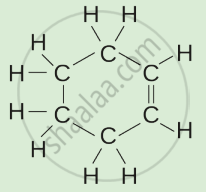 |
Give an example for each of the following statement.
A compound in which three covalent bonds are formed.
The number of pi-bonds present in benzoic acid molecule are ______.
The correct structural formula of butanoic acid is -
Although metals form basic oxides, which of the following metals form an amphoteric oxide?
Oils on treating with hydrogen in the presence of palladium or nickel catalyst form fats. This is an example of
In covalent bond formation, the sharing of ______ electrons takes place in their outermost shell.
Write notes on the characteristics of covalent compounds.
