Advertisements
Advertisements
Question
The atomic numbers of four elements P, Q, R and S are 6, 10, 12 and 17 respectively. Which two elements can combine to form a covalent compound?
Options
P and R
Q and S
P and S
R and S
Advertisements
Solution
P and S
Explanation:
APPEARS IN
RELATED QUESTIONS
List three characteristic properties of covalent compounds.
State the reason to explain why covalent compounds "are bad conductors of electricity".
What would be the electron dot structure of carbon dioxide which has the formula CO2?
Ethane, with the molecular formula C2H6 has ______.
Explain the nature of the covalent bond using the bond formation in CH3Cl.
What type of bond exists in CCl4?
Giving one example, state what are covalent compounds.
Name one covalent compound containing chlorine.
Using electron-dot diagrams which show only the outermost shell electrons, show how a molecule of oxygen, O2, is formed from two oxygen atoms. What name is given to this type of bonding?
(At. No. of oxygen = 8)
Explain why, diamond is hard while graphite is soft (though both are made of carbon atoms).
State one use of diamond which depends on its ‘extraordinary brilliance’ and one use of graphite which depends on its being ‘black and quite soft’.
State any two uses of diamond.
One of the following compounds is not ionic in nature. This compound is:
Which of the following cannot exhibit isomerism?
The number of isomers formed by the hydrocarbon with molecular formula C5H12 is ______.
An element A has 4 valence electrons in its atom whereas element B has only one valence electron in its atom. The compound formed by A and B does not conduct electricity. What is the nature of chemical bond in the compound formed? Give its electron-dot structure.
Define a covalent bond.
Which element exhibits the property of catenation to maximum extent and why?
Explain the following term with example.
Homopolymer
The carbon compound is used in daily life is ______.
Explain the following briefly.
Pure water does not conduct electricity, but on adding sodium chloride to it, it starts conducting electricity.
(a) Compound X consists of molecules.
Choose the letter corresponding to the correct answer from the choices (a), (b), (c) and (d) given below
X is likely to have a :
Explain why carbon tetrachloride does not dissolve in water.
Name a neutral covalent molecule which contains one lone pair of electrons.
The molecule which contains a triple covalent bond is ______.
An element L consists of molecules.
- Which type of bond is present in the particles that make up L?
- When L is heated with iron metal, it forms a compound FeL. What chemical term would you use to describe change undergone by L?
Acids dissolve in water and produce positively charged ions. Draw the structure of these positive ions.
State the type of bond formed, and draw Lewis structure of water.
Define the functional group and complete the following table.
| S.I. No. | Functional Group | Compound | Formula |
| (1) | ______________ | _______________ |
C2H5OH |
| (2) | _______________ | _______________ | CH3CHO |
Generally, the melting and boiling point of carbon compounds are found to be less than _______ °C.
Explain covalent bond with example.
Complete the following activity.
Write the names of the hydrocarbons for the following structural formula.
(isobutylene, cyclohexane, propene, cyclohexene, cyclopentane, benzene, propyne, isobutane, propane)
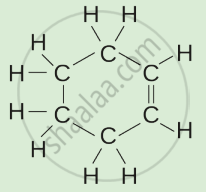 |
Discuss in brief about the properties of coordinate covalent compounds.
Consider the coordination compound, K2[Cu(CN)4]. A coordinate covalent bond exists between:
Which of the following is the purest form of carbon?
Which of the following statements are usually correct for carbon compounds? These
- are good conductors of electricity
- are poor conductors of electricity
- have strong forces of attraction between their molecules
- do not have strong forces of attraction between their molecules.
Although metals form basic oxides, which of the following metals form an amphoteric oxide?
"Carbon prefers to share its valence electrons with other atoms of carbon or with atoms of other elements rather than gaining or losing the valence electrons in order to attain noble gas configuration." Give reasons to justify this statement.
