Advertisements
Advertisements
प्रश्न
One of the following contains a double bond as well as single bonds. This is:
पर्याय
CO2
O2
C2H4
C2H2
Advertisements
उत्तर
C2H4
Explanation:
Ethene (C2H4) consists of two carbon atoms connected to each other by a covalent double bond (C = C). Additionally, each carbon atom is bonded to two hydrogen atoms via two single covalent bonds (C-H). Therefore, the entire molecule simultaneously contains one double bond and four single bonds, thereby achieving full structural stability.
APPEARS IN
संबंधित प्रश्न
Give reason why carbon compounds are generally poor conductors of electricity.
State the reason to explain why covalent compounds "are bad conductors of electricity".
Ethane, with the molecular formula C2H6 has ______.
Write any three features and give two examples of covalent compounds
What do you call the compounds having the same molecular formula but different structural arrangements of atoms?
Write the electron-dot structure for the following molecule:
Cl2
The form of carbon which is known as black lead is ______.
Draw the electron-dot structure of the following compound and state the type of bonding in the given case:
NH3
Draw the electron-dot structure of the following compound and state the type of bonding in the given case:
N2
State one use of diamond which depends on its ‘extraordinary brilliance’ and one use of graphite which depends on its being ‘black and quite soft’.
Of what substance is graphite made?
The pencil leads are made of mainly ______.
An element E exists in three allotropic forms A, B and C. In allotrope A, the atoms of element E are joined to form spherical molecules. In allotrope B, each atom of element E is surrounded by three other E atoms to form a sheet like structure. În allotrope C, each atom of element E is surrounded by four other E atoms to form a rigid structure.
(a) Name the element E.
(b) What is allotrope A.
(c) What is allotrope B?
(d) What is allotrope C?
(e) Which allotrope is used in making jewellery?
(f) Which allotrope is used in making anode of a dry cell?
State the type of bonding in the following molecule.
Water
Define a coordinate bond.
Elements forming ionic compounds attain noble gas electronic configuration by either gaining or losing electrons from their valence shells. Explain giving reason why carbon cannot attain such a configuration in this manner to form its compounds. Name the type of bonds formed in ionic compounds and in the compounds formed by carbon. Also explain the reason why carbon compounds are generally poor conductors of electricity.
Draw an electron dot structure of the following molecule. (Without showing the circle) :
Ethene
Explain the following term with example.
Hetero atom in a carbon compound
The following structural formula belongs to which carbon compound?
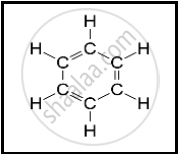
Explain the following:
Covalent compounds are generally gases or liquids or soft solids.
Choose the correct answer from the options given below
Condition favorable for formation of a covalent bond is
The electronic configuration of N2 is 2, 5. How many electrons in the outer shell of a N atom are not involved in the formation of a nitrogen molecule?
Electrons are getting added to an element Y.
- Is Y getting oxidized or reduced?
- Which electrode will Y migrate to during the process of electrolysis?
Draw the electron dot diagram and structure of methane.
State the type of bond formed, and draw Lewis structure of water.
Element A has 2 electrons in its M shell. Element B has atomic number 7.
If B is a diatomic gas, write the equation for the direct combination of A and B to form a compound.
What is the difference between :
Ionic compounds and covalent compounds
Write the molecular formula of the given compound.
Propylene
Your body is made up of carbon.
Write an Explanation.
Alkane
Explain covalent bond with example.
The correct structural formula of butanoic acid is -
Which of the following statements are usually correct for carbon compounds? These
- are good conductors of electricity
- are poor conductors of electricity
- have strong forces of attraction between their molecules
- do not have strong forces of attraction between their molecules.
Which of the following are correct structural isomers of butane?
- \[\begin{array}{cc}
\ce{H}\phantom{...}\ce{H}\phantom{...}\ce{H}\phantom{...}\ce{H}\\
|\phantom{....}|\phantom{....}|\phantom{....}|\\
\ce{H - C - C - C - C - H}\\
|\phantom{....}|\phantom{....}|\phantom{....}|\\
\ce{H}\phantom{...}\ce{H}\phantom{...}\ce{H}\phantom{...}\ce{H}\\
\end{array}\] - \[\begin{array}{cc}
\ce{H}\phantom{...}\ce{H}\phantom{...}\ce{H}\\
|\phantom{....}|\phantom{....}|\\
\ce{H - C - C - C - H}\\
|\phantom{.....}|\phantom{.....}|\\
\ce{H}\ce{H-C-H}\ce{H}\\
|\\
\ce{H}\\
\end{array}\] - \[\begin{array}{cc}
\ce{H}\phantom{...}\ce{H}\phantom{...}\ce{H}\\
|\phantom{....}|\phantom{....}|\\
\ce{H - C - C - C - H}\\
|\phantom{.....}\backslash\phantom{..}|\\
\phantom{....}\ce{H}\phantom{......}\ce{C - H}\phantom{}\\
\phantom{.......}|\\
\phantom{.......}\ce{H}\\
\end{array}\] - \[\begin{array}{cc}
\ce{H}\phantom{...}\ce{H}\\
|\phantom{....}|\\
\ce{H - C - C - H}\\
|\phantom{....}|\\
\ce{H - C - C - H}\\
|\phantom{....}|\\
\ce{H}\phantom{...}\ce{H}\\
\end{array}\]
Carbon forms four covalent bonds by sharing its four valence electrons with four univalent atoms, e.g. hydrogen. After the formation of four bonds, carbon attains the electronic configuration of
Carbon can neither form C4- cation nor C4 anion. Why?
