Advertisements
Advertisements
प्रश्न
Element A has 2 electrons in its M shell. Element B has atomic number 7.
If B is a diatomic gas, write the equation for the direct combination of A and B to form a compound.
Advertisements
उत्तर
\[\ce{3A + B2 -> A3B2}\]
संबंधित प्रश्न
Why covalent compounds are different from ionic compounds?
Ethane, with the molecular formula C2H6 has ______.
Why are most carbon compounds poor conductors of electricity?
Buckminsterfullerene is a spherical molecule in which 60 carbon atoms are arranged in interlocking hexagonal and pentagonal rings of carbon atoms.
- How many hexagons of carbon atoms are present in one molecule of buckminsterfullerene?
- How many pentagons of carbon atoms are present in one molecule of buckminsterfullerene?
Write two points of difference in the structures of diamond and graphite.
Draw an electron dot structure of the following molecule. (Without showing the circle) :
Water
Give examples for the following:
Two solid covalent compounds.
Taking MgCl2 as an electrovalent compound, CCl4 as a covalent compound, give four difference between electrovalent and covalent compounds
Write scientific reason.
Benzene compounds are called aromatic compounds.
Complete the following activity.
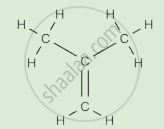
Write the names of the hydrocarbons for the following structural formula.
(isobutylene, cyclohexane, propene, cyclohexene, cyclopentane, benzene, propyne, isobutane, propane)
 |
